The Aesthetic
Mono no Aware: The Bittersweet Beauty of Impermanence
Mono no aware names a moving awareness of transience. The Edo scholar Motoori Norinaga raised it into a concept — he did not invent the feeling.
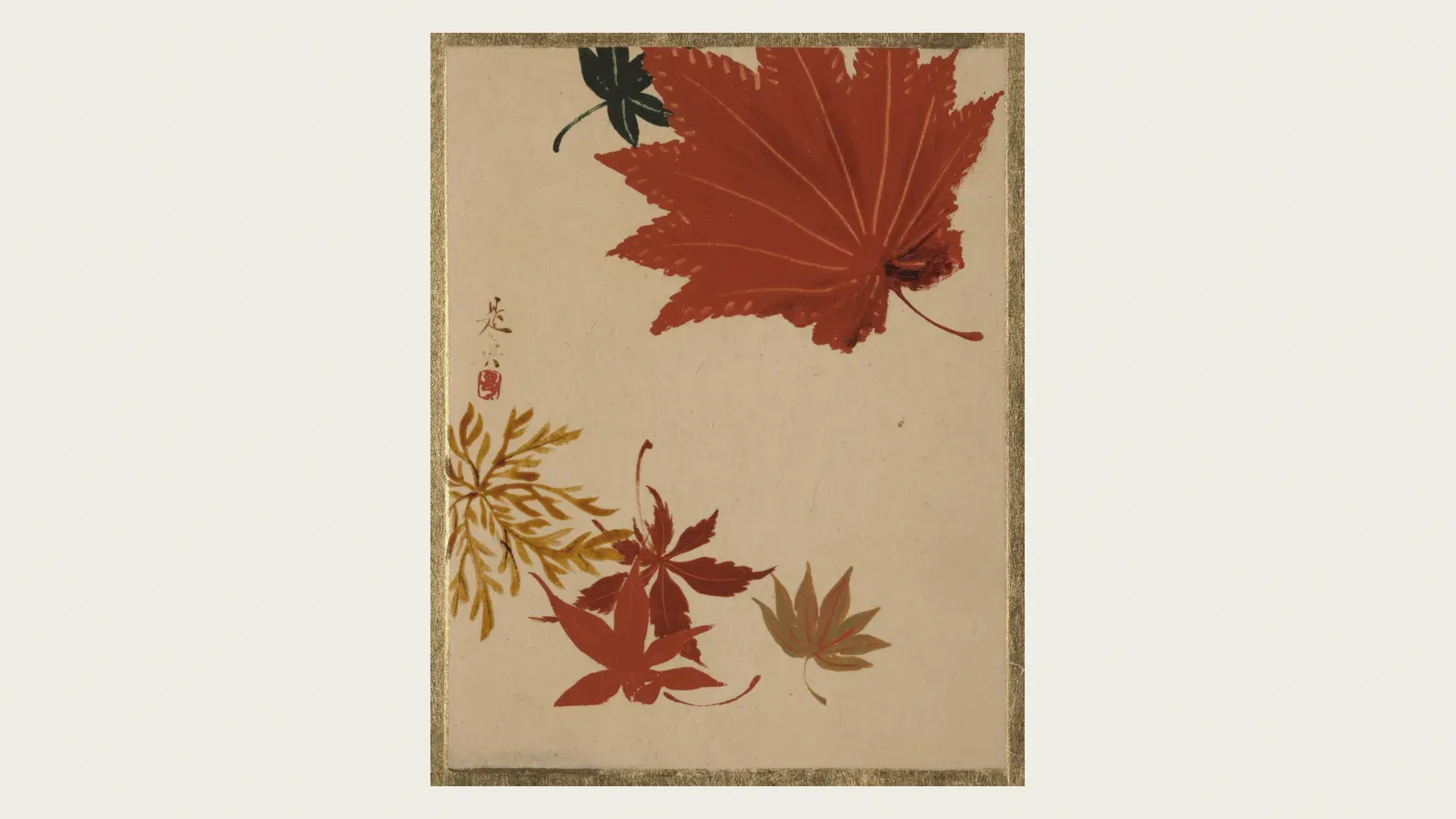
Mono no aware (物の哀れ) is a heightened, accepting sensitivity to the transience of things — moving precisely because what it sees does not last. It was raised into a critical concept by the Edo-period scholar Motoori Norinaga (1730–1801), who identified it as the core sensibility of Heian literature, above all The Tale of Genji. He named it. He did not invent it.
A cherry tree at full bloom photographs well. A cherry tree three days later, shedding its petals down a path, is the thing people take the afternoon off to stand under. The flower is no lovelier falling than it was open. It is the same blossom. What has changed is that you can now see its ending inside it, on a timescale short enough to watch. That recognition, that the thing in front of you is already leaving, is close to what the Japanese tradition means by mono no aware.
The word, taken apart
The phrase has three pieces. Mono (物) is “thing,” in the widest sense the word will bear: an object, a person, a season, an event. No (の) is the possessive particle, “of.” Aware (哀れ) is the hard one. In the Heian period it did not yet mean the “pity” it later hardened into. It was closer to an exclamation, the sound a person lets out when something strikes them, an “ah” or an “oh.”4 So the literal compound is “the aware of things,” which English usually renders as “the pathos of things,” and which one translator has cheerfully englished as “the ahness of things.”4
What the phrase names is a particular emotional response, the kind that arrives on its own rather than on command. You notice something: a slant of late-autumn light, a friend grown visibly older, the last warm afternoon before the cold sets in. You are moved, and part of what moves you is knowing it is passing. The feeling is gentle rather than sharp. It leans toward sadness without tipping into grief. “Bittersweet” is a fair approximation, and so is “wistful,” though both leave out the acceptance the Japanese word carries. The transience is the condition that lets the beauty register at all. The sensibility takes it as given.
The word came first, the theory came much later
Here is the correction most popular accounts need, because they hand mono no aware down as a timeless slogan of “the Japanese soul.” The feeling is old. The concept is not.
The word aware runs all through the earliest surviving Japanese writing — the eighth-century chronicles Kojiki and Nihon shoki, and the great poetry anthology Man’yōshū (万葉集), where it is usually set off by something in nature, a bird’s call or the turn of a season.3 By the Heian court (794–1185) the full phrase mono no aware was in circulation, and the sensibility it points to saturates the literature of that world, reaching its fullest pitch in Murasaki Shikibu’s Tale of Genji (源氏物語) in the early eleventh century.3 All of that was lived and written centuries before anyone stood back and made it a theory.
Norinaga names it
That step belongs to one person. Motoori Norinaga (本居宣長, 1730–1801) was a physician and philologist from Matsuzaka and the leading figure of Kokugaku (国学), the “National Learning” movement that set out to recover an authentically Japanese sensibility from the oldest texts, cleared of the Chinese and Buddhist moral frames later readers had laid over them.2 In his long commentary on the Genji, Genji monogatari Tama no Ogushi (源氏物語玉の小櫛, “The Jeweled Comb of the Tale of Genji”), finished in the 1790s, he took direct aim at the scholars before him, who had read Murasaki’s novel as a moral fable — a catalogue of court vices to be judged and warned against.2
Norinaga threw that reading out. The novel’s purpose, he argued, was to move the reader, not to instruct: to render its characters’ inner weather so finely that you feel with them, page after page. The name he gave to that capacity, and to the whole sensibility the book is built on, was mono no aware.1 He pressed it past literature into a general disposition. To know mono no aware in full, he wrote, is to be stirred by the essence of every single thing that exists, not only the moon and the blossoms but each thing in the world. A court adjective became, in his hands, a theory of how an awake person meets what is in front of them.
The move was of a piece with everything Kokugaku wanted. Norinaga and his circle read the oldest Japanese texts to dig out a native way of feeling that centuries of imported thought had buried, and the buried thing they most wanted back was direct emotional response, unmediated by the Chinese moral philosophy that dominated learned life.2 Reading the Genji as a warning against vice made it Confucian. Reading it as a lesson in worldly detachment made it Buddhist. Norinaga’s claim was that the book is neither, that it is a sustained record of people being moved by each other and by the passing world, and that this responsiveness is the older, truer Japanese thing. Mono no aware was the flag he planted on it.
This is the distinction to hold onto. Mono no aware as we use the term is an eighteenth-century critical concept describing an eleventh-century sensibility. Norinaga found the feeling everywhere in the old writing and gave it a name and an argument. The feeling was already there, a thousand years deep, waiting for a reader patient enough to see what held it all together. Crediting him with the emotion itself gets the history exactly backward, and the backward version is the one usually told.
Why the cherry blossom
The standard emblem of mono no aware is sakura (桜), the cherry blossom, and the reason is exact rather than sentimental. As the Stanford Encyclopedia of Philosophy puts it, cherry blossoms are prized less for any beauty they hold over apple or pear than for their evanescence, usually beginning to fall within a week of opening.1 The beauty and the brevity are a single fact about the flower, fused.
So the emotional center of blossom-viewing, hanami (花見), arrives with the falling. The petals coming loose and drifting down, the brown carpet of them going soft on the path a day later, are what the tradition lingers on, more than the full crown at its height. A flower that held for the whole summer would be pleasant and would mean nothing. The cherry works because its end is legible in its prime, quickly enough for a person to sit and watch it happen. The Heian poets said as much directly. The courtier Ariwara no Narihira (825–880) built a whole poem out of the paradox, and it survives as no. 53 in the first imperial anthology:
世の中に
たえて桜の
なかりせば
春の心は
のどけからまし
yo no naka ni
taete sakura no
nakariseba
haru no kokoro wa
nodokekaramashi
If in this world
there were no cherry
blossoms at all,
the heart in spring
might rest at ease.
One of the anthology's most-quoted spring poems. It praises the blossom by conceding that the blossom is what will not let the spring heart settle. A plain rendering of the classical text.
The poem does not resolve the tension it names, and that refusal is the whole of it. Narihira would rather have the unrest than the peace, because the unrest is the sign that something worth losing is in front of him. A spring with nothing in it to mourn would be a calmer spring and a smaller one, and he knows which he prefers.
The sensibility lived in the poems first
Long before Norinaga theorized it, the feeling had a home, and the home was verse. In 905 four poets, led by Ki no Tsurayuki, presented the Kokin Wakashū (古今和歌集, “Collection of Poems Ancient and Modern”) to Emperor Daigo — the first waka anthology commissioned by the throne, and the book that fixed the shape of Japanese court poetry for centuries.5 Tsurayuki opened his preface with a line every later poet knew by heart: Japanese poetry has the human heart as its seed and grows into a myriad leaves of words.5 The claim is that a poem starts in feeling and reaches for the world to say it.
The tool the anthology used to bind feeling to the world was the season. A waka fixes its emotion to a precise moment of the year — the first warbler, thinning autumn leaves, snow on a plum branch — so that naming the season does the emotional work without a word of statement. Mono no aware is what that machinery runs on. The poets were catching the pull a passing thing exerts on a watching person, and the weather was only the occasion for it. The Genji Norinaga later prized is, among other things, a novel stuffed with such poems and the moments that produce them, its characters forever exchanging verses over a fading flower or a departing carriage.
From the Heian court to Ozu’s front room
The sensibility did not fossilize in the eleventh century. Its clearest modern carrier is the filmmaker Ozu Yasujirō (1903–1963), and the case for him is a scholarly one, not a stretch. The Stanford Encyclopedia of Philosophy describes his films as “a series of exercises in conveying mono no aware,” and points to how he does it: feeling is carried less by the actors’ faces than by objects and empty spaces, a held shot of a vase or a hallway or a train pulling out.1
Watch Tokyo Story (1953) with that in mind and the technique is plain. An aging couple visits their grown children in the city, is quietly found inconvenient, and goes home. The mother dies soon after. Ozu declines almost every chance to underline it. He shoots from the height of someone kneeling on a tatami mat, holds the camera still, and cuts to a quiet room, a kettle, the light on a wall — the small transitional shots critics later named after him. The loss is left to sit in the ordinary furniture the people will keep using. What the cherry does with a petal, Ozu does with a corridor and a hung towel. The passing thing is shown, the watching is left to you, and the film trusts that the recognition will arrive on its own. The story is a family drama on its surface and an argument about transience underneath, which is the same double life The Tale of Genji leads.
Four words that keep getting blurred
Mono no aware sits inside a small family of Japanese ideas that popular writing tends to mash into one soft mood. They are related, and they are distinct, and the differences are easy to keep straight once you see the axis each one lives on.
Underneath all of them is mujō (無常), the Buddhist teaching that everything is in constant change and nothing holds. Mujō is the premise, a flat statement about how things are.1 The Stanford Encyclopedia is careful to add that in the Japanese reading this is no cause for despair, but rather a call to attend fully to the present.1 The other three ideas are all responses to that premise, each pitched differently.
| What it is | Where it lives | Emblem | |
|---|---|---|---|
| Mujō (無常) | The Buddhist fact that nothing lasts | A premise about reality | — |
| Mono no aware | A felt response to transience | In perception, the moment you notice | A falling cherry blossom |
| Wabi-sabi | An aesthetic of imperfect, weathered things | In objects and surfaces, over time | A mended, rough tea bowl |
| Ichigo-ichie | An instruction to honor the unrepeatable meeting | In conduct, what host and guest do | A single tea gathering |
Wabi-sabi is a quality you can hold in your hand: austerity, asymmetry, the marks that age and use leave on a bowl or a beam, the crack mended in gold that kintsugi makes into the object’s biography, the taste set out in its seven principles. It stays put for you to handle. Mono no aware moves through you instead and then is gone, the catch in the chest at the falling petal or the parting. One is enduring and external. The other is fleeting and felt.
The line between mono no aware and ichigo-ichie (一期一会, “one time, one meeting”) is the one to draw most carefully, because both grow straight out of mujō and are constantly confused. Mono no aware is a response, the thing that happens to you when you notice the light going. Ichigo-ichie is an instruction: because this gathering will not recur, do the work it deserves while it is here. One asks only that you be moved. The other asks that you act. The tea tradition keeps them on opposite sides of the same fact, which is why ichigo-ichie was set down in a tea manual and mono no aware in a book about poems.
Where it meets the tea year
Tea does not preach mono no aware as doctrine, and it would be a poorer practice if it did. The sensibility is built instead into the structure of a gathering, mostly through the calendar. Chadō (茶道), the way of tea, is tuned to the seasons in obsessive detail: the change from the portable brazier to the sunken hearth, the flower in the alcove, the shape of the sweet, the very bowl chosen to cool tea in July or hold its heat in January, all track the time of year, a system laid out by the tea year and its saijiki. The single largest hinge of that year is the switch from the furo brazier of the warm months to the ro hearth sunk in the floor for winter, a changeover fixed by the calendar rather than the thermometer. Every one of those choices is timed to a moment that will not return in the same form: this snow, these particular blossoms, this guest at this stage of a life.
Building the room to pass is the point of the exactness. The deep winter bowl gets put away in April. The October flower is already half-spent when it goes in the alcove. A host who marks the season this precisely is registering that it is on its way out, which is the same recognition Narihira wanted from the cherry and Norinaga found threaded through the Genji. If you keep tea at home, the plainest way to feel it is to let the year change what is on the tray, which is the whole argument for a seasonal practice over the same bowl every morning.
One caution about the wellness version, since it is everywhere. Mono no aware is routinely sold as a life lesson: let impermanence teach you to seize the day. That inverts it. The sensibility asks something quieter than a moral. It asks you to attend to the thing that is leaving, on its own terms, and to let whatever feeling comes come. Norinaga spent his life proving that a thousand-year-old novel about court affairs was, at bottom, an instrument for that kind of attention. The cherry makes the same argument in three days. A bowl of tea, if you are paying attention, makes it in the twenty minutes before it goes cold.
Sources
6sourcesStanford Encyclopedia of Philosophy, 'Japanese Aesthetics'
SupportsMono no aware as the 'pathos (aware) of things, deriving from their transience'; cherry blossoms prized for evanescence, beginning to fall within a week; mujō as the basic condition, 'no cause for nihilistic despair, but rather a call to vital activity'; Norinaga bringing mono no aware to the forefront of literary theory through his Genji study; Ozu's films as 'a series of exercises in conveying mono no aware'
Encyclopædia Britannica, 'Motoori Norinaga'
SupportsNorinaga's dates (1730–1801); leader of the Kokugaku (National Learning) movement; commentary Genji monogatari Tama no Ogushi identifying mono no aware as the central theme of the Tale of Genji
Nippon.com, 'Mono no Aware: The Essence of the Japanese Sensibility'
SupportsMono no aware as 'the pathos of things' and an empathy toward things; the word aware in the Kojiki, Nihon shoki, and Man'yōshū; the sensibility reaching its apogee in the Tale of Genji
Wikipedia (English), 'Mono no aware'
SupportsAware as a Heian-period expression of measured surprise, similar to 'ah' or 'oh'; the compound rendered as 'the ahness of things'; mujō (impermanence) as the aesthetic's basis; Norinaga's cherry-blossom illustration
Wikipedia (English), 'Kokin Wakashū'
SupportsFirst imperially commissioned waka anthology, presented to Emperor Daigo in 905; Ki no Tsurayuki's kana preface opening 'Japanese poetry has the human heart as seed'; Ariwara no Narihira among its poets
Thomas McAuley, Waka Poetry (University of Sheffield), 'Kokinshū'
SupportsText of Ariwara no Narihira's Kokinshū no. 53, 'yo no naka ni / taete sakura no / nakariseba / haru no kokoro wa / nodokekaramashi'