The Way
Ichigo-Ichie: One Time, One Meeting
Ichigo-ichie was coined by Ii Naosuke, not Rikyū. What the four characters mean, where they come from, and what they ask of a tea gathering.
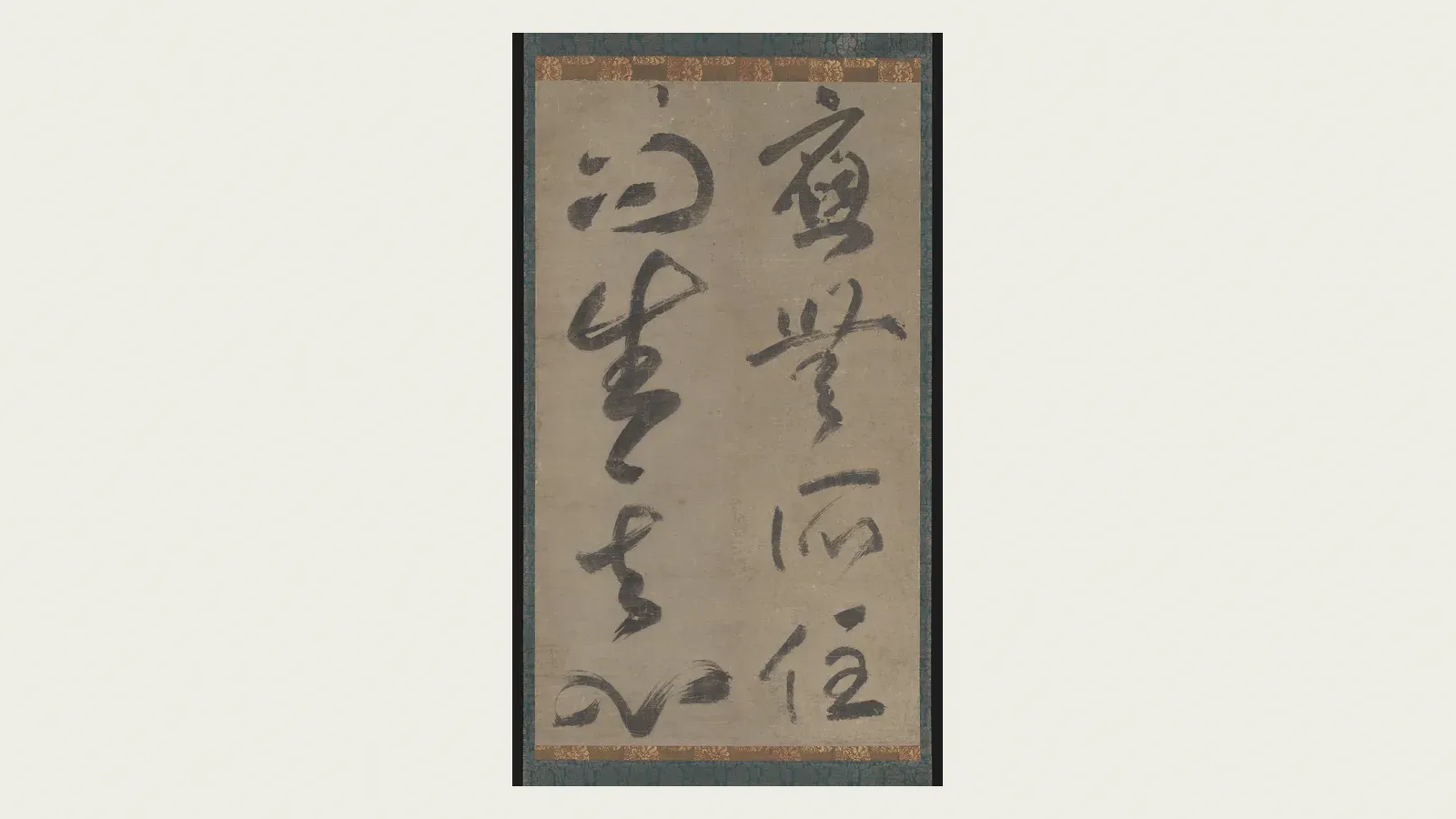
Ichigo-ichie (一期一会), “one time, one meeting,” was coined by the tea master and statesman Ii Naosuke in 1858, drawing on a sentence of Sen no Rikyū recorded by his disciple Yamanoue Sōji. It means a given gathering of these people, on this day, will never recur in exactly this form — so host and guest owe it their full care.
You have probably met these four characters on a mug, a tote bag, or a wall decal, glossed as “live in the moment” or “cherish every encounter.” That gloss is not wrong so much as sanded smooth. The phrase comes out of the tea room, where it carries a specific and demanding instruction — one closer to a host’s checklist than to a feeling. Here is what it meant when a nineteenth-century minister set it down, where he found it, and what it still asks of anyone who makes tea for someone else.
The four characters and their literal sense
The phrase is two pairs: 一期 (ichigo) and 一会 (ichie).
Ichie (一会) is the easy half. It means “one meeting,” “one gathering.” In a tea context it names the assembly itself — this host, these guests, this room, this set of utensils, this day, held once and then dissolved.
Ichigo (一期) is the loaded half, and it is where the weight of the phrase lives. It is a Buddhist term meaning “one lifetime,” the whole span from birth to death — the word a monk would use for a person’s single passage through the world.1 Set beside ichie, it pushes the reading past “one moment” toward something stricter: one lifetime, one meeting. The gathering is measured against the entire length of a life and found to be singular within it. This particular configuration of people and things will assemble exactly once, and then the people age and the season turns and it is gone for good.
Behind ichigo sits the premise that gives the whole idea its gravity: mujō (無常), the Buddhist teaching that all things are in constant change and nothing holds.7 Once you accept that no state of affairs is permanent, a single afternoon of tea stops being one instance of a repeatable event and becomes a thing that exists once. That is a factual claim before it is a sentimental one. Even if the same five people meet for tea next month in the same room, the scroll will be different, someone will be a year older or newly worried, the water will boil on a different day under different weather. The meeting in front of you is not a rough draft of a better one to come. There is no second take.
Where it actually comes from
Most popular accounts hand the phrase to Rikyū, and the lineage is more interesting than that, so it is worth setting down in order.
The four-character phrase ichigo-ichie was coined by Ii Naosuke (井伊直弼, 1815–1860), not by Rikyū. Ii was the daimyō of the Hikone domain and, at the end of his life, tairō (大老) — the great elder, the single most powerful minister of the Tokugawa shogunate. He was also a committed tea man. He had trained in the Sekishū-ryū (石州流) tradition and founded his own branch of it within Hikone, taking the tea name Sōkan.5 In 1858 he completed a treatise on the single tea gathering, Chanoyu Ichie Shū (茶湯一会集), a work of twenty-three articles, and it is there that the compressed four-character idiom first appears with its definition attached.2 Ii opens the book by stating the idea flatly:
An encounter today can never be experienced again. The host should attend to every single matter, the guest should never neglect the host’s care, and both should meet in earnest.
Ii inherited that thought, and he knew he had. Roughly three centuries earlier, Sen no Rikyū (千利休, 1522–1591) had taught that a host should treat every gathering as a meeting that could occur only once in a lifetime. We know this at second hand, through his disciple Yamanoue Sōji (山上宗二, 1544–1590), who wrote it into his record of Rikyū’s teaching, the Yamanoue Sōji ki (山上宗二記). An authentic manuscript dated 1588 survives in the Omotesenke collection.4 The wording Sōji preserves is ichigo ni ichido no e (一期に一度の会) — “a gathering once in a lifetime.”1 That is the seed. Ii Naosuke pruned it from a sentence into four characters.
Sōji himself met the fact he had written down. Hideyoshi had him executed in 1590, after the fall of the Later Hōjō at Odawara, the year before Rikyū’s own ordered death.4 The record that carried Rikyū’s teaching about the once-only meeting was set down by a man with one gathering of his own left to live.
So the chain runs Rikyū’s instruction → Sōji’s record of it in 1588 → Ii’s coinage in 1858.3 Crediting the four-character phrase to Rikyū collapses three centuries and two authors into one man. The sentiment is Rikyū’s. The slogan is Ii’s. Getting that order right is the whole rigor of the thing, because the story usually told — that Rikyū, the great codifier, minted the great phrase — is tidier than the truth and wrong.
The man who wrote it down
There is a hard irony folded into the authorship, and it is not decorative. Ii Naosuke wrote about the unrepeatable meeting during the two years he held supreme power and made the enemies who would kill him.
As tairō he governed a Japan cracking open under foreign pressure. In 1858, the same year as the treatise, he authorized the Harris Treaty with the United States, opening ports to Western trade without waiting for the emperor’s sanction, and then moved hard against the officials and lords who opposed him in the purge remembered as the Ansei Purge.5 On a snowy morning in March 1860, as his palanquin approached the Sakurada Gate of Edo Castle, a band of samurai from the Mito and Satsuma domains ambushed the procession and cut him down.6 He was assassinated within walking distance of the shogun’s castle, two years after writing that any gathering held today can never be held again.
For most people who quote the phrase, the unrepeatable meeting is a gentle idea about savoring good company. For the man who coined it, it was closer to a working assumption. A host at that level of the shogunate might well be receiving a guest for the last time, and know it.
What it asks inside a tea gathering
Strip off the wall-decal version and ichigo-ichie is mostly a distribution of obligations, split between two parties who face each other across a bowl.
For the host, it explains why so much labor goes into something that lasts a few hours. The scroll in the alcove, the flowers, the sweets, the choice of bowl, the timing of the charcoal and the boil are all selected for these guests on this day, and the same combination will not be assembled again. Every element is a variable the host has set on purpose. The kettle answers the season — the sunken hearth (ro) in the cold months, the portable brazier (furo) in the warm. The scroll answers the occasion. The sweets answer the month. Because the occasion is unrepeatable, there is no rehearsal and no make-up day. The preparation is the only chance to get it right. You can watch every one of those variables being set inside a single temae, the choreographed sequence of laying the fire, cleaning the utensils, and serving the tea.
For the guest, the obligation is symmetrical and easy to forget: to receive that care fully, attentively, without treating it as routine or as the first of many such afternoons. Ii is explicit on this — the guest who shrugs off the host’s preparation has misread the meeting as badly as a careless host would. Attention is owed in both directions. The gathering is a thing the two parties make together, and half-made from either side, it fails.
This is why the principle belongs to tea specifically, and not merely to life in general. A tea gathering is a deliberately bounded event: fixed guests, a closed room, a sequence with a beginning and an end. Inside that frame the unrepeatability is structural, not abstract. You cannot pause it, replay it, or attend it twice. Outside the room the same truth holds — every hour is singular — but there it dissolves into the general fact that time passes, which is true and nearly impossible to act on. The room draws a border around a few hours and says: this much, once. That is what makes the idea teachable instead of merely true.
Gatherings can be warm, even funny. The concept has little to do with the room being solemn. Ichigo-ichie observes that the warmth, too, is finite and present only here, which is a reason to give it your attention rather than a reason to lower your voice. It is the temporal half of what makes a gathering matter, and it pairs with the conduct half — the four principles of wa-kei-sei-jaku, harmony and respect and purity and the tranquility they produce. Those four say how to hold a gathering. Ichigo-ichie says why this one, in particular, is worth holding that way.
The host sits alone
Chanoyu Ichie Shū is not a single aphorism. It runs to twenty-three articles that follow a gathering from invitation to farewell, and Ii threads three linked terms through it. Ichigo-ichie opens the event and sets its stakes. Yojō zanshin (余情残心), “lingering feeling, remaining heart,” governs the parting — the host’s care that follows the guests out the door and does not slacken because the meeting is technically over. And dokuza kannen (独座観念), “solitary seated reflection,” closes the whole thing.9
The last is the one to dwell on, because it is where the idea stops being advice and becomes a practice. After the guests leave, Ii writes, the host sees them off until they are out of sight, then goes back alone into the tea room. He does not clear up and move on. He sits down again by the kettle, quietly makes one more bowl of tea, and drinks it by himself, in the room the gathering has just emptied.9 The others are already walking home. The host sits with the plain fact that the afternoon is finished and those people, in that arrangement, will not gather in this room again.
That closing rite is the whole doctrine compressed into one image, and it is a good deal harder than “cherish every encounter.” Ii, a man who had certified his own Zen enlightenment before he ever held office, built the concept to be felt at the moment it costs something: alone, with the tea gone cold in the pot, and no guest left to perform it for.9
How it differs from mono no aware
Ichigo-ichie gets shelved next to mono no aware (物の哀れ), and the two do share a root: both grow from mujō, the sense that things pass. But they are different kinds of thing, and the difference is worth stating cleanly, because the wellness literature tends to blur them into a single mood of wistful appreciation.
Mono no aware is a response. It is the feeling that moves through you when you notice the cherry petals coming down, or an old friend grown visibly older — a gentle, accepting sadness at transience as it happens. It asks nothing of you but that you be moved. It lives in perception.
Ichigo-ichie is an instruction. It takes the same fact, that this will not come again, and turns it outward into a demand: because the meeting is unrepeatable, do the work it deserves while it is in front of you. Make the tea well, for the people actually here, this once. Mono no aware happens to you. Ichigo-ichie is something you carry out. One is an aesthetic of the heart. The other is closer to a professional ethic, which is exactly why it was written down in a tea manual and not a book of poems.
Put them over the same event and the split is clear. A guest watches the last of the winter light leave the small window of the tea room and feels the afternoon slipping. That pull is mono no aware, and it asks the guest for nothing but the feeling. The host, seeing the same light go, checks that the next bowl is already whisking and the charcoal will hold to the end. That is ichigo-ichie, and it asks the host for the work. The falling light is one fact. The two concepts stand on either side of it, one receiving and one responding.
Beyond the tea room
The phrase did not stay in the tea room, and its escape is well documented. It became a standard motto in the martial arts, where a swordsman is taught to meet each bout as the only one — you do not get to fight this exact opponent, on this ground, in this state of mind, twice — and it turns up in the vocabulary of noh theater and, by now, across ordinary Japanese speech.1 A 2019 international bestseller, The Book of Ichigo Ichie by the authors of Ikigai, carried it to the global self-help shelf as a philosophy of “making the most of every moment.”8
That spread is where the concept thins out, and here I will stake a view: the popular version has it backwards. It reads ichigo-ichie as a prompt to feel more — to be present, to savor, to summon a heightened state over your coffee. Ii Naosuke’s treatise asks for the opposite. It asks you to do more, and says nothing about how you are supposed to feel while doing it. The instruction is external and specific: attend to every detail of the thing you are hosting, and if you are the guest, honor the attention you are being shown. The feeling, if it comes, is a byproduct. The wellness rendering keeps the byproduct and discards the work, which is most of the phrase.
The honest application
You do not have to manufacture a state of presence over a bowl of tea. That is the good news buried in the correct reading. Ichigo-ichie asks for nothing internal at all. It asks you to make the tea well, for the people who are actually there, this once — and, if you are the guest, to notice that someone did. The attention has somewhere concrete to go: the water reaching temperature, the bowl turned to its front, the person across from you, the hour you are in and will not get back.
That is also why the phrase sits comfortably beside the practical end of tea rather than floating above it. The principle is only ever realized in particulars, which is the whole argument for learning to host a small gathering yourself: choose the bowls for the people coming, be ready before anyone knocks, serve the tea while it is hot. Ii Naosuke understood the unrepeatable meeting in a way few of his readers will, because he wrote the phrase between signing a treaty that would get him killed and the snowy morning at the Sakurada Gate. The rest of us get an easier version of the same fact, and a bowl of tea in which to practice noticing it.
Sources
9sourcesWikipedia (English), 'Ichi-go ichi-e'
SupportsLiteral gloss 'one time, one meeting'; ichigo (一期) as Buddhist term for one lifetime, ichie (一会) as one meeting; four-character form coined by Ii Naosuke in Chanoyu Ichie Shū (1858); Rikyū's expression 一期に一度 (ichigo ni ichido) recorded by Yamanoue Sōji as 一期に一度の会; link to Zen and impermanence; use in budō and noh and popular culture
Japanese Wiki Corpus, 'Chanoyu Ichie Shu (Collection on the Oneness of Chanoyu)'
SupportsWritten by Ii Naosuke (tea name Sōkan), lord of Hikone; completed 1858; 23 articles; opening passage that an encounter today can never be experienced again, so host attends to every detail and guest never neglects that care, both meeting in earnest
Japanese Wiki Corpus, 'Yamanoue no Soji ki (The Record of Soji Yamanoue)'
SupportsYamanoue Sōji ki (1588) records Rikyū's teaching to treat a gathering as a meeting once in a lifetime; a secret text of Rikyū's tea handed to a disciple
Wikipedia (English), 'Yamanoue Sōji'
SupportsYamanoue Sōji (1544–1590), disciple of Rikyū; authentic 1588 manuscript of his record held in the Omotesenke collection; executed after the fall of the Later Hōjō at Odawara
Wikipedia (English), 'Ii Naosuke'
SupportsIi Naosuke (1815–1860), daimyō of Hikone and Tairō of the Tokugawa shogunate (1858–1860); practitioner of Sekishū-ryū tea, founding his own branch in Hikone; signed the Harris Treaty (1858); the Ansei Purge
Wikipedia (English), 'Sakuradamon Incident (1860)'
SupportsIi Naosuke assassinated 24 March 1860 outside the Sakurada Gate of Edo Castle by a band of samurai from Mito and Satsuma domains, on a snowy morning
Stanford Encyclopedia of Philosophy, 'Japanese Aesthetics'
SupportsMujō (無常), impermanence, as the Buddhist premise underlying the Japanese aesthetics of transience; mono no aware as a response to it
Héctor García & Francesc Miralles, The Book of Ichigo Ichie (Penguin, 2019)
SupportsInternational bestseller by the authors of Ikigai; example of the phrase's popular spread as a life-philosophy of 'making the most of every moment' outside the tea room
Umoregi-no-ya (Museum of Ii Naosuke's residence, Hikone), 'Tea Ceremony'
SupportsIi Naosuke's Zen training and enlightenment certification; the three famous concepts of Chanoyu Ichie Shū — ichigo ichie, dokuza kannen, yojō zanshin; dokuza kannen described as the host, after seeing the guests off, returning alone to the tearoom to quietly make and drink one more bowl of tea
Common questions
Did Sen no Rikyū coin ichigo-ichie?
No. The four-character phrase was coined by Ii Naosuke in his 1858 treatise Chanoyu Ichie Shū. Rikyū taught the underlying idea — treat a gathering as a meeting that could happen only once in a lifetime — and his disciple Yamanoue Sōji recorded it around 1588 as 'ichigo ni ichido no e.' The sentiment is Rikyū's; the slogan is Ii's, three centuries later.
What does ichigo-ichie literally mean?
One time, one meeting. Ichigo (一期) is a Buddhist term for one whole lifetime, birth to death; ichie (一会) means one meeting or gathering. Read strictly, it is 'one lifetime, one meeting' — this configuration of people and things will assemble exactly once.
Is ichigo-ichie the same as mono no aware?
No, though both grow from the Buddhist sense of impermanence. Mono no aware is a felt response — being moved by transience as you notice it. Ichigo-ichie is an instruction: because the meeting is unrepeatable, do the work it deserves. One is something that happens to you; the other is something you do.