The Aesthetic
The Tea Year: Saijiki & Seasonality in Chadō
How the saijiki, the haiku seasonal almanac, frames the tea year: the furo/ro changeover, robiraki and kuchikiri, shincha, and a gathering tuned to the season.
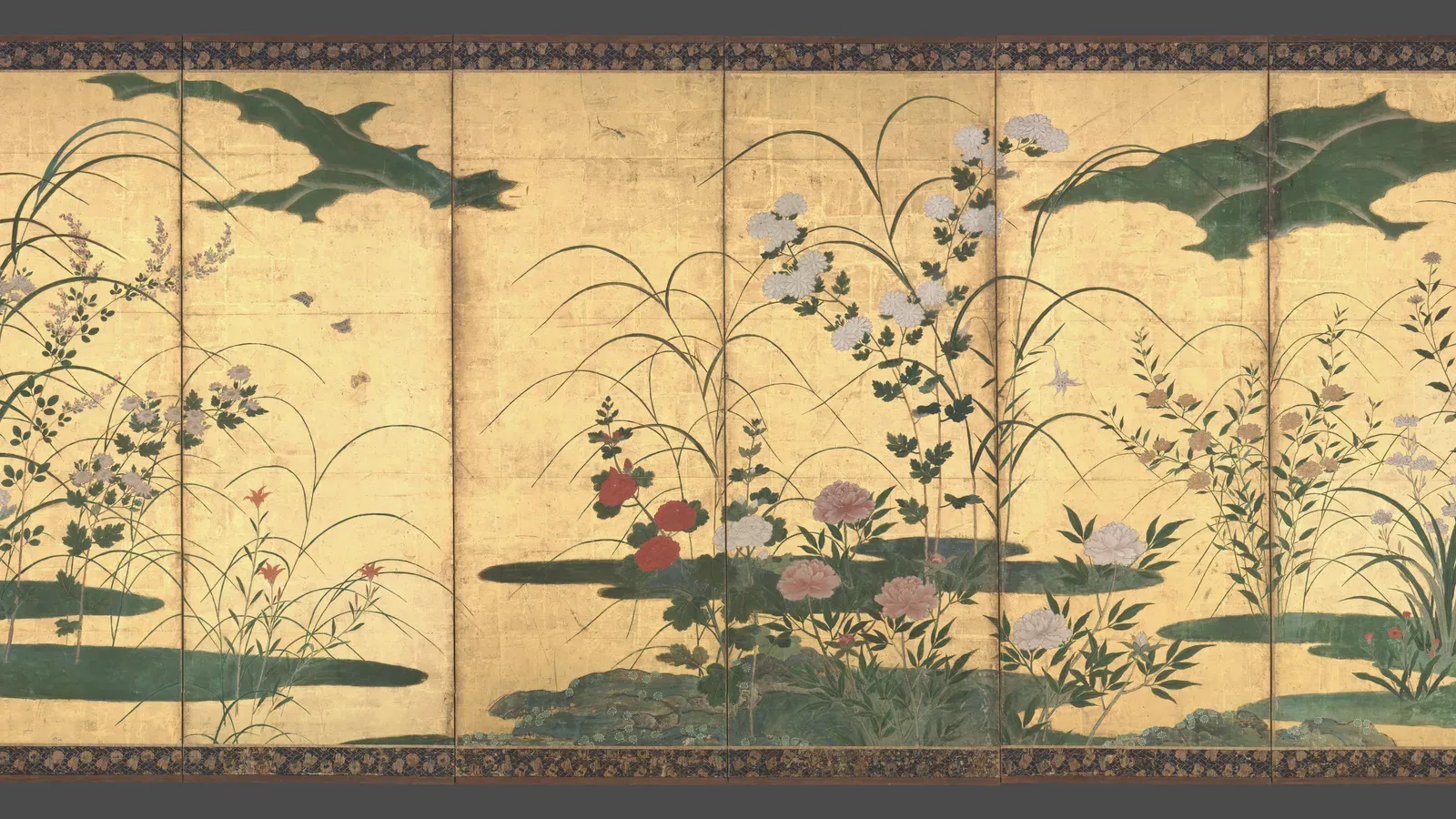
Chadō runs on a seasonal calendar as exact as the saijiki, the haiku almanac of season-words. Two hearths split the year, November’s robiraki and kuchikiri open the tea year, and every element of a gathering — sweets, flower, scroll, bowl — is chosen to match the month.
Few things people still practice are this thoroughly keyed to the calendar. The season here decides the equipment, the movements, the food, the flower in the alcove, and the depth of the bowl in your hands. Put a Kyoto host in late July beside the same host in January and they are doing recognizably different things, on purpose, by rule. The powder in the bowl is the same matcha. Almost everything around it has moved.
Japanese poetry built a tool for this kind of attention centuries before tea codified its own year, and chadō borrows the logic wholesale. Learn how the almanac works and the tea calendar reads less like etiquette and more like a grammar.
What a saijiki is
A saijiki (歳時記, “year-time chronicle”) is a working reference for poets. It catalogues kigo (季語, “season-words”), terms that carry a fixed seasonal charge in haiku and in the linked verse that came before it. Open one and you find five parts: the four seasons, plus a standalone section for the New Year, which sits at the seam of winter and spring and takes no internal subdivision. 1 Inside each season the entries are graded early, mid, and late, then filed under a standing set of headings — the season itself, the heavens, the earth, human affairs, observances, animals, plants. Each entry gives the word, its near relations, and a few example verses.
The boundaries follow the old lunisolar calendar, which is why they land a beat early for anyone raised on solstices and equinoxes. Spring runs roughly from 4 February to 5 May, summer to 7 August, autumn to 6 November, and winter back around to early February. 1 A season-word earns its keep in that scheme. Drop “first frost” or “young leaves” into seventeen syllables and you have pinned the poem to a fortnight of the year without ever writing a date.
The almanac grew out of the rules of linked verse. In renga (連歌) and the haikai (俳諧) that came after it, the opening stanza had to name the season, and a saijiki was the shared crib that told poets which words counted and when. 1 Classical practice asks a hokku to carry one season-word and no more, so the choice of kigo is the first move a poem makes. Chanoyu inherited the same reflex. Before a host settles on a scroll or a sweet, the host settles on where in the year the gathering stands.
Tea sits inside the almanac at more than one spot. Chatsumi (茶摘, “tea-picking”) is a late-spring season-word, and Bashō built a hokku on it. 2
木隠れて
茶摘みも聞くや
ほととぎす
kogakurete
chatsumi mo kiku ya
hototogisu
Hidden in the leaves,
the tea-pickers too hear it,
a cuckoo.
Chatsumi, tea-picking, is a late-spring season-word. The hototogisu, a summer cuckoo, belongs to the next season, so the verse rests on the seam between the two.
Closer to the room itself, chanoyu keeps a saijiki of its own. There is a chadō no saijiki (茶道の歳時記) that fixes each observance, utensil, and sweet to its slot in the year, the way the poets’ almanac fixes a word. 2 The room organizes itself with the poet’s instinct: name the season first, and let the objects fall out of the name.
The two hearths split the year
The single largest seasonal fact in any tea room is which fire is burning.
For roughly half the year the host works over a furo (風炉), a portable brazier standing on the tatami. For the other half the fire drops into a ro (炉), a hearth sunk into the floor beneath a removable panel of matting. The switch runs on the calendar, and the weather gets no vote. Ro season is November through April, furo season May through October, and the dates barely flex for an unseasonable spring. 3 The changeover is physical labor at each end: the tatami mat over the hearth is swapped for a plain one, or the reverse, and the charcoal is relaid. 3
The two arrangements solve opposite problems. Through the warm months the furo can stand well back from the guests, and the host rakes the ash and lays the charcoal to read as cool even while the kettle heats. 4 Through the cold months the sunken ro pulls the fire down into the floor and nearer the guests, so the heat reaches them where they kneel. 4 The fire is dressed differently at each pole of the year, too. In the furo months the host builds the ash into crisp seasonal forms and banks the charcoal so the glow stays half-hidden, a fire meant to be sensed more than felt. 4 In the ro months a larger kettle and a fuller charcoal load throw real heat into the room. That winter kettle is often too big for the summer brazier and too heavy for its ash, which is one more reason a single set of utensils cannot serve both halves of the year. Everything else forks at the hearth: how the kettle is handled, where the water jar goes, the sequence of movements, even which utensils are the right physical size for the space. The May opening of the furo carries its own name, shoburo (初風炉, “first brazier”), and its own note of early-summer freshness. The full mechanics of the split have their own page, furo vs. ro.
The turning points of the tea year
The hearths cut the year in half. Four moments give the halves their shape, and they arrive in a deliberate order: new leaf in spring, the brazier through summer, farewell in autumn, the jar broached in winter.
Shincha and hachijūhachiya, in spring
The year’s leaf is keyed to hachijūhachiya (八十八夜, “the eighty-eighth night”), counted eighty-eight nights out from risshun (立春), the old first day of spring around 4 February. It lands on 1 or 2 May. 5 The reckoning is agricultural before it is poetic. By the eighty-eighth night the danger of a late frost has mostly lifted, and a single late frost can strip a first flush overnight, so the first picking of shincha (新茶, “new tea”) begins. 5 There is even a set phrase for the last cold snap before the leaf is safe: hachijūhachiya no wakare-jimo, “the parting frost of the eighty-eighth night.” 5 For the tea room, this spring picking is the year’s supply arriving, still months away from the bowl. Shincha sold as a loose leaf tea is drunk within weeks of picking, prized for the raw green sharpness of the new season. 5 The tencha bound for the whisk takes the slower road, into the jar and out of sight until autumn.
The furo opens, in May
As the pickers move through the gardens, the ro is shut for the season and the furo comes out under the name shoburo. The switch is felt as relief. The floor closes over the sunken hearth, the fire moves up and away, and the room reads as a summer room from the first gathering of the warm half. Guests coming in from real heat meet a brazier set at a polite distance and a wide bowl waiting, the whole arrangement pitched toward coolness. 4 The leaf just harvested, meanwhile, goes straight into the jar, where it will sit out the summer and change. That storage is the quiet center of the whole calendar, and the November opening pays it off.
Nagori, in October
October carries a mood the tradition names outright: nagori (名残, the ache of something ending). Two things converge to earn the word. Last year’s tea is down to the dregs, the fine leaf near the top of the jar long gone and only the broken tea at the bottom left, and the furo is living out its final month before the ro takes over. 6 A host leans into the decline rather than dressing over it. Worn, chipped, and mended utensils come out on purpose, and the brazier slides toward the middle of the mat, the nakaoki (中置き) placement, dragging the last of its warmth back toward the guests as the room cools. 6 The farewell has its own gathering, the nagori no chaji, held to see the furo out before the ro takes over. 6 By long consensus October is the most wabi month on the tea calendar, and it is a deliberate setup: the old tea is being used up so the new can be opened clean.
Robiraki and kuchikiri, in November
November is the tea year’s New Year. 7 Two observances land together. Robiraki (炉開き, “opening the hearth”) is the first fire in the sunken ro for the cold season. Kuchikiri (口切り, “cutting the mouth”) is the breaching of the chatsubo (茶壺), the sealed jar that has held the spring leaf since May. By the old reckoning robiraki falls near rittō (立冬), the first day of winter, so the hearth opens as the calendar itself turns cold. 7 The two observances often run inside one gathering, and between them they close a year and open the next.
The jar that ties the year together
The chatsubo is the thread running through all twelve months. Packed inside is a small paper pouch of the finest koicha-grade tencha (碾茶, the steamed, de-veined leaf that is later stone-ground into matcha), buried in a mass of lesser leaf tea whose only job is to cushion and insulate the good pouch. 8 The jar is closed with a wooden lid, dressed in cloth and cord, and set aside around early summer to rest through the heat while the ro stays shut, roughly six months of maturing before anyone tastes it. 7 Freshly picked leaf comes out bright and sharp, and the months in the closed jar round that edge off, settling the tea into something rounder for whisking. 8
In the seventeenth century that rest was a literal journey. The shogun’s tea travelled in the o-chatsubo-dōchū (お茶壺道中), the tea-jar procession: the party reached the Uji gardens in early May, packed the jars there, then carried them by mountain road and held them in cool storage through the summer heat, so the tea reached Edo around the start of autumn. 8 The trip and the maturing were one act.
In November the cord and cloth come off, the paper seal is cut, the koicha leaf is ground on the spot in a small stone mill, and the first bowl of the new tea is whisked over the first fire of the ro. 7 That first bowl is thick tea, koicha (濃茶), the dense, almost paint-textured preparation kept for the best matcha, and it holds the whole year at once. Spring’s leaf, summer’s rest in the sealed jar, autumn’s farewell, winter’s opening: one bowl.
| Period (lunar-calendar season) | Hearth | What happens | The mood |
|---|---|---|---|
| Early spring (Feb–Mar) | Ro | The cold-season hearth, settled in | Quiet, inward |
| Late spring (Apr–early May) | Ro | Chatsumi; hachijūhachiya ~1–2 May; shincha picked | Anticipation, new leaf |
| Early summer (May–Jul) | Furo | Shoburo opens the warm half; the leaf is sealed in the chatsubo | Coolness sought |
| Late summer (Aug) | Furo | Deep heat; the brazier kept far from the guests | Restraint, shade |
| Autumn (Sep–Oct) | Furo | Nagori; nakaoki; the old tea runs out | Lingering, wabi |
| Winter (Nov–Jan) | Ro | Robiraki and kuchikiri, the tea New Year | Renewal, warmth |
How the season shows up in one gathering
None of the calendar stays abstract. It lands on the low tray and in the guest’s hands, object by object.
The sweet arrives first, often ahead of the tea, and it is the most openly seasonal thing in the room. A wagashi (和菓子) is shaped and named for the month: a plum for late winter, a single young maple leaf for early autumn, a sheaf of something just cut. The flower in the alcove, the chabana (茶花), is whatever is in bloom that week, set in sparely as though carried straight from the field. The scroll above it, the kakemono (掛物), pitches the season’s key in a few brushed words or a stroke of ink. Even the hardware is season-bound. Many a mizusashi or kettle is too big for the furo or too small for the ro, so the calendar chooses the utensils before the host does. 4 Even the water carries a seasonal reading: the same ladle is framed as warmth in December and as coolness in July, and the host’s handling nudges the guest toward whichever comfort the month is short on. 4
Reading the room is half the guest’s job. A trained guest walks in and takes the season’s temperature from the evidence: the shape of the bowl, the depth of the kettle, the flower, the two or three words on the scroll, the sweet already waiting. None of it is announced. The host lays out a set of seasonal signals and trusts the guest to add them up, which is why one physical gesture can read as coolness in one month and shelter in another. A gathering works best when host and guest are carrying the same almanac in their heads.
The bowl obeys the year like everything else. Through summer a host reaches for a hira-gata (平形), a wide, shallow bowl that spreads the tea into a thin layer and lets it shed heat fast, a small mercy in July. 9 Through winter the bowl grows tall and narrow, a tsutsu-gata (筒形), which stacks the tea in a deep column and holds the warmth down where the first sips are. 9 The tallest of these come out only in the deepest cold of mid-winter. One shape is doing thermodynamic work and flagging the season in the same gesture.
Here is where the calendar earns a real preference. November gets the celebration, the fresh jar and the thick first bowl, and it has earned it. October is the better month to be a guest. The mended bowl, the brazier crept toward the center, the last broken leaf out of a jar that is nearly empty: that room tells the truth about a year more plainly than any New Year can, because it is the month that admits the tea is running out. A host who can make the end of last spring’s tea taste like an occasion has understood the calendar better than one who only knows how to celebrate the new.
That disposition, building a room designed to pass and then sitting in it while it passes, is close to what the Japanese call mono no aware. The tea year turns that attention into a schedule, and the schedule is why the change stays in front of you instead of behind you. For a home-sized version, the working guide is seasonal tea practice. The wider feeling behind it belongs to the tea room’s aesthetic. You do not need a sunken hearth to borrow the habit. You need to know what month it is, and let that month choose one thing on the tray.
Sources
9sourcesWikipedia (Saijiki)
SupportsSaijiki structure: four seasons plus New Year; early/mid/late subdivision; standing categories; traditional lunisolar season boundaries
WKD / Matsuo Bashō Archives (World Kigo Database)
SupportsChatsumi (tea-picking) as a spring kigo; Bashō's kogakurete hototogisu hokku; the existence of a tea-ceremony saijiki (茶道の歳時記)
Wikipedia (Japanese tea ceremony)
SupportsRo season November–April and furo season May–October; the May furo opening; the tatami hearth panel swap
d:matcha Kyoto
SupportsFuro set far from guests and shaped to read cool; ro brought near for warmth; utensils sized to the season
Group Shinka
SupportsHachijūhachiya counted 88 nights from risshun, falling ~May 1–2; the parting-frost threshold; start of the shincha harvest
Issoan Tea (October Seasonal Notes)
SupportsOctober as nagori; nakaoki placement of the furo; worn and mended utensils; last year's tea down to the dregs of the jar
Global Japanese Tea Association
SupportsKuchikiri: tencha sealed in the chatsubo in early summer, opened in November; the tea practitioner's New Year; leaf ground on the spot
The Tea Crane
SupportsChatsubo packing (a koicha-grade tencha pouch cushioned by lesser leaf); ~6-month maturing; the Edo-era Uji-to-Edo tea-jar procession
Growing Karma
SupportsHira-gata (flat, wide) summer bowl cools tea quickly; tsutsu-gata (tall, cylindrical) winter bowl retains heat