The Implements
Furo vs. Ro: The Brazier, the Sunken Hearth & the Tea Year
The furo brazier (warm season) and ro sunken hearth (cold season) split the chanoyu year in two, and the November changeover is tea's true new year.
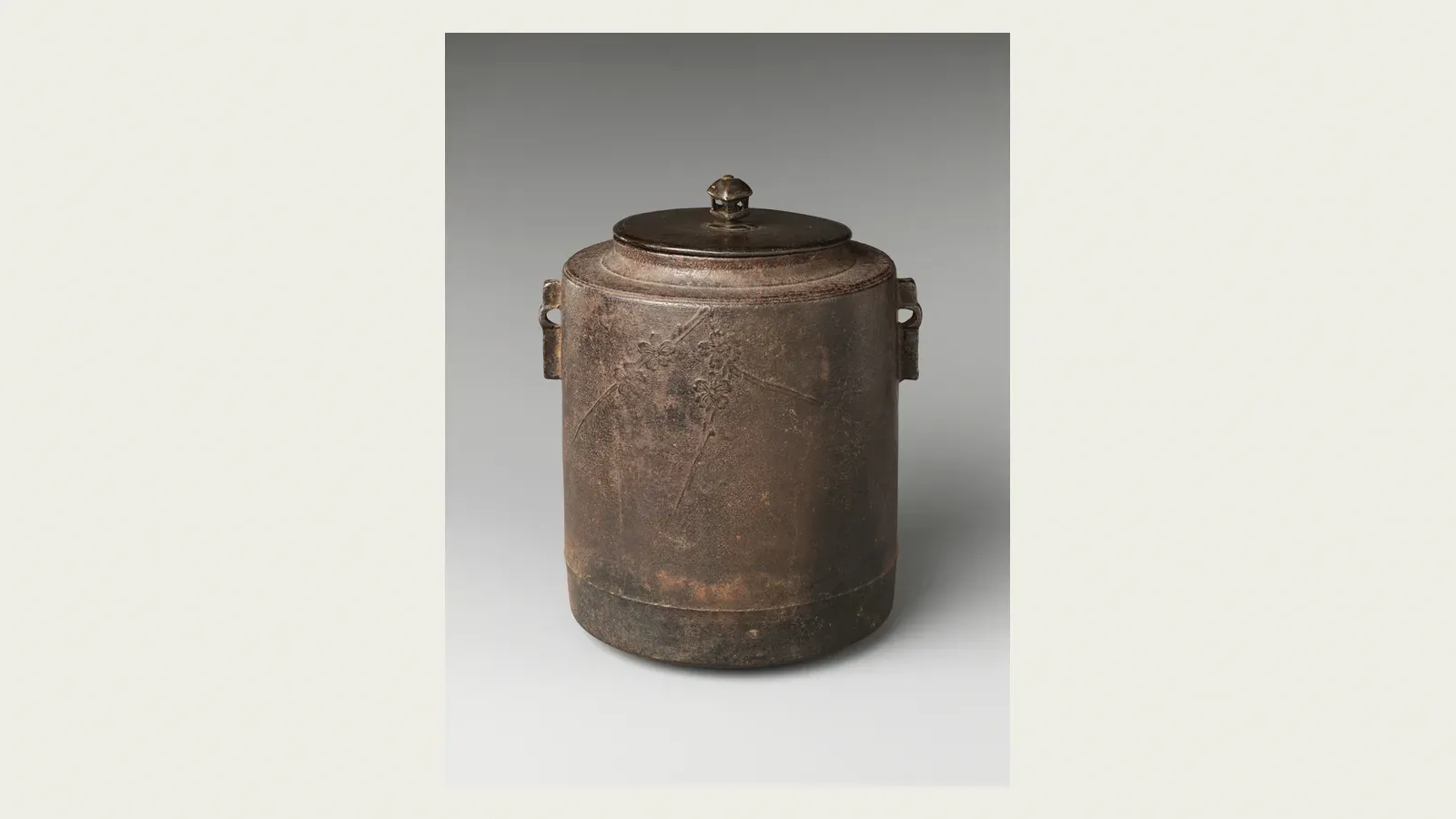
Chanoyu heats water two ways. The portable furo (風炉) brazier runs May to October, set well away from the guests so its charcoal doesn’t add to the summer. The ro (炉), a hearth sunk into the floor, runs November to April and pulls the fire close for warmth. The November switch, robiraki (炉開き), opens the tea year, the same gathering at which the matured leaf jar is broached.
One fact settles whether chanoyu (茶の湯), the practice of tea, keeps the calendar or ignores it: look at where the fire sits. In a room arranged for July, the kettle is pushed to the far edge of the host’s mat, as distant from the guest as the layout allows. In the same room in January, a square of tatami has been lifted away and the fire burns in a pit a few feet from the guest’s knees. Same room, same host, same kettle of boiling water. Only the season has changed, and the room is built to answer it.
Two hearths do that work, and everything else in the space bends to whichever one is lit. This is the furo and the ro, the warm-season brazier and the cold-season pit. Between them they organize the entire year of practice, and they are the plainest place in the tea room’s kit to watch the calendar operate.
The furo: the warm-season brazier
The furo is a portable hearth, a basin of ash and burning charcoal with the kettle set on top. It is cast in bronze (karakane, 唐銅, a refined copper alloy), forged in iron, or fired from clay, and it stands on a lacquered board, the shiki-ita (敷板), roughly a shaku square, which takes the heat off the mat beneath. 6 Nothing about the room is altered to receive it. The host carries it in, sets it on its board, and carries it out again. In Urasenke and the other major schools it serves the warm half of the year, roughly May through October. 1
The reasoning is physical. A guest in August wants less heat, so the host sets the furo at the far corner of the working mat, as far from the company as the arrangement allows, and rakes the ash into crisp ridges that read as coolness even while the water climbs to a boil. 1 Much of furo practice bends the same way: a shallower water jar, a wider bowl, an unhurried pace, the kettle’s lid cracked so steam registers as a hint. The same boiling kettle is made to feel like less of an event.
The name is usually written 風炉, “wind hearth,” for the airflow that feeds a brazier standing up in the open room. The oldest forms are iron, and the potters and casters added the rest later. A furo carries a named shape the way a good bowl does. There is the kimen-buro (鬼面風炉) with demon-face lugs holding its metal rings, the deep mayu-buro (眉風炉) with a fire-window cut under its raised brow, and the plain three-footed Dōan-buro named for Rikyū’s stepson. 6
The ro: the cold-season pit
The ro is the opposite gesture, and a permanent one. It is a square well cut down into the floor. The opening measures one shaku four sun on a side, close to 42 centimeters, edged by a wooden frame, the ro-buchi (炉縁), that guards the surrounding tatami. 7 Below the frame sits the ro-dan (炉壇), a clay-lined box set into the floor structure that holds the ash and the fire beneath the level of the mats. 7 It burns from roughly November through April. 9
Because the pit is built into the host’s own working area, the ro brings the fire down and in, close to where everyone kneels, and the charcoal and kettle are laid to hand the guest as much warmth as the room can give. 1 In winter that warmth is the welcome, so the host stops hiding it. In a purpose-built tea room the ro is a fixed square in one particular mat, boarded over and hidden through the furo months, then opened again for the cold. Practitioners keep a saying that a tatami room without a hearth is no tea room at all. 2
The kama: one kettle for each hearth
The kettle changes with the fire under it. A kama (釜) is cast iron, occasionally copper, and a single household keeps two: a smaller furo-gama and a larger ro-gama. 8 The difference runs deeper than size. The furo kettle carries a flange, the hane (羽), a thin cast rim that lets it rest on the raised collar of the brazier. The ro kettle drops the flange and hangs instead on a gotoku (五徳), a three-legged iron trivet standing in the ash of the pit. 9 Put a furo kama over a ro and the geometry fails. The winter kettle is bigger and heavier than a summer brazier and its ash bed can carry, which is one reason a single set of utensils won’t cover both halves of the year. 8
How the fire reshapes the room
The switch between the two rebuilds the geometry of the whole encounter. It is far more than lifting one object from here to there.
| Furo (風炉) | Ro (炉) | |
|---|---|---|
| Season | ~May–October | ~November–April |
| Form | Portable brazier on a board | ~42 cm pit sunk in the tatami |
| Kettle | Smaller furo-gama, hane on the collar | Larger ro-gama, on a gotoku trivet |
| Fire and the guest | Far corner, held away | Drawn down into the floor, close |
| Intent | Keep summer heat off the guest | Share the winter warmth |
With the ro lit, the hearth occupies a corner of the host’s own mat, and the host works in relation to that opening in the floor. 4 The kettle sits down in the tatami rather than up on a board to one side. The host’s reach shortens, the ladle drops to a lower angle, and sumi-demae (炭手前), the laying of charcoal done in front of the guests, is rebuilt for a fire tended from above instead of from across. 4 The schools treat furo temae and ro temae as separate bodies of work. At each changeover, in May and again in November, practice returns to the basic seated procedure and builds it up from the foundation for the new hearth. 1
October is the hinge, and it has a placement of its own. As the warm season runs out and the guest begins to feel the cold, the host slides the furo off its far corner toward the middle of the mat. This is nakaoki (中置き), the middle setting, the brazier creeping back toward the company to hand over the last of its warmth before the ro takes the job outright. For that one month the furo behaves a little like the hearth about to replace it.
Robiraki: the hearth opens
The November switch carries a name and a weight the May switch does not. Robiraki, “opening the hearth,” is the first fire laid in the ro for the cold season, and it works as the new year of the tea calendar. 2
The date descends from an older household custom. Opening the hearth fell on the first day of the boar, the i-no-hi (亥の日), in the tenth lunar month, the period the old almanac calls Kannazuki (神無月). 3 The choice ran on yin-yang reckoning. Among the five elements the boar belongs to water, and water was held to guard a house against fire, so the boar’s day was the safe day to bring live coals back indoors. The same logic opened the household kotatsu. 5 On the modern calendar the tenth month begins around 7 November with rittō (立冬), the first day of winter, so robiraki now lands in early November. 5 Tea took the date and the reasoning together. The occasion is marked with small offerings laid at the hearth: rock salt, unpolished rice, and bonito flakes. 2 Households also ate inoko-mochi (亥の子餅), boar-day cakes taken for health and a full house. 5
What lifts robiraki above a change of furniture is what happens to the tea. The finest leaf is picked in spring, around 10 May, then sealed warm into a tall ceramic jar, the chatsubo (茶壺), its mouth stopped with layered, glued paper. 3 Inside, a pouch of koicha-grade (濃茶, thick-tea) leaf is packed among coarser leaf destined for usucha (薄茶, thin tea), and the whole jar rests in the dark for roughly six months. 2 At robiraki the paper seal on the jar’s neck is cut in front of the guests, the ceremony called kuchikiri (口切り), “cutting the mouth,” and that year’s leaf is stone-ground fresh for the first bowl. 3 The hearth opens and the jar opens on the same day. This piece stays with the fire. The jar’s long journey and the season-by-season gathering have their own full treatment in the tea year and, at home scale, in seasonal tea practice.
The hearth through the year
Set against the months, the two hearths and their placements read as one continuous move. The fire is pushed away for summer, edged back in autumn, dropped into the floor for winter, then lifted out again in spring.
| Month | Hearth | Where the fire sits |
|---|---|---|
| May — shoburo (初風炉) | Furo | Brazier out for the first time, set well back from the guest |
| June–September | Furo | Held at the far corner, ash and pace pitched cool |
| October — nakaoki | Furo | Slid to the middle of the mat, edging back toward the guest |
| November — robiraki | Ro | Hearth opened in the floor, fire close, the jar broached |
| December–April | Ro | Larger kettle, fuller charcoal, real heat into the room |
The May opening carries its own name, shoburo (初風炉), “first brazier,” and its own note of early-summer relief as the floor closes over the sunken hearth. The bronze and ceramic forms of the furo, and the kama that sit on them, belong to the wider family of Japanese tea ceramics and metalwork.
Why the seasons live in the fire
Read cold, every move here answers a plain question, and nothing more. A host in August keeps the fire distant because the guest is warm enough already. A host in January drops it into the floor because the guest is cold. The tea that pours best in November is the leaf that went into the jar the previous spring and had the autumn to settle. Put together, those answers mean the room is never the same two seasons running, and a guest who comes back in a different month meets a different room, built down to the position of the kettle for the weather outside the paper screens.
If there is a season where chanoyu is most itself, it is the ro. The furo is hospitality at arm’s length, cool and considerate and slightly held back. The ro gives up the distance. The fire comes into the host’s own mat, the winter kettle throws real heat, and the year’s new tea is ground over the first coals, so the room stops managing the guest’s comfort and shares its own outright. The clearest bit of engineering in the whole practice is that shifting distance, the few feet the fire travels between the far corner in July and the sunken pit in January. Measure it and the tea year comes to about a meter of tatami. The calendar is not painted on the walls. It is cut into the floor.
Sources
9sourcesd:matcha Kyoto
SupportsFuro (May–Oct) and ro (Nov–Apr) seasons; furo set far from guests and dressed to read cool, ro brought close for warmth; May and November changeovers rebuild the basic temae
The Tea Crane
SupportsNovember as the tea year's new year; robiraki offerings of rock salt, unpolished rice, and bonito flakes; chatsubo maturing ~6 months from the ~May harvest; koicha pouch packed among usucha leaf; kuchikiri seal-cutting; the saying that a room without a hearth is no tea room
Ueda Sōko Chanoyu
SupportsChatsubo mouth sealed with layered, glued paper; kuchikiri as the formal jar-opening chaji; harvest around May 10 (five days after the lunar first day of summer); hearth opened on the first day of the boar
Chanoyu Decoded (Ro Temae: Host and Guest)
SupportsLayout shift from furo to ro; the ro cut into the host's mat; host and guest positioning around the sunken hearth
Nippon.com
SupportsHearth/kotatsu opening on the first day of the boar (i-no-hi) in the tenth lunar month; boar–water correlation held to ward off fire; inoko-mochi; today falls in early November as the tenth month begins near rittō (~7 Nov)
Chanoyu Decoded (Furo: Style and Form)
SupportsFuro materials — iron, bronze/karakane, ceramic; named forms (kimen-buro, mayu-buro, Dōan-buro); the shiki-ita board, ~1 shaku square, set under the brazier to take heat off the tatami
Chanoyu Decoded (Ro and Hai: Hearth and Ash)
SupportsRikyū's ro opening of 1 shaku 4 sun (~42 cm) square; the ro-dan hearth-foundation set in a box below; the frame that guards the surrounding tatami
Wikipedia (Chagama)
SupportsKama are cast iron or copper; heated over the furo in spring/summer and in the ro in autumn/winter; kama for furo are slightly smaller than those for ro
Chanoyu Decoded (Furo to Ro)
SupportsFuro used May–October, ro November–April; the furo kama's hane flange rests on the brazier's collar while the ro kama is supported by a gotoku trivet
Common questions
When does the tea year change over?
At robiraki, the opening of the sunken ro hearth. It falls traditionally on the first day of the boar in the tenth lunar month and today is observed in early November. That gathering, not 1 January, works as the tea year's new year, because the leaf jar sealed the previous spring is also broached then.
Why is the furo set away from the guests?
The furo is the warm-season brazier, used from roughly May to October. Placing it at the far corner of the host's mat keeps its charcoal heat from adding to an already warm room. It is one piece of a summer practice pitched throughout toward coolness.
What is robiraki?
Robiraki (炉開き), 'opening the hearth,' is the first laying of the fire in the sunken ro each cold season, held in early November. It functions as the tea calendar's new year and usually coincides with kuchikiri, the cutting of the paper seal on the matured leaf jar.