The Implements
Raku, Hagi, Oribe, Seto, Bizen: Japan's Tea Ceramics
Five Japanese ceramic traditions made for tea — Raku, Hagi, Oribe, Seto, Bizen — and how to tell their bowls apart by clay, glaze, and feel.
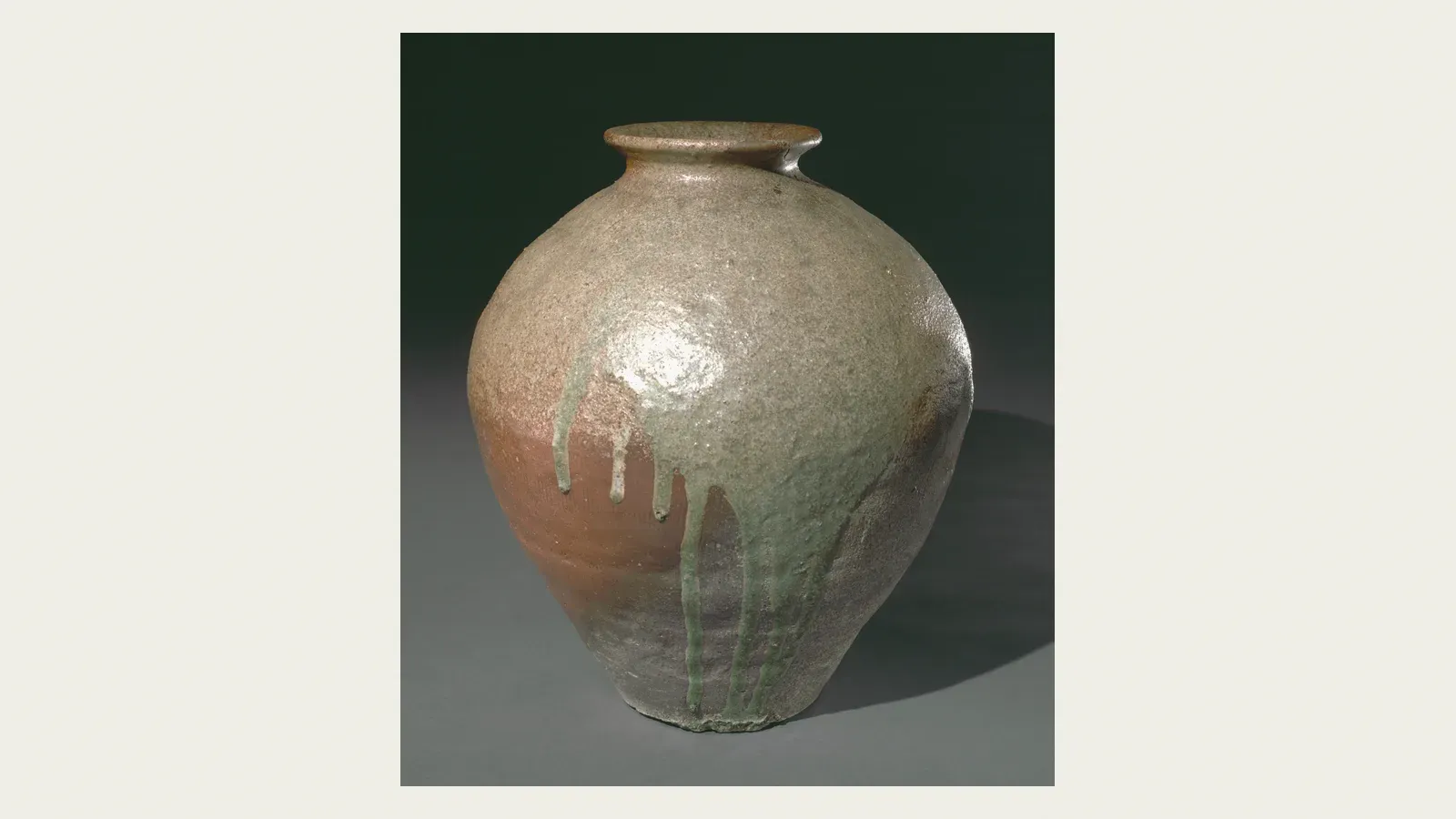
Five named traditions shaped the Japanese tea bowl: hand-built low-fired Raku, soft crackled Hagi that stains with use, distorted green-glazed Oribe, the glazed Seto kilns whose name became the word for pottery, and unglazed wood-fired Bizen. Each reads differently in the hand.
Pick up three Japanese tea bowls and your hands sort them before your eyes do. One is light and a little soft, warm before any tea goes in. One is dense and cool, the colour of iron. The third leans off its own centre far enough that you turn it to check for a chip. Each came out of a particular kiln, a particular clay, and a particular idea of what a vessel for whisked tea should be.
These five are named traditions with addresses. Different potters made them, in different provinces, for different patrons, and three of the five run straight back to the founding generation of the tea ceremony in the late sixteenth century. Telling one from another is the first real skill in reading a chawan (茶碗). That companion guide covers how to hold, turn, and choose one, so this page stays on the wares themselves and the wider kit of implements they belong to.
Raku: built by hand for one purpose
Raku (楽) is the only one of these traditions invented outright for tea, and the only one that traces to a single commission.
Around 1579 in Kyōto, the tea master Sen no Rikyū (千利休) asked a tile-maker named Chōjirō (長次郎) to make bowls to his wabi taste: quiet, rustic, stripped of display 1. What Chōjirō produced broke with the prized Chinese wares that elite tea had favoured. The bowls were monochrome, black or a warm oxblood red, and severe in their plainness. In Chōjirō’s own lifetime nobody called them raku. They were ima-yaki (今焼), “the ware of now” 2.
The defining fact is in the making. Raku bowls are shaped entirely in the hand. The potter builds the body in the palm and pares it down with a spatula, which leaves the walls a little uneven and the form quiet, a touch off-round 2. The Metropolitan Museum keeps a Momoyama-period black bowl described in exactly those terms, “molded by hand rather than thrown on a potter’s wheel,” and prized in the tea ceremony for that restraint 3. The clay carries a lead glaze and fires at a low temperature, and each glazed piece is drawn from the hot kiln while still glowing and left to cool in the open air 1. Low firing leaves the body soft and porous. That is why a Raku bowl feels lighter and less cold than its size predicts, and why it warms fast to the hand and to the tea.
Two colours split the tradition. Black raku (kuro-raku, 黒楽) takes a dark, iron-rich glaze and is pulled from the kiln at full heat, which is where the deep near-matte black comes from. Red raku (aka-raku, 赤楽) is gentler work: an ochre slip under a clear lead glaze, fired lower, warm russet to salmon 2. Rikyū is most closely tied to the black bowls, whose plain dark walls give a whisked green the cleanest possible ground.
The name arrived after the bowls did. Toyotomi Hideyoshi gave Chōjirō’s successor Jōkei a seal cut with the character raku (楽), “ease” or “enjoyment,” most likely borrowed from his Jurakudai palace, and the word settled into a family name 2. The Raku house has carried it through fifteen generations to the sixteenth head at work today. An old ranking among tea people runs ichi Raku, ni Hagi, san Karatsu, “first Raku, second Hagi, third Karatsu” 4, and Raku has held the top of it for four centuries. In the hand the bowl earns the place: light, warm, and quiet, the wabi aesthetic pressed into clay. The Raku house is a story of its own — one family across sixteen generations, and a Western tradition that took the name and little else — told in full in Raku ware.
Hagi: the bowl that changes
Hagi (萩) ware comes from the castle town of Hagi, on the Japan Sea coast of Yamaguchi Prefecture at the western tip of Honshū. The kilns date to 1604, when the domain lord Mōri Terumoto settled two Korean potters, Ri Shakkō and Ri Kei, in his territory after the invasions of Korea, and the work keeps its Joseon-dynasty bones to this day 4.
Hagi clay is coarse and open, and the glaze lies over it as a pale, milky film, white more often than not, sometimes a soft loquat or pink. Clay and glaze shrink at different rates as the bowl cools, so the glaze webs over with a fine mesh of cracks. That crazing has a name, kannyū (貫入), and the whole ware is built around it 4.
The crazing is what makes Hagi the bowl that changes. Tea works into the porous body through the cracks, and across months and years the surface deepens and stains where the liquid has reached. Tea people call the effect Hagi no nanabake (萩の七化け), the “seven transformations of Hagi,” the seven standing loosely for many 4. A new Hagi bowl and the same bowl after ten years of daily matcha read as two different objects. You finish the bowl yourself, slowly, by drinking from it.
A fresh Hagi piece often has to be broken in. The open body can seep at first, which is why a new bowl is usually seasoned before it meets a guest’s tea, soaked in water or steeped with used leaves until the pores settle. One more tell hides underneath. The foot ring, the kōdai (高台) the bowl stands on, is often cut with a deliberate notch or wedge, the kiri-kōdai (切り高台), a habit carried over from Korean practice 4. Turning a bowl over to read its foot is one of the quickest ways to place it. The Korean roots, the nanabake mechanism, and how to season a new bowl are taken up in Hagi ware.
Oribe: distortion on purpose
Oribe (織部) ware takes its name from Furuta Oribe (古田織部, 1544–1615), a daimyō and soldier who studied tea under Rikyū and became the most influential pupil in his circle. After Rikyū was forced to commit seppuku in 1591, Oribe was the foremost tea master in Japan for the next generation, and he taught the art to the shōgun Tokugawa Hidetada 5. Rikyū’s taste ran austere. Oribe’s ran bold, and the ware named for him wears the difference.
Two things mark it. First, colour: a copper-bearing glaze that fires to a deep, half-translucent green, frequently poured over only part of a piece and set against iron-brown designs painted on the bare clay 7. Second, shape. Oribe forms are distorted on purpose, squared off, pinched, slumped, thrown out of true. Oribe chose the off-kilter and the irregular, now and then to the point where a bowl fights the whisk 7. Most of it came from the Mino kilns in what is now Gifu Prefecture.
Oribe is a family of wares. Green Oribe (ao-Oribe, 青織部) carries the copper glaze over part of the piece with iron-brown patterns on the bare ground. Painted Oribe (e-Oribe, 絵織部) sets the design in iron alone. Black Oribe (kuro-Oribe, 黒織部) borrows a jet Seto-black glaze and reserves white panels for its geometric marks 8. The style ran freest of all on the kaiseki table, where the squared and fan-shaped serving dishes let a potter draw and warp with a boldness a tea bowl could not carry.
Oribe went the way his master had. During the Ōsaka campaign of 1615 he was accused of plotting against the Tokugawa from inside Kyōto, and on 6 July that year he was ordered to take his own life by seppuku, together with his son 6. The aesthetic outlasted the man. Of the five traditions here, Oribe is the one that still looks modern: set a squared, green-splashed Oribe dish beside studio ceramics from the last fifty years and it holds its own without apology. The deliberate wrongness that unsettled some of Oribe’s contemporaries reads now as design.
Seto: the kiln that named pottery
Seto (瀬戸), just outside Nagoya in Aichi Prefecture, is the oldest continuously working pottery centre in Japan, close to a thousand years in production 9. It is one of the Nihon Rokkoyō (日本六古窯), the Six Ancient Kilns, the medieval kiln towns that have fired ceramics without a break since before the modern era: Seto, Tokoname, Echizen, Shigaraki, Tamba, and Bizen.
Seto’s distinction among the six is glaze. Through the medieval centuries it was the only one of them making glazed pottery, working ash and iron glazes while the rest turned out bare stoneware 9. That head start made the town so bound up with ceramics that its name became the ordinary Japanese word for the stuff. Setomono (瀬戸物), “Seto things,” still means crockery and tableware in general conversation, whatever kiln it came from 10.
The tea connection runs two ways. Seto’s own medieval output, the ko-Seto (古瀬戸) or “old Seto” wares, imitated Chinese celadon and temmoku glazes for temples and the elite 9. Then, when the wars of the sixteenth century pushed Seto potters south into neighbouring Mino, the tradition seeded the kilns that fired the great Momoyama tea wares: yellow Ki-Seto (黄瀬戸), jet Seto-guro (瀬戸黒), creamy Shino (志野), and Oribe itself 8. Seto is best understood as a deep, adaptable command of glaze, and much of the glazed stoneware in a tea gathering, the caddies and water jars and dark iron-glazed bowls, owes something to it.
Bizen: clay and fire, nothing else
Bizen (備前) ware, from the Imbe district of Bizen City in Okayama Prefecture, is the oldest of the Six Ancient Kilns and the barest in method 11. It wears no glaze and no painting at all. Everything on the surface is the signature of the firing, and it starts with the clay: the iron-heavy earth of Imbe is so sticky and fine that any glaze would shrink and flake off in the kiln, so Bizen learned to do without one 12.
The pieces are packed into a wood-fired climbing kiln and held at 1,200 to 1,300°C for days on end 11. Pine ash drifts through the chamber and melts onto the clay. Flame, smoke, and each pot’s position in the kiln finish the rest. The named effects are the working vocabulary of the ware. Goma (胡麻), “sesame,” is the scatter of glassy flecks where ash has fused on the surface. Sangiri (桟切り) is the grey-blue to brownish shading that forms where a piece sits buried in ash against the kiln wall, starved of direct flame. Hidasuki (緋襷) is the set of scarlet lines left behind by rice straw wound around the clay before firing 11. The round pale blooms called botamochi (牡丹餅), “rice-cake dumplings,” are ash-shadows, left where a smaller dish or a wad of clay was set on the pot to shield a circle from the falling ash 12.
Because every mark is written by the fire, no two Bizen pieces match, and none can be run again. The body is dense, high-fired, and hard, the far end of the scale from soft porous Raku. Tap it and it rings. Bizen’s standing in the tea room rests above all on the water jar: as tea-ware production expanded in the Momoyama period, Sen no Rikyū prized the Bizen mizusashi (水指) and the plain unglazed flower vase, and both remain the ware’s clearest tea use 13. Bizen asks more of use than any glazed bowl and gives more back. Handled and wiped over years, the earth-brown surface takes on a low sheen that a fresh piece cannot have, a record of every hand that has held it. The maker sets the conditions and lets the kiln finish the work, and that willingness to accept the fire’s verdict sits at the centre of the wabi-sabi taste for beauty in the imperfect and unrepeatable.
How to tell them apart
The fastest reads are weight, surface, and foot. Raku and Hagi feel soft and warm because they fire low and stay porous. Seto and Bizen feel dense and cool because they are high-fired stoneware. Glaze splits the rest: Bizen has none, Oribe carries a loud copper green, Hagi a pale crackled film, Raku a plain black or red. When a bowl resists placing, turn it over. The cut of the kōdai and the way bare clay meets glaze at the foot tell you more than the painted front.
| Tradition | Region | Clay & firing | Surface | Feel / use |
|---|---|---|---|---|
| Raku 楽 | Kyōto | Hand-built, low-fired, soft & porous | Plain black or red over lead glaze | Light, warm, quiet; first for koicha |
| Hagi 萩 | Yamaguchi | Coarse clay, low-fired, porous | Pale crackled (kannyū) glaze; notched foot | Stains and shifts colour with use |
| Oribe 織部 | Mino (Gifu) | Stoneware, higher-fired | Bright copper-green glaze; iron painting | Firm; deliberately asymmetric |
| Seto 瀬戸 | Aichi | Stoneware, glazed | Ash and iron glazes, often dark | Smooth, assured; namesake of setomono |
| Bizen 備前 | Okayama | Dense stoneware, high-fired wood kiln | Unglazed; ash, flame, and straw marks | Hard, cool, rings; rewards long use |
Three of the five, Raku, Hagi, and Oribe, grew inside the wabi tea world of Rikyū and his circle, and each answers the same ideal in a different register: Raku states it plainly, Hagi lets it accrue under years of tea, Oribe argues with it. Seto and Bizen are older and broader than chanoyu, and tea reached back for them, Seto for its glaze and the caddies and jars it could make, Bizen for the honesty of a body with nothing laid over it. If you only ever keep two, keep the extremes: a Raku or Hagi bowl that warms and softens against the hand, and a Bizen piece that stays cool and hard and slowly darkens as you use it. Between those two temperatures sits most of what the Japanese kiln has to say about tea.
Sources
13sourcesEncyclopædia Britannica
SupportsRaku ware origin; Chōjirō commissioned by Sen no Rikyū; hand-molded lead-glazed earthenware; black and red
Wikipedia (Raku ware)
SupportsHand-shaping vs wheel; low-fired porosity; kuro-raku and aka-raku; ima-yaki; raku seal from Hideyoshi to Jōkei; sixteen generations
The Metropolitan Museum of Art
SupportsBlack Raku Tea Bowl, Momoyama period; molded by hand rather than thrown; esteemed in chanoyu
KOGEI JAPAN (Association for the Promotion of Traditional Craft Industries)
SupportsHagi ware established 1604 by Korean potters Ri Shakkō and Ri Kei under Mōri Terumoto; nanabake; kannyū crazing; kiri-kōdai notched foot; 'Ichi Raku, ni Hagi, san Karatsu'
Encyclopædia Britannica
SupportsFuruta Oribe 1544–1615; pupil of Rikyū; foremost tea master after 1591; taught Tokugawa Hidetada; forced suicide
Wikipedia (Furuta Oribe)
SupportsDied 6 July 1615; Ōsaka campaign plot; ordered to commit seppuku with his son; Oribe-dōrō lantern
Encyclopædia Britannica
SupportsOribe ware: copper-green glaze, distorted asymmetric forms, Mino region
Wikipedia (Oribe ware)
SupportsSub-types ao-Oribe, e-Oribe, kuro-Oribe, aka-Oribe; Mino kilns alongside Shino, Ki-Seto, Seto-guro
The Six Ancient Kilns of Japan (official site)
SupportsSeto the only medieval glazed-pottery kiln; ko-Seto; the Nihon Rokkoyō; ~1,000-year continuity
Wikipedia (Seto ware)
Supports'setomono' as the generic Japanese word for pottery
Okayama Prefecture Official Tourism Guide
SupportsBizen ware oldest of the Six Ancient Kilns; unglazed, unpainted; fired 1,200–1,300°C; kiln effects goma, sangiri, hidasuki
Wikipedia (Bizen ware)
SupportsIron-rich Imbe clay rejects glaze; botamochi effect from objects set on the pot
Bizen Pottery Guide (Bizen City)
SupportsMomoyama expansion into tea utensils; Rikyū prized the Bizen mizusashi and flower vase
Common questions
Which Japanese ware is best for matcha?
An old tea-world ranking runs ichi Raku, ni Hagi, san Karatsu — first Raku, second Hagi, third Karatsu — and it reflects how well those low-fired, porous bowls hold heat for thick koicha. For everyday thin usucha at home, a wide Raku or Hagi bowl works well. Unglazed Bizen is prized more for water jars and flower vases than for whisking matcha, though Bizen tea bowls exist.
Why does my Hagi bowl stain and darken?
That is expected, not damage. Hagi's coarse, low-fired body wears a crazed glaze, and over months of use tea seeps into the fine cracks and shifts the surface colour. Tea people call it Hagi no nanabake, the seven transformations. Rinse with hot water and skip the soap.
What causes the brown and red colours on Bizen?
All of it comes from the wood firing — Bizen uses no glaze and no paint. Melted pine ash makes the sesame-fleck goma, buried and smoke-starved sections turn the grey-blue to brown of sangiri, and rice straw wrapped around the clay leaves the scarlet lines of hidasuki. The kiln reaches 1,200 to 1,300°C over several days.