The Way
Warrior Tea: Hideyoshi, Rikyū & the Samurai Way of Chanoyu
How Nobunaga and Hideyoshi made tea an instrument of rule, the gold tea room set against Rikyū's two-mat hut, and the forced seppuku of 1591.
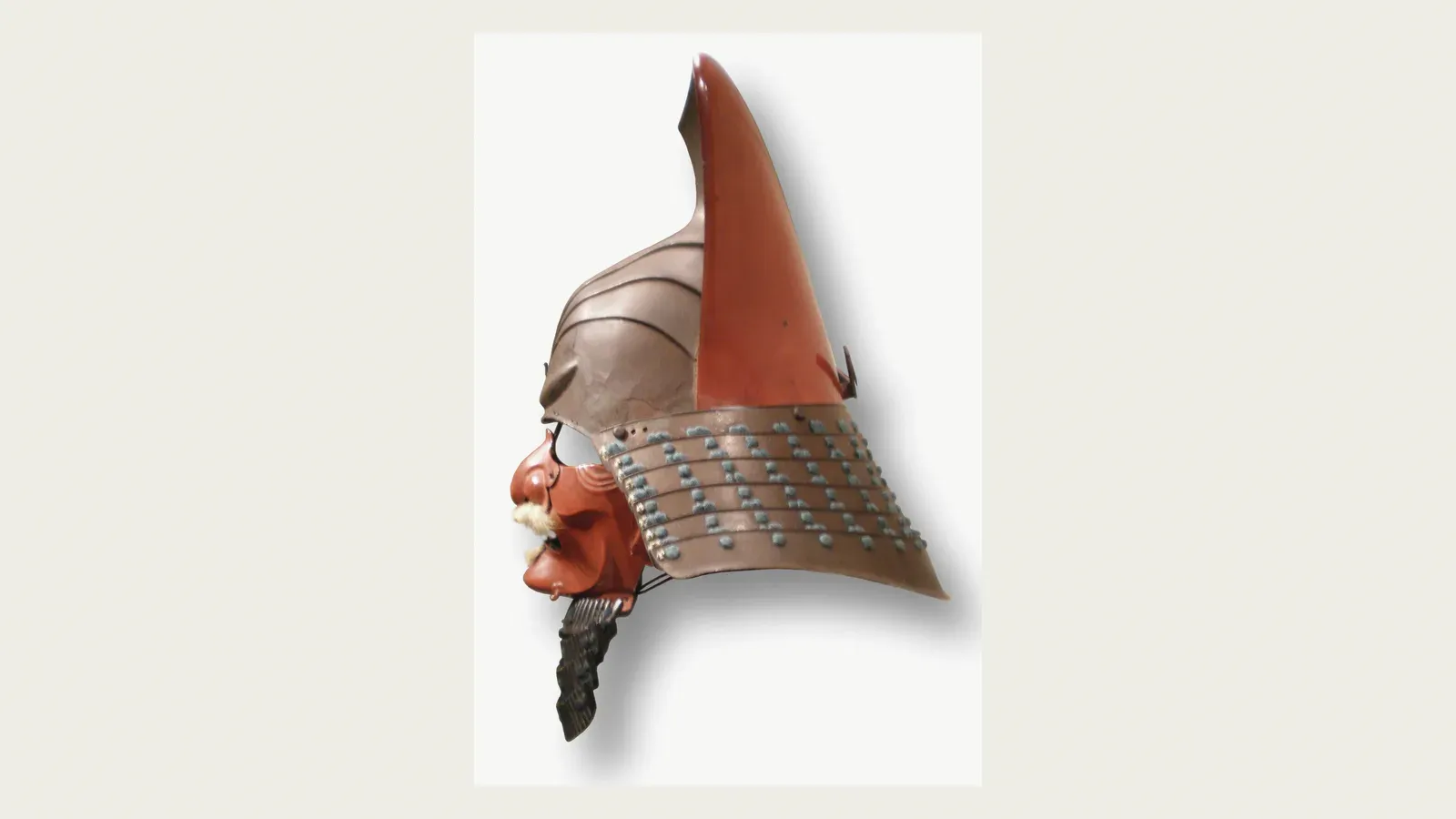
In the same decades Sen no Rikyū refined the tiny grass-hut style of tea, Japan’s warlords turned chanoyu into an instrument of rule, and Toyotomi Hideyoshi had a portable gold-leafed tea room built. That contradiction ran to Rikyū’s forced suicide in 1591, and, a generation later, to his warrior disciple Furuta Oribe’s.
The late sixteenth century produced the most austere room in the history of tea: Rikyū’s two-mat hut, mud walls, a door you crawl through on your knees. It produced the opposite in the same decade. A tea room whose walls, ceiling, pillars, and paper screens were sheathed in gold leaf, framed so it could be taken apart, crated, and carried to wherever the ruler of Japan wanted to drink. Both rooms passed, for a time, through the same tea master’s hands. To read chanoyu (茶の湯, “hot water for tea,” the practice of the tea gathering) in this period you have to hold both in view at once. What follows traces what an art becomes once it turns useful to power, a harder story than the fable of simplicity outlasting excess.
Tea as an instrument of rule
By the time Oda Nobunaga (織田信長, 1534–1582) was hammering central Japan into one state by force, the tea gathering was already prestige property, the pastime of rich Sakai merchants who collected famous utensils and staged one another’s admiration. What Nobunaga added was a policy. His government’s use of chanoyu came to be called ochanoyu goseidō (御茶湯御政道), “rule through tea”: the right to hold a formal gathering became a licence the lord granted, not a thing a retainer could take up on his own.3
The mechanism was the utensils. Land was finite. Japan held only so many provinces to hand out to deserving generals, and every grant of one narrowed what remained. Famous tea objects were finite in a kinder way. A single named tea caddy, an old Chinese jar, a celebrated bowl, could be given as a reward, and in Nobunaga’s accounting the value of such a piece came to equal the value of a fief.3 He collected them with intent, taking them as tokens of allegiance from allies and confiscating them from men he had beaten on the field, a campaign later named meibutsu-gari (名物狩り), the hunt for famous objects. To hold the right piece, granted by the right hand, was to hold a title anyone in the room could read. The tea gathering had become a place where rank was conferred and announced in the language of things.
The warriors closest to Nobunaga learned to prize a caddy the way they prized a castle, because in his system the two were made to trade at par. That is the inheritance Hideyoshi took up.
The gilded room and the grass hut
Toyotomi Hideyoshi (豊臣秀吉, 1537–1598) rose from common birth to the top of the warrior order after Nobunaga’s death in 1582, a foot-soldier turned sovereign, and lineage was the one thing conquest could not supply. Tea offered a substitute. The Met states it flatly: Hideyoshi “recognized cultural knowledge to be as important an attribute of leadership as military might and took up the practice of chanoyu as a means of demonstrating his cultivation.”2 For a ruler with no pedigree, the tea room was a place to be seen as cultivated and not merely victorious.
His tea master, by the mid-1580s, was Rikyū, and the post carried more than taste. Rikyū designed gatherings, appraised objects, and set the etiquette warlords were held to. He stood close enough to power that a contemporary letter could split the regime’s business between two men: confidential matters to Sōeki, Rikyū’s Buddhist name, and official matters to Hidenaga, Hideyoshi’s own brother.3 A fish-merchant’s son from Sakai had become one of two hinges of the government.
Then the gold. In January 1586, Hideyoshi had a tea room carried into the Kyoto Imperial Palace and served tea to Emperor Ōgimachi (正親町天皇) inside it. Its scale was modest, about three tatami mats. Its surfaces were anything but. Walls, ceiling, pillars, and the sliding shōji screens were covered in gold leaf, the utensils gold or gilt, the mats laid with crimson. A frame of cypress, bamboo, and reed let it be dismantled, crated, and rebuilt elsewhere.5 This is the Golden Tea Room (黄金の茶室, ōgon no chashitsu). Reassembled before an emperor or a guest, it worked as an argument in gold, announcing a wealth no rival lord could answer. The original is gone. Several reconstructions stand in Japanese museums today, worked up from records that say almost nothing about who built it.
Set it against what Rikyū had raised four years earlier. Tai-an (待庵, 1582) is the only tea room firmly attributed to him, and Japan lists it a National Treasure. Its working floor is two mats, one for host and one for guest, entered through a nijiriguchi (躙口), a sliding hatch so low that everyone, sword or no sword, crouches and crawls in.11 Earthen walls. Gold leaf’s opposite, surface for surface.
The two rooms are easy to stage as a duel, Hideyoshi’s vulgar glare against Rikyū’s clean conscience, and the staging is wrong. Both belonged to the same court culture, and the same period ran both currents at once. The Met describes Momoyama art as a “robust, opulent, and dynamic style” of lavishly applied gold, beside which “the military elite also supported a counter-aesthetic of rustic simplicity, most fully expressed in the form of the tea ceremony.”1 The gold room and the grass hut were two registers available to the same patrons, sometimes in the same week. Tradition even guesses that Rikyū had a hand in the gold room’s design. The records name no makers, so treat that as plausible and unproven.
What is documented is the contrast, and it needs no embellishment. One room said the ruler could gild a building and carry it to the emperor. The other said two people could still meet over tea in a space smaller than a modern bathroom. Both were arguments about power. They put it to opposite use.
Here is the political spine of those years, from Nobunaga’s policy to the second master ordered to die:
| Year | Event |
|---|---|
| 1570s | Nobunaga formalizes ochanoyu goseidō: holding chanoyu becomes a privilege the lord grants |
| 1582 | Nobunaga killed at Honnō-ji; Hideyoshi seizes power; Rikyū’s Tai-an built |
| 1586 | The Golden Tea Room is carried into the palace for Emperor Ōgimachi |
| 1587 | Kyūshū subdued; the Grand Kitano tea gathering, opened to all ranks and cut short after one day |
| 1591 | Hideyoshi orders Rikyū to commit seppuku |
| 1615 | Furuta Oribe, Rikyū’s disciple, is ordered to seppuku after the siege of Osaka |
The Grand Kitano tea gathering, 1587
The clearest single image of warrior-era tea is a public spectacle. On the first day of the tenth month of 1587, fresh from breaking the Shimazu and subduing the southern island of Kyūshū, Hideyoshi staged the Grand Kitano Tea Gathering (北野大茶湯, Kitano Ōchanoyu) at the Kitano Tenmangū shrine in Kyoto. He advertised it in advance and threw it open on purpose. Signboards declared that anyone devoted to tea was welcome, warriors and their attendants, townspeople, farmers, those of lower station, whatever their rank or means, and that a guest could bring no more than a kettle, a well bucket, a bowl, and some tea.6
The turnout was vast. Something on the order of 1,500 tea sites went up across the shrine grounds. Hideyoshi’s three chief tea advisers, Rikyū, Tsuda Sōgyū (津田宗及), and Imai Sōkyū (今井宗久), all Sakai men, hosted venues among them, and the Golden Tea Room was reportedly on show.6 The event had been announced to run ten days. Hideyoshi closed it after one. The usual explanation is that word reached him of an uprising in Higo Province, far to the southwest, and soured his mood. The records do not fix the reason, and any single motive is a guess wearing the clothes of a fact.6
Read Kitano as a demonstration. A ruler who had just won a war assembled the whole social order around the practice of tea, put himself and his masters at its center, and folded the art itself into his patronage. The gathering was open to everyone and unmistakably his. Historians treat the day as a turning point in chanoyu itself, the one occasion when warrior patronage and popular, all-comers tea stood together in a single field.6 It is also, in hindsight, the last great public moment Hideyoshi and Rikyū shared before the ground between them opened.
Daimyō tea: the warrior line
Tea changed once it passed through the warrior class. It split. Alongside the townsman line that Rikyū’s own descendants would carry ran a second current, the tea of the feudal lords, and in Japanese it has a name: daimyō-cha, the chanoyu of the warrior houses.
That current started inside Rikyū’s own circle. His most prominent students were warlords and generals. Later tradition counts a group called the Rikyū shichitetsu (利休七哲), “Rikyū’s seven disciples,” and every name on the list is a high-ranking samurai, among them the daimyō Gamō Ujisato and Hosokawa Tadaoki, the latter remembered in tea under the name Sansai.10 The “seven” is a retrospective tidy-up, applied after Rikyū’s death, and its membership was never fixed past those two. The list matters less for its roll of names than for what it reveals: the man who pared tea down to a merchant’s austere ideal taught that ideal, face to face, to the lords who ran the country.
The line’s first commanding figure is Furuta Oribe (古田織部, 1544–1615), born Furuta Shigenari, a daimyō who served Nobunaga and then Hideyoshi and studied directly under Rikyū. After Rikyū’s death he became the foremost tea master in the land and taught the second Tokugawa shōgun, Hidetada (徳川秀忠).7 Where Rikyū prized the quiet, the muted, and the regular, Oribe drove toward the bold and the deliberately warped, a taste better fitted to men in armor than to a merchant’s reserve. The record of it is in clay. Oribe ware (織部焼) is known on sight: slumped, off-square shapes, copper-green glaze, abstract painted marks, tea aesthetics with the volume turned up. For where it sits among Japan’s kilns, see the ceramics guide.
The accent carried one generation on and grew more polished as it climbed. Oribe’s pupil Kobori Enshū (小堀遠州, 1579–1647) was himself a daimyō and served as tea instructor to the shōguns Hidetada and Iemitsu. Enshū eased Oribe’s distortion into a manner he called kirei-sabi (綺麗さび), “beautiful sabi,” a graceful, brightened wabi pitched to the expectations of lords.4 Rikyū’s bare aesthetic had been the taste of a self-governing merchant town. Two generations later, in the hands of Oribe and Enshū, it had become court dress, the official tea of the men who now held the country.
Oribe’s life ended much as his teacher’s had. In 1615, during the Tokugawa siege of Osaka, he fell under suspicion of conspiring against Ieyasu, and he and his son were ordered to take their own lives.7 Teacher and student, a merchant and a daimyō, each compelled by the ruler he served to die by his own hand. Hold that recurrence. It is the sharpest thing the period has to say about standing close to a warlord.
The rupture: Rikyū’s forced seppuku
In the second month of 1591, Hideyoshi ordered Rikyū to commit seppuku (切腹), self-disembowelment, at his residence in Kyoto. Rikyū obeyed. He was seventy by the traditional count.8 This is the hardest fact of warrior-era tea, and the words for it matter. He was not lost and he did not pass away. The ruler he had served as master and confidant ordered his death, and he carried it out.
Why he was ordered to die is unsettled, and honestly so. The regime’s own announcement named two charges. The first was lèse-majesté, tied to a wooden statue of Rikyū that the monks of Daitoku-ji (大徳寺) had set in the upper story of a temple gate he had funded, so that Hideyoshi would pass beneath a tea master’s feet to enter. The second was profiteering, the improper appraisal and resale of tea utensils. A Japanese critical review of the causes gathers up the explanations that four centuries have produced and concludes that none has been firmly established.9 The full biographical case for each theory sits in the life of Rikyū. The political reading belongs here.
Read as politics, the killing has a cold logic the stated charges only gesture at. Rikyū was an intermediary of unusual reach, a commoner who commanded the taste and the confidence of the lords beneath Hideyoshi, exactly the warrior-disciples the shichitetsu list preserves. A ruler consolidating absolute control had concrete reason to remove such a man, or to make an example of him for the daimyō who had grown too fond of him. The statue and the utensil-trading read less like motives than like paperwork, the citable pretext for a decision reached on other grounds. That is my reading, and it is a reading, not a proof. The aesthetic-duel version — the gold room against the grass hut, austere conscience against gaudy tyrant — is the most repeated and the least supported. It flatters two complicated men into a morality play and asks the least of the evidence.
What warrior tea left
The gold room is gone. Its leaf survives only in museum copies, while the room people cross the country to kneel in is the two-mat hut. That outcome gets told as austerity’s moral win over excess, and the telling is too clean. Both rooms spoke for the same power. The plain one carried the long argument because it held the more interesting idea about what tea could be, a room that emptied itself until only two people and the tea were left in it.
The heavier legacy is the one the parable leaves out. Warrior tea gave the art its official shape, the daimyō-cha of Oribe and Enshū that dressed Rikyū’s grammar for the shōgun’s court, the form in which much of Japanese tea has come down. It also fixed the price of standing that close to a warlord. Within twenty-four years the two greatest masters of the age, a Sakai merchant and a feudal lord, teacher and student, were each handed the same order by the ruler he served and told to open his own belly. If you want to see what survived the politics, the answer is not in a museum’s gold. It is any evening a host today lays the charcoal, sets two bowls, and holds a small gathering the plain way Rikyū argued for — the practice at the far end of all this power, described here, and traced to its source at the Way of Tea. The tea was an instrument of rule to the very end. So, when it suited the ruler, were the men who made it.
Sources
11sourcesThe Metropolitan Museum of Art, Heilbrunn Timeline — Momoyama Period (1573–1615)
SupportsMomoyama dates; a 'robust, opulent, and dynamic style' of lavishly applied gold, alongside which 'the military elite also supported a counter-aesthetic of rustic simplicity, most fully expressed in the form of the tea ceremony'
The Metropolitan Museum of Art, Heilbrunn Timeline — The Japanese Tea Ceremony
SupportsHideyoshi 'recognized cultural knowledge to be as important an attribute of leadership as military might and took up the practice of chanoyu as a means of demonstrating his cultivation'; wabi-cha; the Kitano gathering
Chanoyu / Omotesenke Fushin'an — Rikyū's Chanoyu and Its Lineage: Rikyū and Nobunaga, Hideyoshi
SupportsNobunaga's 'ochanoyu goseidō' (rule through tea); the value of a famous utensil became equal to that of a fief; meibutsu-gari (utensil hunting); Rikyū as tea master and confidential adviser — 'For confidential matters Sōeki (Rikyū), for official matters saisho (Toyotomi Hidenaga)'
Chanoyu / Omotesenke Fushin'an — The Tradition of Chanoyu: Furuta Oribe and Kobori Enshū
SupportsOribe as Rikyū's leading successor and the tea of the warrior houses; Kobori Enshū, his pupil, tea instructor to the Tokugawa shōguns; the kirei-sabi aesthetic of daimyō tea
Wikipedia — Golden Tea Room
SupportsFirst mention January Tenshō 14 (1586), carried to the Kyoto Imperial Palace for Emperor Ōgimachi; about three tatami; gold leaf on every surface including the shōji; cypress/bamboo/reed frame, portable; original lost, museum reconstructions exist
Wikipedia — Grand Kitano Tea Ceremony
SupportsFirst day of the tenth month, Tenshō 15 (1587), Kitano Tenmangū; follows the Kyūshū (Shimazu) campaign; open to all ranks, bring kettle/well-bucket/bowl/tea; ~1,500 venues; Rikyū, Tsuda Sōgyū, Imai Sōkyū as chief advisers; planned ten days, cut to one, Higo-uprising the common explanation
Encyclopædia Britannica — Furuta Oribe
SupportsBorn 1544 Mino, died July 6 1615 Kyōto; daimyō; favourite pupil of Rikyū; foremost tea master after Rikyū's death in 1591; taught the shōgun Tokugawa Hidetada; implicated in a conspiracy against Ieyasu and forced to commit suicide after the Osaka Campaign
Encyclopædia Britannica — Sen Rikyū
Supports1522–1591; tea master to Nobunaga and Hideyoshi; Hideyoshi ordered him to commit seppuku in 1591 at age seventy
CiNii Research — 'A Critical Review of the Causes of Sen no Rikyū's Ritual Suicide'
SupportsScholarly survey of the proposed causes of Rikyū's seppuku; many explanations offered, none firmly established; the regime's stated charges (lèse-majesté via the Daitoku-ji gate statue; improper appraisal and trade in tea utensils)
Japanese Wiki Corpus — Rikyū shichitetsu (Rikyū's seven disciples)
SupportsSeven high-ranking daimyō/generals counted as Rikyū's foremost disciples; a retrospective grouping, membership never fixed; Gamō Ujisato and Hosokawa Tadaoki (Sansai) appear in every version
Wikipedia — Tai-an
SupportsTai-an (1582), only teahouse firmly attributed to Rikyū, National Treasure; two-mat core, one host mat and one guest mat
Image: https://commons.wikimedia.org/wiki/User:BrokenSphere, Wikimedia Commons · CC BY-SA 4.0