The Practice
How to Host a Simple Tea Gathering at Home
Adapt the shape of a chakai for a beginner host with no tea room: a few guests, a clean room, a seasonal sweet before usucha, and an unhurried hour.
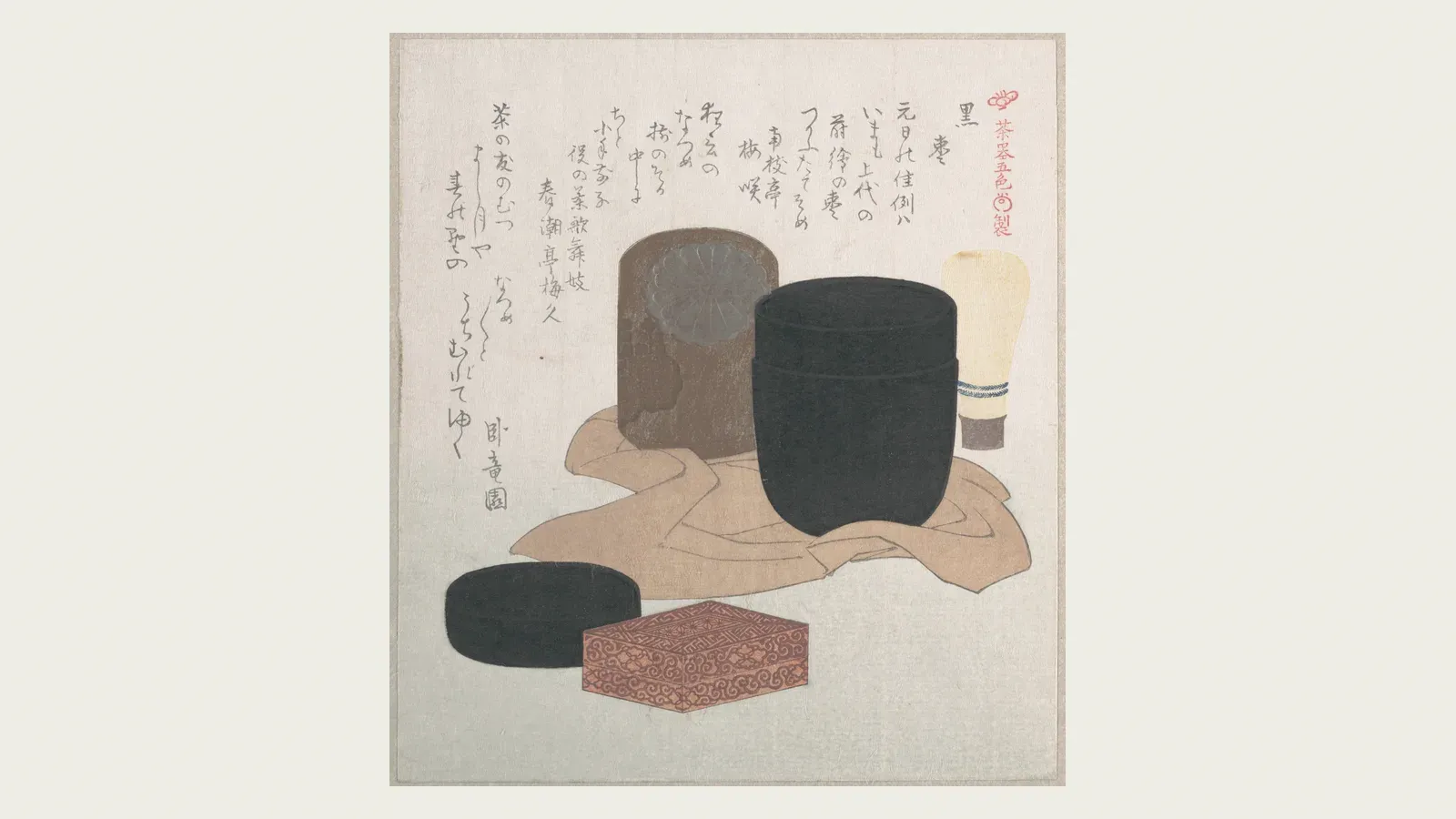
A home tea gathering borrows the shape of a chakai (茶会), the short informal gathering built on thin tea and a sweet, and leaves the four-hour chaji with its meal and fixed procedure to trained practice. Clean the room yourself, set out one seasonal wagashi per guest, serve it before the tea, whisk a bowl of usucha for each person, and give the whole thing an unhurried hour. Skipping the formal procedure and the meal is a legitimate way to practise, not a watered-down failure.
You do not need a tea room, a teacher, or a shelf of matched utensils to make tea for a few people with care. You need a clean room, a sweet, a bowl and a whisk, and an hour you refuse to hurry through. What follows adapts the shape of a chakai for an ordinary home, and it does so openly, without dressing up as the larger thing it borrows from.
What this is, and what it isn’t
Japanese tea recognises two kinds of gathering, and they sit far apart. The larger is the chaji (茶事): four hours or more, a kaiseki (懐石) meal, charcoal laid in front of the guests, thick tea (koicha 濃茶) kneaded and shared as the main act, thin tea (usucha 薄茶) to close, every part following a procedure that takes years to learn. The smaller is the chakai — literally “tea meeting” — an informal event with a flexible format and a limited but open number of guests, built around a bowl of thin tea and a sweet.1 Almost everyone meets the chakai first, at a temple, a festival, or a museum tea room.
A gathering at home is not a chaji, and calling it a “tea ceremony” borrows a credential you have not earned and sets your guests up for a performance you can’t give. It sits far closer to a chakai, with the public setting and the practised host stripped away. So call it what it is: tea, made carefully, for a few people in your own rooms. That honesty carries its own weight, and it takes the pressure off.
What you keep from the tradition is the sequence, because the sequence is sound.
| Chaji (茶事) | A home gathering (chakai in spirit) | |
|---|---|---|
| Length | Four hours or more | An unhurried hour |
| Meal | A full kaiseki | None |
| Tea | Koicha, then usucha | Usucha only |
| Fire | Charcoal laid in view | Kettle in the kitchen |
| Procedure | Formal temae (点前) | None required |
| Setting | Tea room, garden path | A clean, quiet room |
| Guests | A few, versed in etiquette | Two to four, any |
The three schools that carry this tradition — Urasenke (裏千家), Omotesenke (表千家), and Mushakōjisenke (武者小路千家), the houses descended from Rikyū’s grandson Sōtan — spent four centuries refining the order a gathering moves through. You can learn from that order without holding the credential, which is most of what the three schools preserve. The home version keeps the small group, the clean room, the sweet, a bowl whisked for each person, and time with nowhere to be.
Clean the room, and mean it
Here is the part most home hosts skip, and it matters more than any bowl or whisk you could buy: clean the space properly, with your own hands, on the day.
Set this beside the formal tradition and the emphasis is unmistakable. In a chaji the host washes the stone basin and sweeps the garden path the day before, then sprinkles fresh water along the stones on the morning of, partly to lay the dust and partly to signal a place made ready. Okakura tells the story of Rikyū watching his son sweep and water that path, then judging it too clean, and shaking a maple so a scatter of leaves fell across the swept ground.7 The cleanliness was the ground under everything, and the few fallen leaves were the life put back on top of it. You have no garden path. You have a room, and it wants the same care.
Wipe the table. Clear every surface of what has nothing to do with the gathering: the mail, the chargers, the half-read book, the charging cable that lives on the counter. Vacuum the floor people will sit on. Wash the bowl and dry it. None of this is symbolic, and none of it needs explaining to a guest. The room is being made clean, by you, in the hours before anyone arrives, with nowhere you would rather be hurrying off to. That plain condition — a clean room, prepared on purpose for named people — is what separates a gathering from a visit. Purity is the third of the four principles a tea gathering is held to, and in wa-kei-sei-jaku it is defined exactly here, in the wiping and the sweeping rather than in any state of mind. Guests feel the difference between a room that was tidied and a room that was prepared, even when they could never name it.
One flower, in season
Put a single flower, or two or three stems, in a plain vase. This is the home form of chabana (茶花), the tea flowers, and the tradition’s instinct is restraint carried to its edge. Okakura describes a whole tea room given over to one morning glory set in a bronze vessel in the alcove — a single bloom, chosen as the finest of the garden, standing for all the rest.7 The chabana that follows this instinct looks as though it came straight from the field and was set down without arrangement, three stems at most.
A branch of whatever is flowering near you this week does more than a florist’s bouquet. The flower marks that this is this season and no other, the way the whole gathering should: a permanent decoration says nothing, a seasonal one says when you are. If you want the fuller argument for why a single stem carries so much, it lives in chabana and kakemono, and the way the tea year turns through the months is set out in the tea year.
The sweet, and why it comes first
Set out one wagashi (和菓子) per guest on a small plate, and serve it before the tea rather than alongside it. There is a working reason for the order. Usucha whisked from matcha is bright and astringent, and the sweet is eaten first so the sweetness already on the tongue meets and softens that edge when the tea arrives.5 Sweetness and astringency sharpen each other. Each reads more like itself for following the other. Eat your own sweet a few minutes before you drink, once, and the sequence will make more sense than any paragraph can.
Wagashi divide by moisture, and the split maps onto the tea. Namagashi (生菓子), fresh sweets with a high water content, are soft, moulded, and short-lived: bean-paste confections shaped and coloured to the month, or cool translucent jellies in high summer. Higashi (干菓子) are dry pressed sweets, firm and long-keeping, and by the standing convention they are the ones served with thin tea, where the moist namagashi belong with thick koicha.4 At home the line blurs, and either suits an informal bowl of usucha, so choose by the season instead of the rule.
| Season | A good choice |
|---|---|
| Spring | Soft namagashi in cherry pinks, or a sakura-leaf sweet |
| Summer | A cooling clear jelly — kanten or kuzu — for the look of coolness |
| Autumn | Chestnut or persimmon flavours, deeper colours |
| Winter | A denser bean-paste sweet, or dry higashi to keep |
Seasonal design is the whole art of wagashi, and a confectioner’s case reorganises itself every few weeks to follow it.4 Buy one per guest and buy it fresh. Do not invent a shortfall by serving a stale sweet to save a trip. If nothing seasonal is within reach, a good dry higashi keeps for weeks and is an honest fallback.
The run of the afternoon
There is no fixed script at home, which is the freedom of doing this rather than attending it. A workable order runs prepare, welcome, sweet, tea, linger.
-
Prepare before anyone knocks. The room is clean, the flower is in its vase, the sweets are plated, the bowl is washed and dry, the kettle is filling. Be ready early enough that you can answer the door with nothing left undone. A host still tidying when the first guest arrives has already lost the quiet the gathering runs on.
-
Seat your guests and let them settle. Around a low table on cushions, or at an ordinary table, whatever the room offers. Bring water for anyone who wants it. Let the talk find its level before the tea narrows everyone’s attention to the bowl.
-
Serve the sweets. Give each guest their wagashi on its plate and let people eat unhurriedly. This is when conversation runs most freely, and it should. Once the sweet is finished the palate is ready and the room is halfway to quiet on its own.
-
Whisk the first bowl. Heat water to roughly 70–80°C (158–176°F), off the boil and rested a couple of minutes. Sift about 2 grams of matcha, a rounded half-teaspoon, into the warmed dry bowl, add about 60 to 70 ml of water, and whisk briskly in a W or M from the wrist until a fine even foam holds on the surface, around fifteen seconds.3 The full method, and every way it goes wrong, is in how to whisk matcha.
-
Serve one bowl at a time. Hand the first bowl to the first guest, then whisk the next. Usucha is a single serving, made fresh for each person, where the koicha of a chaji is one bowl shared down a line.2 Making them in turn is slower, and the slowness is the feature: nobody drinks a lukewarm bowl, and each is made for the person in front of you.
-
Make your own last, or not at all. The host drinks after the guests, if at all. You will have a run of whisking behind you and no obligation to add a bowl to it.
-
Let it run long. The tea portion of a public chakai often takes well under an hour, and at home the whole thing can take the hour it takes. An unhurried pace is the single feature that separates this from handing someone a mug, so guard it.
A few courtesies that carry their weight
You do not have to teach your guests etiquette, and a gathering weighed down by rules loses the ease that makes people glad they came. A handful of quiet conventions are worth keeping anyway, because each was arrived at for a reason.
- Present the bowl with its front toward the guest. A tea bowl (chawan 茶碗) usually has a more interesting face, often the livelier side of the glaze. By convention the host turns that face to the guest, and the guest rotates the bowl a little before drinking so as not to drink from the finest side. Do it, and let anyone who notices follow, or mention it once and lightly.
- Drink it in a few sips. Usucha is one person’s portion, finished in a handful of sips. Nursing a cooling bowl loses it, and so does tipping it back like a shot.
- Let the room go quiet around the tea. Talk over the sweets is welcome. When the bowls go out the room tends to hush on its own, and it needs no announcement from you.
- Get out of the way. The strongest version of this gathering is one you have prepared well and then mostly stay out of. A clean room and a well-made bowl say more than a running commentary on their meaning.
When it is over
When the last bowl is drunk, clear up without ceremony, and without rushing the guests toward the door to do it. Wash the bowl, rinse the whisk and stand it to dry so the prongs keep their shape, wipe the table. The gathering ends when it ends.
This is where ichigo-ichie (一期一会) earns its place, and the phrase repays being exact about, because it is misattributed almost every time it is printed. The four characters read roughly “one time, one meeting.” The thought traces to Sen no Rikyū by way of his disciple Yamanoue Sōji, but its enduring four-character form was set down much later by Ii Naosuke (井伊直弼, 1815–1860), the Hikone lord and tea man, who completed his treatise on the single gathering, Chanoyu Ichie Shū, in 1858.6 Ii opens it by stating that an encounter today can never be had again, so host and guest both owe it their whole care.6 The full lineage is laid out in ichigo-ichie.
What it names is plain. This gathering — these guests, this flower, this water at this temperature on this afternoon — assembles once and then dissolves. The specific arrangement is unrepeatable, whatever grand claims about impermanence you attach to it or leave off. You will host again. You will never host this again, and that is what the clean room was for.
So do the smaller, honest version, and be at peace that it is smaller. No temae, no kaiseki, no tea room, no scroll you spent a month choosing. A bowl of thin tea whisked well and served attentively, in a room you cleaned yourself for the people in it, holds more than an anxious imitation of a chaji ever could. The formal event is there when you want to understand what you are adapting from: walk it in the temae and kaiseki, step by step, meet the tradition it belongs to in the Way of Tea, and find the rest of the at-home practice at the practice hub. Then put the kettle on for two or three people, and take the hour.
Sources
7sourcesGlobal Japanese Tea Association, 'Chakai 茶会 — a Tea Gathering'
SupportsChakai as the informal tea gathering with a flexible format and a limited-but-open number of guests; a formal event for a small number of guests would be a chaji 茶事
Global Japanese Tea Association, 'Koicha (濃茶)'
SupportsUsucha is thin and frothy, one bowl per guest; koicha is thick and shared from a single bowl in the full chaji
Ippodo Tea (Global), 'Basic Usucha (Matcha)'
SupportsUsucha recipe: 2 g matcha, 60 ml water at 80°C, sift first, whisk vigorously about 15 seconds; preparing quickly preserves the aroma
Wikipedia, 'Wagashi'
SupportsMoisture classes — namagashi 30%+ moisture, higashi 10% or less; omogashi (moist) served with koicha, higashi (dry) with usucha; jō-namagashi at tea ceremonies; colour, shape and flavour vary by season (spring cherry pink, summer clear jellies, autumn chestnut and persimmon)
NAKAMURA TOKICHI HONTEN, 'Perfect Pairings: Japanese Tea & Wagashi'
SupportsWagashi softens the astringency of tea; the sweet and the tea are taken together so the sweetness balances the tea's edge
Japanese Wiki Corpus, 'Chanoyu Ichie Shu (Collection on the Oneness of Chanoyu)'
SupportsWritten by Ii Naosuke (tea name Sōkan), lord of Hikone; completed 1858; opening statement that an encounter today can never be experienced again, so host and guest must both attend to it in earnest
Okakura Kakuzō, The Book of Tea (1906), Project Gutenberg
SupportsRikyū and the swept garden path — cleanliness joined to naturalness, leaves scattered on the cleaned ground; the single flower in the alcove; tea-room cleanliness as the host's first duty; public domain
Common questions
Do I need a tea room to host a tea gathering at home?
No. A tea room, a tatami floor, and a garden path belong to the formal chaji and to trained practice. A home gathering modeled on the informal chakai needs only a clean, quiet room and a low or ordinary table. What you owe your guests is a prepared space and full attention, and both are possible in a one-room apartment.
What sweet should I serve, and when?
Serve one wagashi (和菓子) per guest, and serve it before the tea, not after. The sweetness readies the palate so that usucha's astringency reads as depth rather than harshness. Choose by season: a fresh, moist namagashi or a cooling jelly in warm months, a denser or drier sweet as the year turns colder. Buy them from a confectioner unless you bake, since good wagashi take real skill.
How much matcha do I need per guest?
About 2 grams of matcha per bowl, whisked into roughly 60 to 70 ml of water at 70–80°C, one bowl made fresh for each guest. That follows the published usucha recipe of long-established Kyoto houses such as Ippodo. A small tin covers several gatherings.
Is a home gathering a real tea ceremony?
It is a real, informal tea gathering, in the spirit of a chakai. It is not a chaji, the formal four-hour event with a meal and a fixed procedure, and it is honest to call it what it is. A carefully made bowl of thin tea, served in a clean room to people you have prepared for, is a legitimate practice on its own terms.