The Implements
The Chashaku & Natsume: Scoop and Tea Caddy Demystified
The bamboo tea scoop and the lacquer caddy explained: why the natsume holds thin tea and the chaire holds thick, and how to choose and handle each.
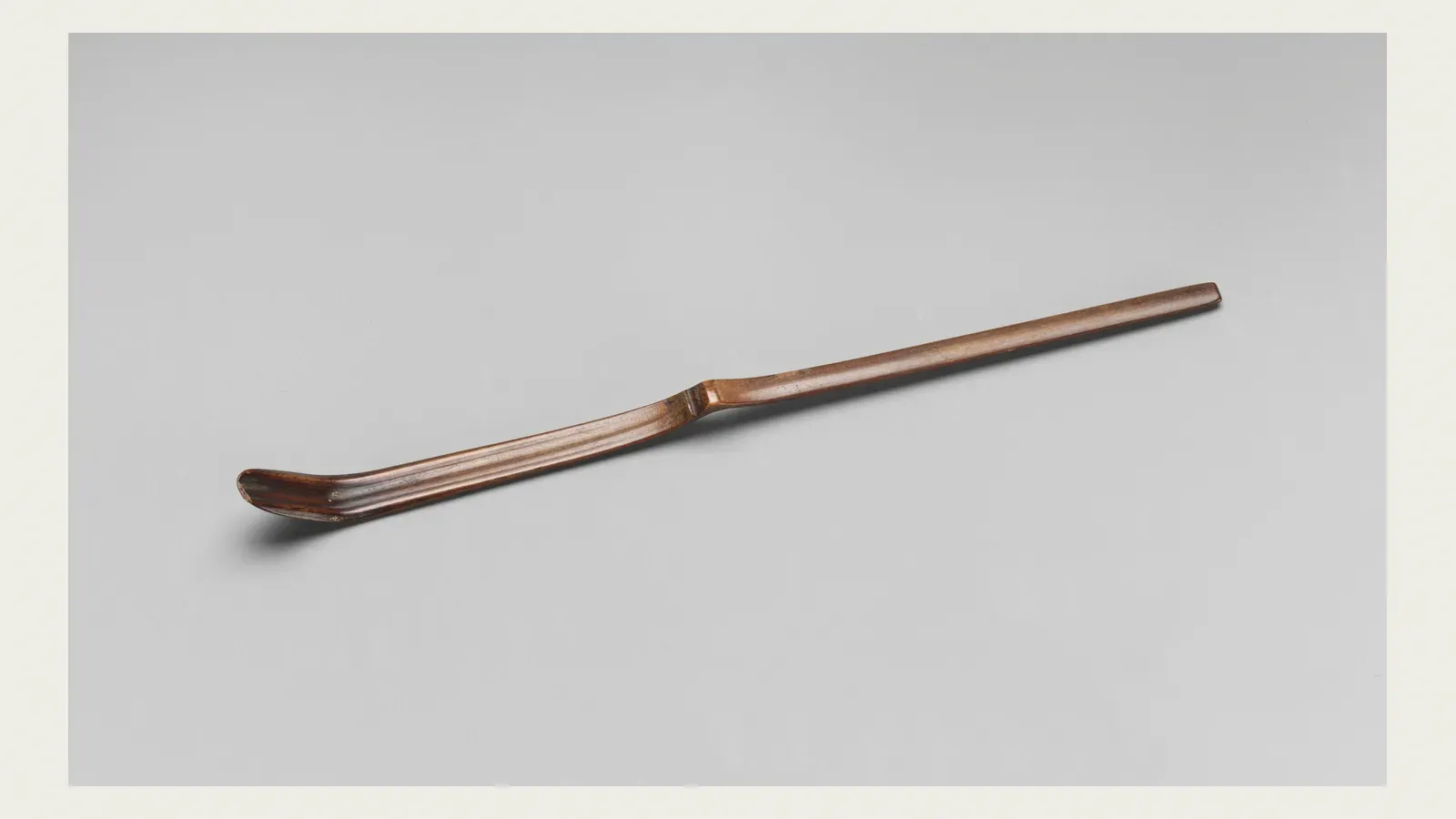
The chashaku is a slender tea scoop carved from a single length of bamboo. The natsume is a lidded lacquer caddy, named for the jujube, that holds powdered tea for usucha (thin tea). Thick tea, koicha, comes from a different caddy: the ceramic chaire.
Two small objects sit beside the bowl in almost every preparation, and both are easy to overlook. One is a thin curl of bamboo with a single bend. The other is a lacquer cylinder small enough to close in one hand. Learn to read the pair and a crowded shelf of teaware resolves into one question asked twice: what holds the tea, and what lifts it out. The answer changes depending on whether the tea is thin or thick, which is where most of the confusion starts.
The chashaku: carved from one length of bamboo
The chashaku (茶杓) lifts powdered tea from the caddy into the bowl. The earliest examples were ivory, copied from the spoons of Chinese medicine, and silver, mulberry, and tortoiseshell all turn up in the record. By the sixteenth century the tea masters had settled on bamboo, and bamboo is what almost every chashaku you will handle today is cut from 1.
A finished scoop runs about 19 to 21 centimeters long and a centimeter wide 1 — long enough to reach the bottom of a deep caddy, narrow enough to lay down a small, controlled measure. The shaved, curved scooping end is the kaisaki (櫂先), tapering to a fine point called the tsuyu (露). The flat handle ends at the kiridome (切止), the cut mouth of the bamboo 3. Between them sits the feature that gives the scoop its character: the fushi (節), the natural node of the plant. The node is a style marker, and where the carver leaves it says a great deal. JAANUS names the parts around it exactly: the wood above the node is the fushiue, below it the fushishita, and the thin scraped hollow on the underside is the arigoshi (蟻腰), the “ant’s waist” 1.
The node, and the men who moved it
Node position carries the history of the scoop, told in three hands. Murata Jukō, the fifteenth-century founder of wabi tea, worked with a bamboo scoop that showed no node at all. Takeno Jōō, his successor and Rikyū’s teacher, left the node at the very end of the handle, at the kiridome — the form called tomebushi (止節). Then Sen no Rikyū (1522–1591) moved the node to the center, the nakabushi (中節), which balanced the scoop in the hand and became the standard after the Momoyama period 3.
Those three positions line up with the three registers of formality that run through all of tea: shin (真) formal, gyō (行) semi-formal, sō (草) informal.
| Grade | Node position | Material and hand |
|---|---|---|
| Shin (formal) | None | Ivory, or plain lacquered bamboo; the oldest, highest form, paired with the finest thick tea |
| Gyō (semi-formal) | At the handle end (tomebushi) | Bamboo; Takeno Jōō’s placement |
| Sō (informal) | At the center (nakabushi) | Plain bamboo; Rikyū’s, and the everyday scoop most people picture |
Formality also climbs with the material and finish, from bare bamboo up through wiped lacquer to ivory, so the node-position mapping stays a rough guide, loose at the edges 1. The through-line still holds. The humblest of the three, Rikyū’s centered node on plain bamboo, is the form that won and became standard equipment.
Scoops with names
Because a master carved his own, the chashaku became the one utensil that carries a signature. A finished scoop was often given a poetic name, a mei (銘), and kept in a bamboo tube, the tsutsu (筒), inscribed with that name and the carver’s hand. Rikyū went further and added an identifying poem to the storage case itself 2. The Met holds a chashaku attributed to Rikyū, cut from a single narrow length of bamboo and dated to the Momoyama period (1573–1615). He cut and inscribed such scoops as gifts to his disciples 4. A named scoop is treasured as an object in its own right, and its worth turns entirely on the hand that made it. A length of bamboo and a sharp blade are the whole bill of materials. What raises the price is whose hand held the blade.
This is the one utensil where a maker’s whole sensibility fits into a hand’s length of bamboo. A tea bowl passes through many hands and the chance of the kiln. A scoop is one person, one piece of bamboo, a few decisive cuts. The bend of the neck, the depth of the kaisaki, the exact seat of the node: all of it is a single carver’s judgment, uninsulated. That is why a scoop by a named master, with its mei and its tube, can matter as much as the bowl it fills.
Caring for one is short work. Bamboo splits when it is soaked and then dried hard, so wipe the scoop with a dry cloth after use and let it air. Keep it clear of radiators, direct sun, and the sink. It should never go under a tap or sit to soak. A good bamboo chashaku costs very little, which is the first reason to be wary of any “master” attribution offered cheaply online.
The natsume: a lacquer caddy named for a fruit
The natsume (棗) holds the powdered tea for thin tea. Its name is literal. The shape copies the jujube, the Chinese red date called natsume in Japanese — a small barrel that swells at the middle and closes under a gently domed lid, roughly a third of the caddy’s height 5. Turned from wood and finished in urushi (漆), the lacquer tapped from the Toxicodendron vernicifluum tree and built up in thin coats, a real natsume is a piece of fine lacquerware in its own right 5. Practice pieces come in plastic or resin, fine for learning and out of place anywhere else.
Formality runs by finish. The most formal shin natsume is plain, undecorated black lacquer. From there, red and vermilion, then decorated grounds, then bare wood grow steadily more casual. A black natsume dusted with gold makie (蒔絵) — lacquer painting fixed with metal powder — reads as ornament, a deliberate step out of the austere black.
Here is a place to stake a claim: for daily use, a plain black shin natsume outclasses most makie. The decorated caddies look handsome on a shelf and busy in the hand. The black one asks nothing, takes every year of handling as a deeper sheen, and stays out of the way of the bowl and the tea. Buy ornament when you host by season and want the caddy to answer a hanging scroll. Buy black to make tea.
Sizes come in three: ō-natsume (large), chū-natsume (medium), and ko-natsume (small). The chū-natsume is the workhorse, about 6.8 centimeters in both height and diameter 5.
Natsume or chaire? Thin tea and thick
This is the distinction that trips nearly everyone, so here it is flat. The lacquer natsume holds the tea for usucha (薄茶), thin tea. Koicha (濃茶), thick tea, is served from the chaire (茶入), a small ceramic jar kept in a drawstring silk pouch called a shifuku (仕覆) 6.
Material follows function, and status follows material. Koicha is the graver preparation, kneaded from roughly twice the tea into a thick, almost paint-like bowl, and its caddy counts as the more precious of the two 7. The most prized chaire are karamono (唐物), Chinese imports, sorted by silhouette into names like katatsuki (肩衝, square shoulders), nasu (茄子, eggplant), and bunrin (文琳, apple) 6. In the warrior century a single famous chaire could be handed to a daimyō as a reward for a battle 6. Usucha and its lacquer caddy came later and sat lower in rank. The wooden natsume grew out of boxes first made to hold the precious chaire 6.
For why the same powder is whisked thin one day and kneaded thick the next, see the split between usucha and koicha. The hand behind the centered node belongs to Sen no Rikyū.
| Natsume | Chaire | |
|---|---|---|
| Material | Turned wood + urushi lacquer | Ceramic |
| Holds tea for | Usucha (thin) | Koicha (thick) |
| Kept | On its own | Sheathed in a shifuku pouch |
| Status | Everyday to formal | The more treasured caddy |
| Prized form | Plain black shin natsume | Karamono imports (katatsuki, nasu) |
Using and choosing them
In a preparation the scoop and the caddy work as a pair. The host lifts the lid, draws tea with the chashaku, and lays it in the warmed bowl. A level scoop holds roughly a gram. A bowl of usucha takes about two scoops, near 2 grams, whisked into some 70 milliliters of hot water. Koicha takes about twice that tea, near 4 grams, kneaded into far less water until it turns to paste 7.
The scoop doubles as the measure, which is why “a couple of scoops” is a real instruction, precise to the gram. Two level chashaku make a usucha serving, and you can dose a home bowl by it before you own a scale. After use the host wipes the scoop and rests it across the lid of the caddy, a fixed small gesture repeated every time. For where these movements fall inside the whole sequence, see the temae, step by step.
Choosing is short. For a scoop, buy plain bamboo with a centered node — correct, cheap, and all you need to make tea. For a caddy, start from what you do. Whisking thin tea at home, which is what nearly everyone does, calls for a natsume, and a plain black chū-natsume is the sound default. Reach for a chaire and its pouch only when you prepare koicha. Wipe real urushi with a soft dry cloth, keep it clear of water and sun, and store it dry. Regular handling buffs the surface to a deeper sheen over the years.
For the bowl that completes the set, see how to read, choose, and hold a chawan. Both objects sit inside the larger grammar the anatomy of the tea ceremony lays out utensil by utensil, and behind that grammar stands chadō, the Way that decided a scoop should be one length of bamboo and a caddy the shape of a fruit.
Of everything on that shelf, the chashaku is the one piece a single person could cut in an afternoon and leave a name on for four centuries. A hand’s length of bamboo, one node, and whose hand held the blade.
Sources
7sourcesJAANUS (Japanese Architecture and Art Net Users System), Columbia University
SupportsChashaku definition; node parts (fushi, fushiue, fushishita, arigoshi); ivory origin and shift to bamboo; dimensions ~19-21.5cm; formality by node position (formal = nodeless/ivory, semi-formal = node at handle, informal = node at center, attributed to Rikyū)
Spurlock Museum, University of Illinois
SupportsMaker progression of chashaku styles (Jōō introduced the bamboo gyō form, Rikyū the centered sō form); Rikyū added a poem to the case identifying the carver; named scoops
SAKURA Japanese Culture Experience Class, Kyoto
SupportsNode-position terms and lineage: nodeless (Jukō), tomebushi node at the handle/kiridome end (Jōō), nakabushi center node (Rikyū) becoming standard after Momoyama; part names (kaisaki, tsuyu, kiridome)
The Metropolitan Museum of Art
SupportsTea Scoop (Chashaku) attributed to Sen no Rikyū, Momoyama period (1573-1615), carved from a single narrow piece of bamboo; Rikyū cut and inscribed scoops as gifts to disciples
Tezumi
SupportsNatsume named for the jujube; domed lid ~1/3 of height; urushi over turned wood; usucha use; sizes (ō/chū/ko, chū ~6.8cm); shin natsume = undecorated black lacquer; not airtight
chano-yu.com
SupportsNatsume (lacquer, usucha) vs chaire (ceramic, koicha, kept in shifuku); chaire's higher status and reward-to-daimyō history; karamono shape names (katatsuki, nasu, bunrin); natsume descended from boxes made to store the chaire
Sugimoto Tea Company
SupportsUsucha vs koicha amounts: ~2 chashaku scoops (~2g) to ~70ml for usucha; ~4 scoops (~4g) with far less water for koicha; ~1g per level scoop
Common questions
Can I store matcha in a natsume?
Only for a day or two of drinking. A natsume's fitted lid closes snugly but is not airtight, so matcha inside loses color and aroma within days. Keep the bulk of your tea in a sealed tin, cold and dark, and fill the caddy from it for the tea you will whisk now.
What is the difference between a natsume and a chaire?
The natsume is a lacquer caddy that holds tea for usucha (thin tea), while the chaire is a ceramic caddy that holds tea for koicha (thick tea) and is kept in a silk pouch called a shifuku. The chaire is treated as the higher-status object, and its most prized forms are Chinese imports (karamono).
Why do some chashaku have names?
Tea masters carved their own scoops from single lengths of bamboo, so a chashaku carries an individual maker's hand the way a signed drawing does. A named scoop is given a poetic name (mei) and stored in an inscribed bamboo tube (tsutsu) recording the name, the carver, and often the occasion.