The Aesthetic
The Roji: The Dewy Garden Path to Tea
The roji is the garden path to the tea room: stepping stones that slow the feet, a middle gate, and a low basin that makes each guest crouch and rinse first.
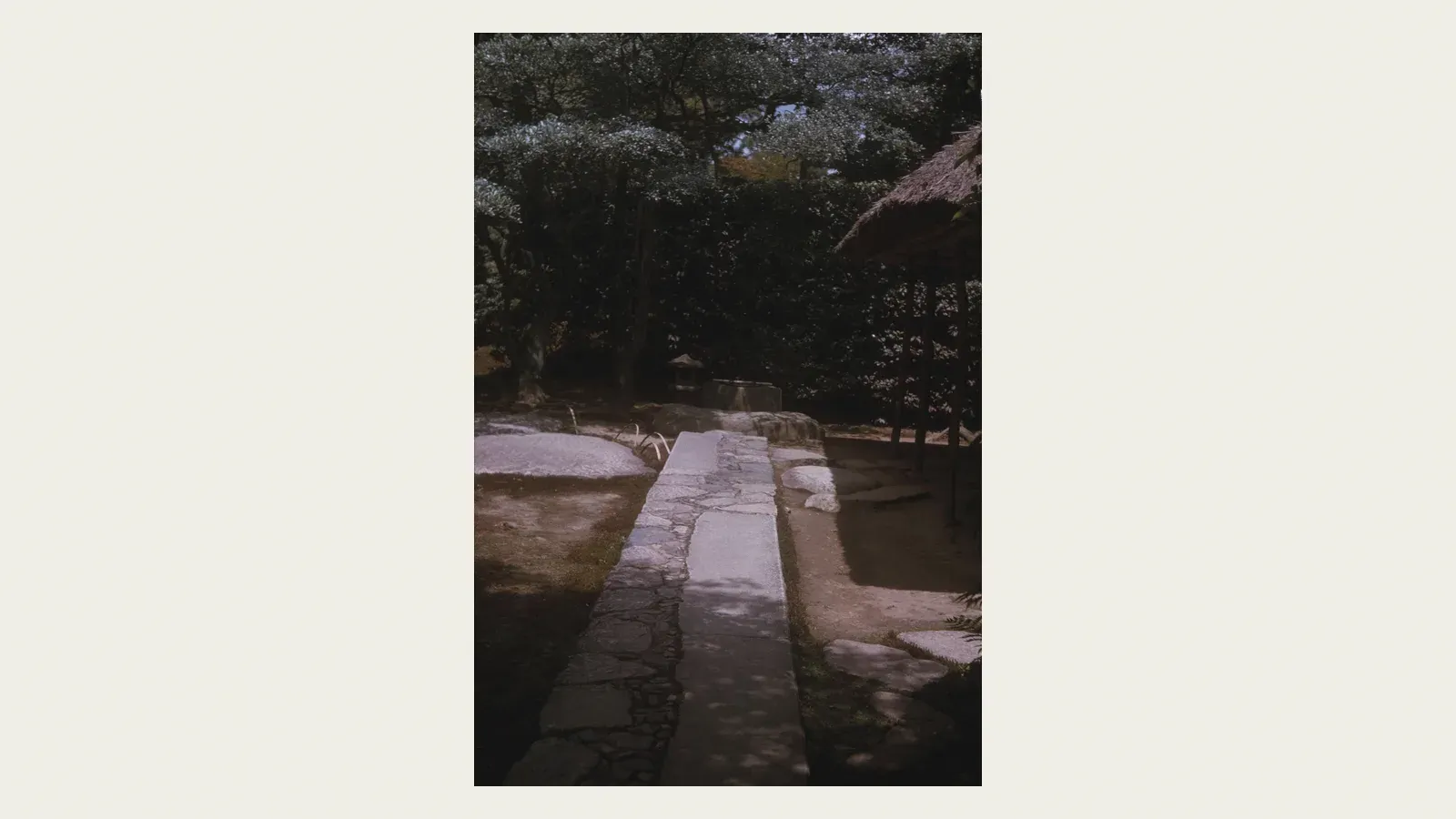
The roji (露地, “dewy ground”) is the garden path to the tea room. You walk it rather than admire it: stepping stones set the pace and pull the eyes down, a middle gate splits the way into an outer and an inner garden, and a low basin makes every guest crouch to rinse. By the time it reaches the tea-room door, the path has already done tea’s first work on the body.
Most Japanese gardens are made to be looked at. You sit on a veranda, the composition arranges itself into a picture, and you take it in from one fixed point. A roji works the other way around. You rarely see it whole. You see the next stone, then the one past it, a basin you have to bend over, a gate low enough to make you stoop. It is a garden read by the feet and the knees before the eyes, a thing built to be crossed. And by the time it delivers a guest to the tea-room door, it has already begun doing what tea does.
What the roji is
The roji is the strip of garden between the entrance gate and the chashitsu, the tea room.2 It took its recognizable form in the Momoyama era (1573–1603), as chanoyu settled into the spare, rustic style its practitioners were shaping — tea in the spirit of wabi, an unforced and slightly austere beauty. Before then the ground had a plainer name. In the generation of Takeno Jōō, Rikyū’s own teacher, the space outside the tea room was called tsubo-no-uchi, the enclosure. It became the roji during Sen no Rikyū’s lifetime, once the crouching basin, the stepping stones, and the rest of the vocabulary took their settled shape.4
Institutions describe the roji as a transition between the outside world and the seclusion of the ceremony, and the word “transition” invites more incense than the thing deserves, so it helps to say concretely what the transition is made of. The garden hands the body a run of small, exact tasks. Mind the gap between two stones. Stoop through the gate. Crouch at the basin. Sit on the bench and wait until you are called. Each task takes just enough attention to crowd out whatever a guest walked in carrying. The calm a roji produces is the residue of those tasks, not a mood anyone is asked to summon.
The dewy ground and the burning house
“Dewy ground” is the standard reading of roji, and the history behind it is easy to overstate, so here it is in order. The everyday word is roji (路地), a lane or an alley between buildings. Tea spells it with a different pair of characters, roji (露地), literally “dewy ground,” and hangs a Buddhist reading on the change. The image is from the Lotus Sutra, from the parable in its third chapter — children coaxed out of a burning house who reach open, dewy ground beyond the flames and take their seats there, safe.3 The scholar A.L. Sadler credited Rikyū with choosing the dewy-ground spelling for exactly that sense: the roji as the cleared, bare ground you stand on once you are out of the burning house of ordinary life.2
Two caveats travel with that, and they matter. The 露地 spelling and its Lotus Sutra gloss are first recorded in the Nanpōroku, an Edo-period account of Rikyū’s teaching transcribed roughly a century after his death, and scholars have long argued over how faithfully it reports him.3 No note in Rikyū’s own hand assigns the sutra to the garden. Read the etymology as the tradition’s considered account of itself, handed down and likely refined after the fact, rather than a line the master set down. It stays exact about what the garden does, whoever first thought to say so.
Outer and inner: the two-part garden
A developed roji comes in two parts. A low middle gate, the chūmon (中門), divides it into a nijūroji, a double garden: the soto-roji (外露地), the outer garden, and the uchi-roji (内露地), the inner one.1 The double form arrived after the single strip, and a few large gardens add a third, intermediate section between the two.4
The two halves are pitched against each other. The outer roji, where guests first arrive, runs more open and more formal — predominantly evergreen, with tightly clipped shrubs and room to gather.5 It holds the koshikake machiai (腰掛待合), a plain roofed bench where guests sit and wait to be received.3 Past the gate, the inner roji closes in: a tree canopy overhead, shrubs left in their natural shape, the tea house standing near at the end of it.5
The gate is the hinge of the whole design. When the host has finished preparing, he walks out to the chūmon and greets the waiting guests there, often without a word — a bow exchanged across the gate, and the guests rise and come through. Passing the low gate is the moment a guest leaves the outer world on the far side of it. And because the gate is built small, going through it means bending, a slight physical submission the architecture asks for so the host does not have to.
The elements
Set the vocabulary of a roji in a list and it is short. Every item earns its keep by function first, and whatever beauty it carries is what is left over once the job is done.
| Element | Japanese | What it is | What it does |
|---|---|---|---|
| Outer / inner garden | soto-roji 外露地 / uchi-roji 内露地 | The two halves of a developed roji | Stages the approach, open and formal outside to close and wild within |
| Middle gate | chūmon 中門 | Low gate dividing the two gardens | Marks the crossing, where the host greets guests, and forces a stoop |
| Waiting bench | koshikake machiai 腰掛待合 | Roofed bench in the outer roji | Holds guests until the host calls them forward |
| Stepping stones | tobi-ishi 飛び石 | Irregular stones set in moss | Meter the pace, pull the gaze down, fix each footfall |
| Water basin | tsukubai 蹲踞 | Low stone basin with a bamboo dipper | Makes every guest crouch to rinse hands and mouth |
| Stone lantern | ishi-dōrō 石灯籠 | Stone lantern by the path and basin | Lights the footing and the basin at dusk |
| Planting | moss, shida, tokiwagi | Moss, ferns, evergreens | Reads as a mountain track, and defers to the flower indoors |
Stepping stones (tobi-ishi)
The path is laid in tobi-ishi (飛び石), “flying stones” — irregular stones set into mossy ground with gaps between them.2 They are not run in a straight, even line. They are spaced and angled so that walking them takes attention. You look down, you place each foot, you cannot stride and you cannot let your mind wander off the ground.
Here the garden governs two things at once, your pace and your gaze. The spacing of the stones sets the rhythm of your steps, which fixes the speed at which you cross the garden, and it is a slow speed. The height and tilt of each stone pull your eyes downward, which hands the host control of what you see and when. The NAJGA study of the tea garden records a maxim credited to Rikyū for laying such a path: passage six parts, landscape four parts — the stones should be six parts practical footing to four parts beauty.1 Footing leads. A stone that looks handsome and lands wrong under the foot is a failed stone.
Of everything in a roji, the stepping stones are the piece most people walk straight past and the piece that does the most exact work. A lantern is easy to admire and a basin is easy to remember. The stones are the part that quietly rewrites how you move, and almost no one notices them doing it.
The water basin (tsukubai)
The tsukubai (蹲踞) is a low stone water basin set near the tea house, in the inner roji. Its name comes from tsukubau, the verb for crouching or bowing down, and the name is the instruction.7 The basin sits close to the ground, so a guest has to fold down low to reach it. Using a bamboo dipper, you rinse the hands and then the mouth — a plain wash, and the last act before the door.5 The basin rarely stands alone. A guest steps onto a front stone, the mae-ishi, to reach it, and the arrangement often sets a stone for a hot-water pail on one side and a stone for a hand-candlestick on the other, for use in winter and after dark.7
This is the roji’s most concentrated gesture. The rinsing is purification in the literal sense, water over hands and mouth in order, and it carries sei, purity, one of the four principles of the gathering, wa-kei-sei-jaku. The two readings hold together honestly. The hands and mouth are being made clean, and the crouch lowers a person, prince or merchant alike, to the same posture at the same low stone. The figurative meaning rides on the physical one and needs no talking up beyond it.
There is a much-repeated illustration of how precisely Rikyū worked this moment. At his teahouse in Sakai, which looked out on the Inland Sea, he is said to have planted a hedge that hid the water along the entire path, so that only when a guest bent low at the basin did a sliver of sea appear, framed beneath the hedge.2 The view was the reward for stooping. Whether the story is strict history or partly legend, it is exact about the method: the host decides what you see, and makes you lower yourself to see it.
The stone lantern (ishi-dōrō)
The ishi-dōrō (石灯籠) is a stone lantern, set along the path and usually near the basin. Its first job is light. Gatherings often run to dusk or into the dark, and the lantern shows the footing and the basin where a guest has to crouch, which is hard to do blind.3 The light is meant to be modest — enough to find the next stone, short of flooding the garden. Like everything else on the path, the lantern earns its spot by use before it earns it by looks.
The planting
The planting is kept deliberately low. Showy, flowering plants are avoided in favor of moss, ferns, and evergreens, with the occasional restrained maple or ume.2 The dominant note is green and brown and damp — a mountain track rather than a cultivated bed. The tradition even keeps out species associated with the ordinary village, so the roji reads as somewhere apart.3
There is a working reason for the restraint, beyond taste. Rikyū discouraged bright or exotic blooms on the path because they would compete with the single flower arranged in the tokonoma (床の間), the alcove inside the room — the chabana.1 The garden is held quiet so the one bloom waiting indoors lands with full weight. Nothing on the way is allowed to upstage what the way is leading to.
Uchimizu: the wet path
Just before guests arrive, the host wets the path. This is uchimizu (打ち水), sprinkling water over the stones and the ground, and it is more than housekeeping. In tea, once the host has finished every preparation, he sprinkles water at the entrance, and a guest who reaches a wet path reads it as the signal that the room is ready and they are expected.6 The glistening ground is a message sent without a word.
Inside a formal gathering, the wetting follows a fixed rhythm, a set of three sprinklings called sanro. The first, hatsumizu, goes down before the guests come. A middle water, nakamizu, freshens the path during the intermission. A last, tachimizu, wets it again as they leave.6 The practice reaches back to the Sengoku and Momoyama periods as a courtesy to guests, and it doubles as purification, a Shinto habit of cleansing a place with water.6 It also does the plainest thing of all. It makes the “dewy ground” the name promises. For a few minutes at dusk, with the lantern lit and the stones dark and shining, the etymology stops being a metaphor and the path is exactly what it is called.
The decompression corridor
Set the elements in sequence and the roji reads as a single, deliberate descent. Guests reach the outer roji and sit on the koshikake machiai, still half in the day they came from. At the host’s signal they rise, pass the low chūmon, and the street is on the far side of the gate. The inner roji tightens — narrower, mossier, darker under the canopy. The stepping stones meter every footstep and bend the eyes to the ground. At the basin the guest crouches lowest of all, rinses hands and mouth, and stands up clean. A few stones further and the door is there.
By then the work the roji exists to do is mostly finished. The slowing has happened in the legs, the narrowing in the eyes, the rinsing at the stone. What waits at the end is the nijiriguchi, the crawl-through door barely sixty-six centimeters square that makes a guest kneel and bow to enter — the threshold that finishes the job inside the room. But the door meets a guest the garden has already reset. If you ever set out to receive guests yourself, even a simple gathering at home, the roji is the part you can borrow without an acre of moss: a slow approach, a place to wait, water to rinse, and a few paces that ask the arriving guest to shed some speed at the door.
Rikyū’s hand in it
Much of the roji’s spareness traces to Sen no Rikyū (千利休, 1522–1591), the tea master who codified the wabi aesthetic and was later forced by Toyotomi Hideyoshi to commit seppuku. Rikyū did not invent the tea garden. He is credited with paring it toward the austere, mountain-track character it has carried since — and with fixing the crouching basin and the stepping-stone path as the settled parts of it.4 The six-to-four rule, the hedge at Sakai, the ban on flowers that would rival the alcove bloom: these are the moves of someone subtracting until only the working parts are left.
Okakura Kakuzō, writing in 1906, gave the corridor its clearest short account.
The roji was intended to break connection with the outside world, and produce a fresh sensation conducive to the full enjoyment of aestheticism in the tea-room itself.
That is the through-line from the garden to everything past the door. The roji is the host’s first argument, made before a word is spoken or a bowl is whisked: slow down, lower yourself, watch where your feet are. And the argument closes with a trick of timing. The host wets the stones at the last moment, so that the guest who steps onto them finds a path wet and shining — the name made briefly, literally true, right at the point the garden hands them over to the room.
Sources
8sourcesNorth American Japanese Garden Association (NAJGA), "Chapter 7: The Tea Garden"
SupportsRoji as transitional space between secular world and chanoyu; nijūroji two-part layout with chūmon dividing sotoroji/uchiroji; Rikyū's 'passage six parts, landscape four parts' maxim; planting restraint so the garden does not compete with the tokonoma flower; tsukubai
Wikipedia, "Roji"
Supports露地 'dewy ground'; alt etymology 路地 'alleyway' (Marc Keane); Lotus Sutra source and A.L. Sadler crediting Rikyū's choice of the word; Momoyama-era (1573–1603) development; tobi-ishi, tsukubai, tōrō, wicket gate; moss/fern/evergreen planting; Rikyū's Sakai hedge concealing the Inland Sea, revealed at the basin
Japanese Wiki Corpus, "Roji (the garden outside a ceremonial tea room)"
SupportsTerm derives from the Lotus Sutra's Hiyuhon (third chapter, Simile and Parable); the 露地 character form appears in the Edo-period Nanpōroku, originally written 路地; ishi-dōrō stone lantern added as light for evening tea; koshikake-machiai bench; tsukubai replaced the chōzubachi; naturalness in planting
Nara National Research Institute for Cultural Properties, "Tea Garden (roji)"
SupportsSpace called tsubo-no-uchi in Takeno Jōō's time, came to be known as roji in Sen Rikyū's time when the crouching basin and stepping stones developed; the double (inner/outer) and triple tea garden appeared later
University of Illinois, Japan House — "Tea Garden"
SupportsSoto-roji (outer, formal, evergreen, open) contrasted with uchi-roji (inner, tree canopy, natural shapes); transition at the gate and hedge; tsukubai rinse of hands and sip; koshikake waiting bench; roji as 'the dewy path to spiritual enlightenment'; Rikyū as developer
Japanese Wiki Corpus, "Uchimizu"
SupportsHost sprinkles water at the entrance once preparations are complete, so guests seeing the wet ground know they are expected; in sadō, uchimizu done regardless of season as sanro (three waterings): hatsumizu, nakamizu, tachimizu; purification implication; a courtesy from the Sengoku/Azuchi-Momoyama period
Wikipedia, "Tsukubai"
SupportsName from the verb tsukubau, 'to crouch' / 'to bow down'; ritual rinse of hands and mouth; the crouch as a gesture of humility before entering; bamboo dipper; placement in the tea garden
Okakura Kakuzō, The Book of Tea (1906), Project Gutenberg
SupportsChapter IV, 'The Tea-Room': the roji as the garden path from the machiai to the tea-room, 'the first stage of meditation'; 'intended to break connection with the outside world'; twilight of evergreens, stepping stones over dried pine needles, moss-covered granite lanterns; public domain
Image: Carlquist, Sherwin John, 1930-2021, Wikimedia Commons · CC BY 4.0
Common questions
Do I need a big garden to have a roji?
No. The roji is a short sequence of actions more than an acreage — slow down, stoop, crouch, rinse, wait. The historical wabi roji were often narrow urban strips squeezed between city buildings. A few stepping stones set slightly awkwardly, a low basin you have to bend to, and a couple of paces of moss and evergreen between a gate and a door reproduce most of what the design does. It is the walking that matters, not the size of the garden.
Why do you crouch at the water basin?
The basin is called a tsukubai (蹲踞), from tsukubau, to crouch or bow down. It is set low to the ground on purpose, so a guest has to bend down to reach the water and rinse the hands and then the mouth with a bamboo dipper. The crouch is doing two things at once: a literal wash, and a posture that puts a daimyō and a merchant on the same low knees at the same low stone. The humility is built into the height of the basin, not asked for in words.
What is planted in a roji, and why no flowers?
Moss, ferns, and evergreens, with the odd restrained maple or ume — greens and browns and damp, the suggestion of a mountain track. Showy, flowering plants are kept out on purpose. Rikyū discouraged blooms in the garden because they would compete with the single flower waiting in the alcove inside the tea room, the chabana. The path is kept quiet so the one arrangement indoors lands with full force.