The Way
Wa-Kei-Sei-Jaku: The Four Principles of Tea
Harmony, respect, purity, tranquility — the four principles at the heart of chadō, what each asks of host and guest, and why jaku is a result.
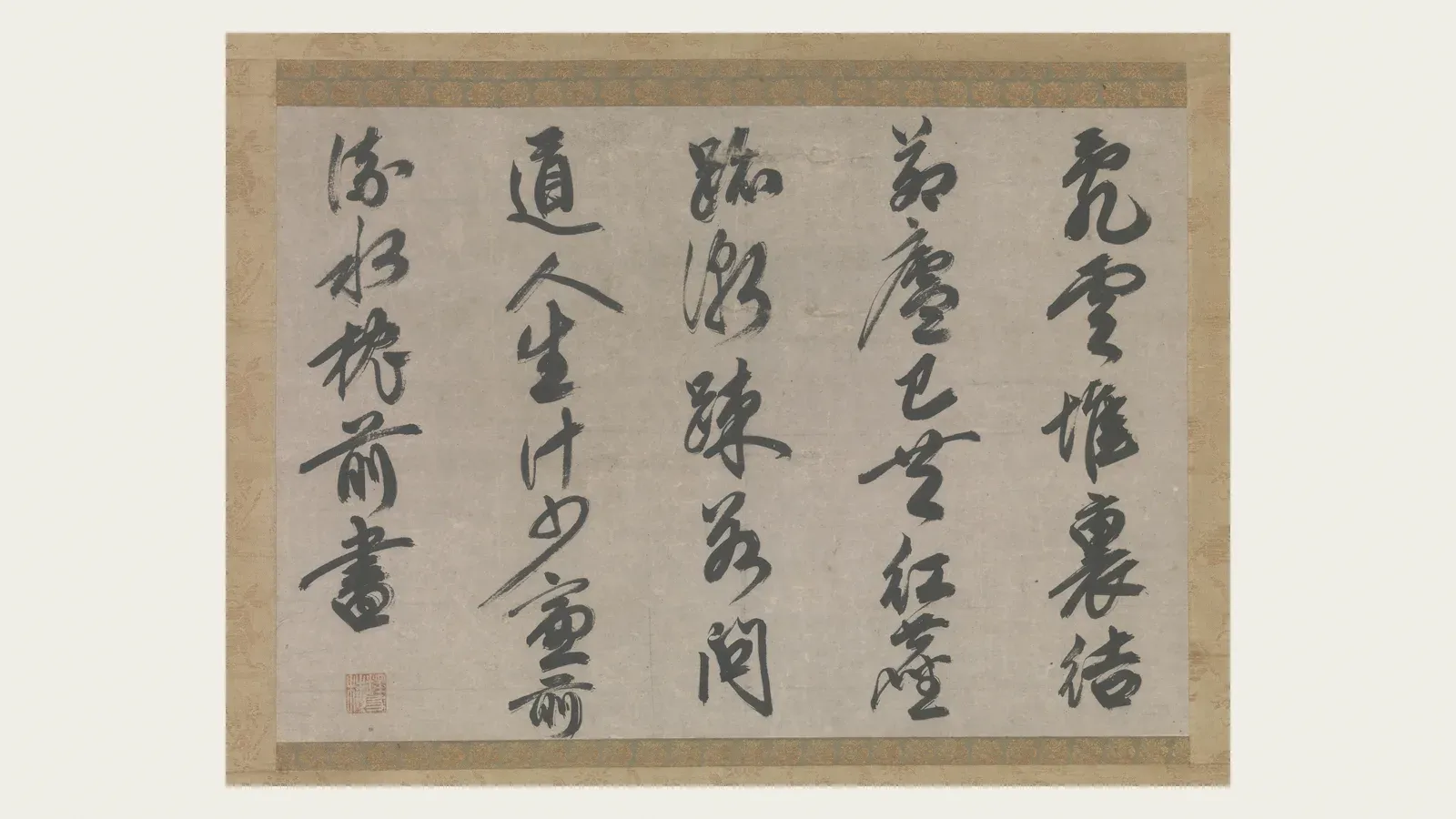
Wa-kei-sei-jaku (和敬清寂) — harmony, respect, purity, tranquility — is the ethic of a tea gathering taught by Urasenke. Tranquility is not a fourth task but what the first three produce.
Four characters hang in a great many tea rooms, brushed on a scroll in the tokonoma (床の間) where the guests see them first: 和 敬 清 寂. Wa, kei, sei, jaku. Harmony, respect, purity, tranquility. Urasenke (裏千家), the largest of the tea schools, sets these four characters at the head of its own account of chadō (茶道) and names them the four principles.1 The tradition traces them to Sen no Rikyū (千利休, 1522–1591), the tea master who shaped the practice into the form still followed today.2
They are easy to recite and easy to mistake for a mood board. Read them as atmosphere and they dissolve into the soft, uplifting language tea attracts. Read them as instructions — what the host does with both hands, how a guest lifts a bowl, whether the garden path was swept before dawn — and they hold their shape. That is the argument of this whole essay: the four principles mean something only when you read them as things to do.
One matter of record before the principles themselves, because this site cares about being right. Urasenke teaches the four characters as Rikyū’s, and that is the living tradition.2 The documentary record is thinner. The phrase appears in no material compiled during Rikyū’s lifetime, and one study (Machida, 2004) traces its formulation instead to Daishin Gitō (大心義統, 1657–1730), an abbot of Daitoku-ji (大徳寺), the Rinzai Zen temple bound to the Sen family for generations.4 The teaching sits at the centre of chadō. Its exact authorship does not. Both hold at once, the same double truth that shadows most of what gets hung on Rikyū’s name, from his life to the four principles here.
Recited straight through, the four run from the outside of a gathering inward:
| Kanji | Romaji | Principle | Where it shows in the room |
|---|---|---|---|
| 和 | wa | Harmony | Utensils chosen so none clashes; the whole gathering matched to the season |
| 敬 | kei | Respect | The bow at the crawl-through door; the bowl set down and received with both hands |
| 清 | sei | Purity | The swept and watered garden path; caddy, scoop, and bowl wiped in plain sight |
| 寂 | jaku | Tranquility | The stillness left once the first three are done — a result, not a task |
Wa 和 — harmony
Harmony is the easiest word to wave at and the hardest to arrange. In a tea gathering it is concrete, and it pulls in several directions at once.
Between the people, first. The host usually chooses the guests, knows roughly who they are, and seats them in an order. The room is small — four and a half mats is the classic size, about three square metres — and conversation stays within what that space can hold. There is nowhere for a jarring remark to go.
With the season, which the host builds by hand. The cold months use the sunken hearth (ro, 炉), cut into the floor so the fire sits close to the guests. The warm months use the portable brazier (furo, 風炉), which moves the fire away from them. Sweets, flowers, the hanging scroll, the design painted on a bowl are all matched to the time of year. The host reads the day, and the guests read the host’s reading of it.
And among the objects. A host assembles bowl, caddy, scoop, and kettle so the rough sits beside the fine without either one losing. Harmony here means difference arranged to sit together. Get it right and no single piece shouts. The tableful of things becomes one thing.
Kei 敬 — respect
Respect in chadō lives in physical actions you can watch happen.
It starts at the door. In a wabi tea house the guests’ entrance, the nijiriguchi (躙口), is a sliding panel barely more than two feet square. You kneel and crawl through it. A long sword will not fit, and historically did not, so it stayed on a rack outside. Everyone comes in the same way, bent low, on the same level, whatever rank they hold beyond the wall. The architecture levels the room so the people don’t have to.
It is in the bowl. The host sets it down with both hands, its decorated front turned to face the guest. The guest takes it with both hands, bows, and rotates it a couple of times before drinking, turning that front aside rather than setting their lips to the face the host offered. At a gathering with more than one guest, they first raise the bowl a little in thanks and murmur an apology to the person beside them for drinking ahead of them. A wipe of the rim, and it passes on. Each gesture is small, and each is a piece of regard made visible.
It reaches the things, too. The cheap caddy and the named, centuries-old one are lifted the same way and set down without a sound. Handling a humble object as though it deserved attention is the discipline — and, not by accident, how you keep from breaking the costly one. The regard and the care are the same motion.
Sei 清 — purity
Sei is where loose tea writing reaches fastest for “purity of heart.” Start instead with the floor, the basin, and the cloth, because that is where the principle actually lives.
Purity in a gathering is, first, cleaning you could photograph. Before the guests arrive the host sweeps the roji (露地), the garden path to the tea house, then sprinkles it with water so it reads as dewy and freshly kept. A low stone basin, the tsukubai (蹲踞), waits near the entrance. Guests crouch to rinse their hands and mouth before going in, the way one purifies at a shrine gate. Okakura describes a host sweeping until “not a particle of dust” is left, and then shaking a tree so a few leaves drift back down onto the cleared path, because bare perfection would be its own kind of boasting.7 Clean, and not sterile.
Inside, the cleaning goes on in full view. During the procedure (temae, 点前) the host wipes the tea caddy and the scoop with a folded silk cloth, the fukusa (袱紗), and rinses and wipes the bowl and the whisk while everyone watches. The cloth, the bowl, and the whisk are being made clean, in order, with nowhere to hurry to. The attention has somewhere concrete to go, and the room follows it there.
The inner reading of sei — a mind not scattered across a dozen things — follows the outer one. You clean the room, and the cleaning quiets you. The tradition asks you to wipe the bowl properly, and trusts the rest to follow.
Jaku 寂 — tranquility
Here is where most explanations go wrong, and it is the hinge of the whole phrase. Jaku is the state the first three produce. The fourth character names a result, not a fourth task.
Urasenke and the other schools teach it plainly: where harmony, respect, and purity are present, tranquility arises on its own.5 It is what is left in the room once the work is done — the host’s preparation finished, the guests settled, nothing more to adjust. You reach jaku by arranging the harmony, performing the respect, and doing the cleaning, the way silence is what remains when the noise stops. Aim at it directly, dimming the lights and lowering your voice and willing a mood into the room, and you have misread the grammar of the phrase. Tranquility gets earned. It cannot be set out like an utensil.
This is why the order of the four characters carries the meaning and is not a matter of euphony. They are three actions and their consequence. My own view is that this is the single most-missed thing about wa-kei-sei-jaku: recited as four equal virtues, it loses the one structural fact that lifts it above a list of nice words.
The character 寂 carries a Buddhist weight. In Zen it points toward stillness, the quieting of disturbance — a near neighbour of the sabi in wabi-sabi, which is one reason the two phrases get tangled. That knot gets cut below.
How the four fit together
Read straight through, the principles describe one gathering from the outside in. Wa is the arrangement: people, season, and objects set to belong together. Kei is the conduct inside that arrangement: the bows, the handling, the turned bowl. Sei is the condition under both: the swept path, the wiped utensils, the cleared attention that lets harmony and respect be real rather than staged. And jaku is what you hold when those three are true — a room quiet because there is nothing left to fix.
This is why the four are usually taught alongside the seven rules, the two together forming the shiki shichisoku (四規七則), “four principles, seven rules.” The four are the ethic. The seven are how it reaches a host’s hands. Rikyū’s seven, in their traditional wording:6
| # | Rule | What it asks |
|---|---|---|
| 1 | Make a satisfying bowl of tea | Get the tea itself right; everything downstream serves it |
| 2 | Lay the charcoal so the water boils well | Build the fire for its work, not for show |
| 3 | Arrange the flowers as they stand in the field | Suggest the natural; don’t compose a bouquet |
| 4 | In summer suggest coolness, in winter warmth | Read the season and answer it |
| 5 | Be ready ahead of time | Finish preparing before the guests arrive |
| 6 | Be prepared in case it rains | Anticipate; carry the spare umbrella |
| 7 | Give your whole attention to the guests | The room is shared; tend to everyone in it |
A guest once asked Rikyū for the secret of tea, the story goes, and got these seven flat instructions. Told that he already knew all that, Rikyū answered that anyone who could carry them out without fail, every time, would become his teacher.6 The rules are obvious. Performing them, gathering after gathering, is the whole of the practice. The four principles work the same way: quick to state, a lifetime to keep.
The seven map back onto the four without much forcing. Rules five and six — be ready early, be ready for rain — are sei made practical, the preparation that clears friction out of the day before a guest ever sees it. Rule four, coolness in summer and warmth in winter, is wa, the gathering tuned to its season. Rule seven, whole attention to the guests, is kei in a single line. And rule one, a satisfying bowl of tea, is the thing the other six exist to serve. Get everything else right and hand over a poor bowl, and the gathering has failed at its one job. The seven never legislate jaku, and that silence is exact: jaku is the weather that settles over a room where the other six were kept. You can watch all four run at once inside a single temae, the choreographed sequence of laying the fire, cleaning the utensils, and serving the tea.
How Urasenke teaches it
Urasenke is the largest of the three Sen schools that descend from Rikyū’s grandson Sen Sōtan, and it puts the four principles at the front of a student’s path.3 They head the school’s own introduction to the practice, ahead of any instruction in how to fold the cloth or whisk the tea.1 The teaching passes down through the iemoto system, a single grand master heading the line from the Konnichian in Kyoto, so the four characters reach a beginner in Kyoto and a student in San Francisco in the same order and with the same weight.
The order also has a source the schools name openly: cha-zen ichimi (茶禅一味), “tea and Zen, one taste.” The four principles carry the register of the meditation hall into the tea room, quiet and attentive and stripped of surplus. It fits that when the phrase was finally fixed on paper, the hand belonged to a Daitoku-ji abbot rather than a tea master. The Sen family’s training ran through that Rinzai temple, and the principles read as Zen practice arranged around a bowl of tea. That is the neighbourhood of ichigo-ichie too, the insistence that the gathering in front of you is the only one that will ever happen in exactly this way.
None of it is meant to stay in the tea room. The principles are taught as a way of moving through ordinary rooms — how you treat a shared kitchen, a guest, an object you would rather rush past — which is the subject of bringing wa-kei-sei-jaku into everyday life. The plainest test of whether you have understood them is to host a small gathering yourself: sweep the path, choose the bowls so they sit together, be ready before anyone knocks, and watch whether the quiet arrives on its own.
Why this is not wabi-sabi
Wa-kei-sei-jaku gets fused with wabi-sabi constantly, and the confusion does real damage, because the two are different kinds of thing.
Wa-kei-sei-jaku is an ethic — a code of conduct for a gathering. It governs how people act toward one another and toward the objects in the room: how the host prepares, how the guests receive, how everything is cleaned and set. It is about action.
Wabi-sabi is an aesthetic — a sensibility about how things should look and what kind of beauty is worth valuing. Wabi is the beauty of the austere, the restrained, the humble. Sabi is the beauty of age, wear, and the marks of time. It is about taste.
The two work together in a tea room without being the same. Wabi-sabi guides the what: the unglazed bowl, the rough-walled room, the single seasonal flower, the mended crack left in view. Wa-kei-sei-jaku guides the how: the way that bowl is offered, the silence in which the flower is noticed, the care that swept the room. A gathering can be wabi in its objects and empty in its conduct, or plain in its wares and exact in its manners. This is the one place where the distinction is worth stating by contradiction, because the error is that common: the principles are not an aesthetic, and a practitioner who treats them as one has lost the use of both.
The tangle starts at the shared character. The jaku of the four principles and the sabi of wabi-sabi are written with the same kanji, 寂, and both point at quietness. One names a result you reach through conduct. The other names a quality you find in worn and humble things. Same character, two jobs.
Which returns to the order the four are always written in. Recite wa-kei-sei-jaku as four virtues and you can admire it on a scroll and carry nothing away. Read it as a sequence — arrange, conduct, cleanse, and then, only then, the stillness — and it turns from a slogan into a set of instructions you could follow this afternoon. The scroll in the tokonoma isn’t naming four things to feel. It is naming three things to do, and one thing that happens to you if you do them well.
Sources
7sourcesUrasenke Konnichian (official English site), 'An Introduction to Chado'
SupportsUrasenke's own statement that the principles underlying the art are Harmony, Respect, Purity, and Tranquility; the four head the school's introduction to chadō
Urasenke Tankokai San Diego Association
SupportsUrasenke statement that Rikyū introduced the four principles wa, kei, sei, jaku; lineage to the current headmaster
Japan House, University of Illinois (Urasenke-affiliated)
SupportsUrasenke as the largest chadō tradition; four precepts; Rikyū 1522–1591; descent from Sen Sōtan
Japanese Wiki Corpus, 'Wakei Seijaku'
SupportsScholarly caveat: phrase not in credible material contemporaneous with Rikyū; Machida (2004) attributes it to Daishin Gitō (1657–1730), 273rd chief priest of Daitoku-ji; correct kanji 和敬清寂
Path of Cha, 'Four Principles of Japanese Tea Practice (Chado)'
SupportsJaku taught as what arises when wa, kei, and sei are in place, rather than a goal pursued directly; concrete glosses of each principle
Tea Ceremony Japan Experiences MAIKOYA, 'Rikyū's Seven Precepts'
SupportsJapanese text and English of the seven rules (shichisoku); the story of the guest who found them too simple
Okakura Kakuzō, The Book of Tea (1906), Project Gutenberg
SupportsTeaism as an ethic of conduct; the swept-and-scattered garden path anecdote; tea-room cleanliness; public domain
Common questions
Is wa-kei-sei-jaku the same as wabi-sabi?
No. Wa-kei-sei-jaku is an ethic — a code of conduct for a tea gathering (harmony, respect, purity, tranquility). Wabi-sabi is an aesthetic — a sensibility about beauty in the austere and the aged. They share the character 寂 (jaku / sabi), and both point at quietness, but they answer different questions: how to act versus what to find beautiful.
Did Sen no Rikyū really create the four principles?
The tea schools teach the four characters as Rikyū's, and that is the living tradition. The phrase appears in no material compiled during his lifetime; one study (Machida, 2004) attributes its formulation to Daishin Gitō (1657–1730), an abbot of Daitoku-ji. The teaching is central to chadō even though its exact authorship is unsettled.
Why is tranquility (jaku) listed last?
Because it is a result, not a task. Harmony, respect, and purity are things the host and guests actively do; tranquility is what arises in the room once those three are present. You reach jaku by arranging the other three, not by pursuing it directly.