The Aesthetic
Chabana & Kakemono: Flowers and Scrolls in the Tea Room
The hanging scroll is the tea room's most important object, chosen and read first. A single seasonal flower answers it. Why chabana is not ikebana.
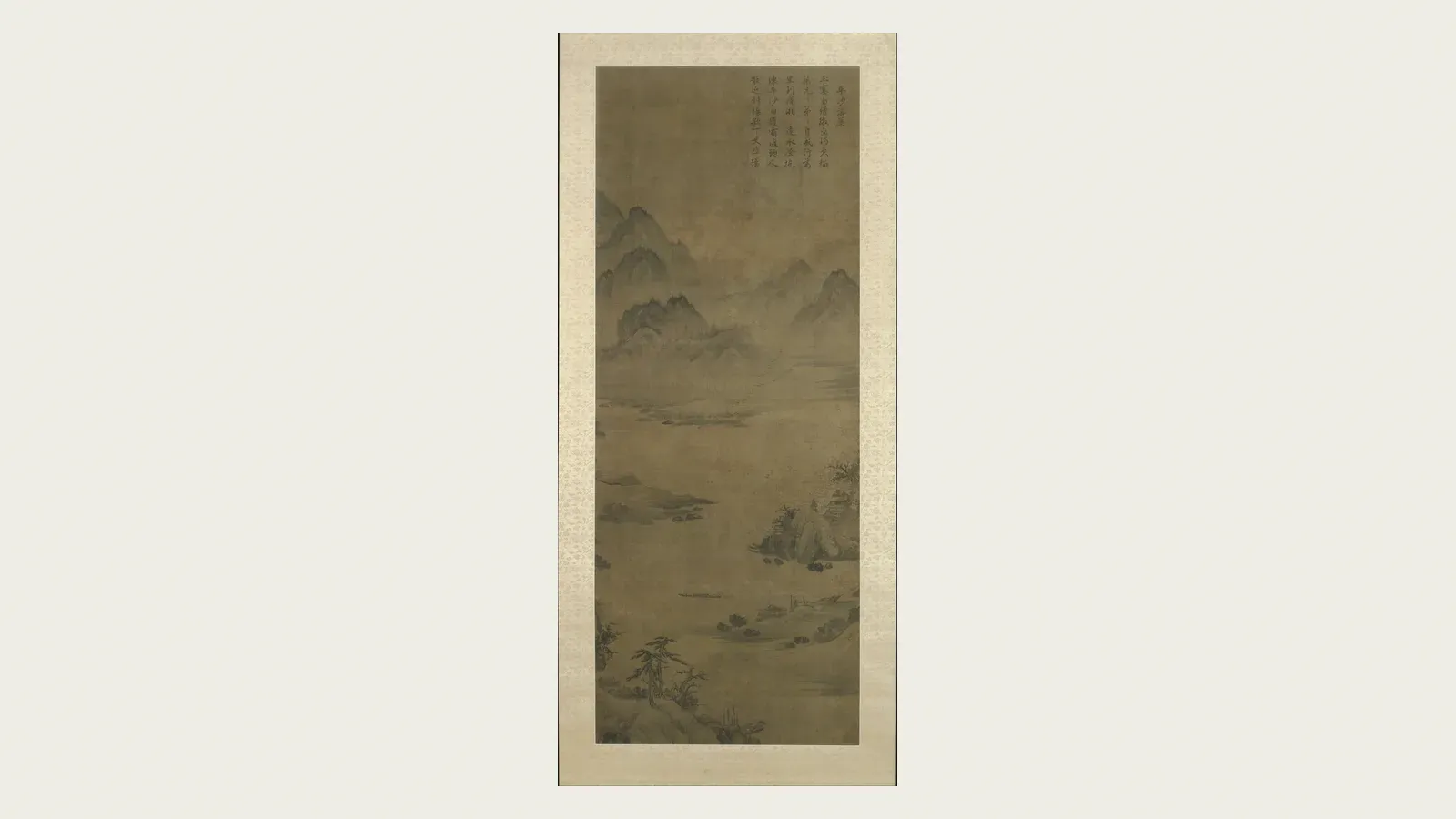
In the tokonoma alcove, the kakemono (hanging scroll) is chosen first and read first — it is treated as the most important object in the room and sets the theme of the gathering. The chabana, a few seasonal stems placed as if still growing in a field, answers it. Chabana is not ikebana: it strips away the formal art rather than performing it.
A guest at a tea gathering does the same thing on the way in, every time, before the kettle is heard or a bowl is seen. They cross to the tokonoma (床の間), the shallow raised alcove at the head of the room, kneel, and look. Two things wait there: a scroll above, a flower below. The host settled both before deciding anything else, and a guest reads them in a fixed order, scroll before flower. This is where the host states what the morning is about, in ink and in a cut stem, without saying it aloud.
The rest of the room gives the eye almost nothing. The wabi tea room is bare clay, raw wood, and diffused daylight, built so that the few objects present carry the whole visual weight of the afternoon. The alcove is the one composed thing in it, and it is changed for every gathering. So the two objects hanging and standing there are not incidental to the room. They are the reason a guest looks up on entering, and the first courtesy of the day is to read them.
The kakemono is chosen first
The kakemono or kakejiku (掛物 / 掛軸) is a hanging scroll: a length of paper or silk, painted or brushed on, mounted with a fabric border and weighted with a wooden roller so it hangs flat and rolls away for storage. In a tea gathering it occupies the tokonoma, and by long convention it is the single most valued object in the room.3 Everything else is chosen to serve it.
That primacy is usually traced to a line in the Nanpōroku (南方録), a record of Sen no Rikyū’s (千利休, 1522–1591) teaching, holding that no implement matters more than the kakemono. The sentiment sits at the center of how tea is taught. The source needs a caveat. The Nanpōroku surfaced roughly a century after Rikyū’s death, transcribed by Tachibana Jitsuzan in 1686, and scholars treat parts of it as later embellishment or outright forgery — the scroll-above-all emphasis among the passages in question, since tea in Rikyū’s own day arguably prized the tea container as highly.2 The scroll’s supremacy is doctrine, deeply held and consistently practiced, rather than a verbatim instruction in Rikyū’s hand.
What the scroll does is concrete. When a host plans a gathering, the scroll is the first thing decided, and the flower, the bowl, the sweets, and the food are then assembled to agree with it. A phrase suited to early summer, or to a guest’s circumstances, or to the weather that morning, tunes the whole event before a bowl of tea is whisked. Guests kneeling before it are expected to read it and take its meaning. Of everything in the room, the scroll is the one object the host asks you to interpret.
The most prized scrolls are bokuseki (墨跡, “ink traces”), calligraphy brushed by a Zen monk. These were venerated less as art than as residue of the person: a line by a respected abbot was received as an embodiment of his standing, and the historically most valued were carried back from China by Japanese pilgrims.4 Murata Jukō (村田珠光, 1423–1502), the early wabi-tea figure, is traditionally credited with first hanging Zen calligraphy in the tea space, binding tea to Zen in a way Rikyū would later make definitive. Often the scroll is a single vertical line, an ichigyō-mono (一行物) of a few characters a guest can sit with for the length of a gathering. Not every scroll is calligraphy. Some carry a seasonal painting, some a few lines of poetry, and the writing itself need not be legible to a casual reader, because part of what is on display is the movement of the brush — fast or slow, wet or dry, confident or halting. How to read that calligraphy, and what the recurring phrases mean, are their own subjects: start with how to read the tea scroll, then the one-line Zen phrases themselves. Here the interest is the scroll’s role, not the reading of it.
The chabana is a flower, not an arrangement
Below the scroll, or later in its place, sits the chabana (茶花, literally “tea flowers”): the flowers of the tea room. The word covers any flower arranged for a gathering. The thing itself is specific and easy to misread. It is usually a single stem, or a small number of stems, in a plain vase of bamboo, unglazed pottery, bronze, or basketry. A white camellia in deep winter. One morning glory. A branch carrying two leaves and a single bud.
The governing instruction is Rikyū’s. The first of the seven precepts attributed to him concerns flowers, and the usual rendering runs: arrange the flowers as they are in the field.1 What the precept asks for is the appearance of no arrangement at all, a flower that looks as though it were carried in from a meadow or a hedgerow and set down, its natural form undistorted. The method is nageire (投入, “thrown in”), a style Rikyū is credited with originating, which lets the stem fall as it will inside the vase. The teaching is to place the flower in one breath and leave it, without touching or adjusting it once it is in.5
Even the flower’s height follows the field. A branch that grows above eye level in the wild is hung from a vase fixed to the wall or suspended from the ceiling, and a flower that grows low is set in a vase resting on the alcove floor, so the plant keeps roughly the height it would hold outdoors.5 A flower carrying no trace of having been arranged is the whole aim, and the placement rules exist to protect it.
Why chabana is not ikebana
This is the distinction that gets flattened most often, so here it is plainly. Chabana grows from the same broad tradition as ikebana (生け花), Japanese flower arranging, and shares vocabulary with it. The two pull in opposite directions.
Ikebana as a formal art has schools, rules of proportion, named structural lines, and centuries of codified technique, and an arrangement is meant to be admired as an accomplished composition, often large, often the focus of a room. Chabana refuses nearly all of it: no governing geometry, no elaborate structure to display, no ambition to be read as a work. Its aim is to look unarranged, to suggest a flower still rooted in its field rather than a designer’s hand. The skill in a good chabana is the skill you do not see. So a rough test holds. If it looks composed, it leans toward ikebana. If it looks as though it just grew there, it is chabana. The difficulty, and it is real difficulty, is making something look that effortless.
The rules of the flower
Restraint in chabana is enforced by a set of exclusions, worked out over centuries and passed down as convention. A flower must not compete — not with the tea, not with the food, not with the season the host is evoking, and not with the guest. That rules out several categories at once.
| Avoid in chabana | Why |
|---|---|
| Thorns (roses, most brambles) | Aggression in a room built for ease, though a few thorned plants like the hamanasu rose are allowed as exceptions |
| Strong scent | Fragrance competes with the tea and the sweets and fills a small room |
| Showy, opulent blooms | Display fights the understatement the whole room is tuned to |
| Out-of-season flowers | The alcove has to name the exact week of the year, and forced or off-season blooms lie about it |
| Long-lasting or “Western” cultivars | Durability and cultivation read as the opposite of the transient, native, field-grown ideal |
| Flowers with an unlucky or coarse name | An old exclusion of association — ominaeshi, for one, carries a demeaning name |
The named lists are not fixed. One traditional record has the tea master Furuta Oribe naming flowers unfit for tea — ominaeshi, kōhone, keitō (cockscomb), miyama shikimi, the flower of the tea plant itself, kinsenka (pot marigold), sennōge, zakuro (pomegranate) — while other teachers and schools draw the line elsewhere.5 Treat any such list as a school’s convention, not universal law. What is stable is the direction of the taste: away from the durable, the loud, and the artificial, toward the seasonal and the plain. The flowers that recur are humble — camellia, plum, chrysanthemum, narcissus, wild grasses.1
The count stays small, and it tracks the size of the room. In a small wabi room, the rule of thumb is one kind of flower with one or two pieces of foliage. A four-and-a-half-mat room permits two kinds. A basket arrangement, looser by nature, may hold three, and up to five for the last flowers of autumn.5 The water in the vase is real and fresh, and the flower is alive and may not outlast the gathering. That impermanence is a fact about the flower, and the host lets it stand as one, without narrating a lesson from it.
The vase sets the formality
The flower goes into a hanaire (花入), and the choice of vase is not free. Vases are graded on the three-level scale of formality that runs through much of chanoyu, shin-gyō-sō (真行草), from formal to informal, and the material carries the rank.6
| Register | Japanese | Vases | Where it fits |
|---|---|---|---|
| Formal | shin 真 | Bronze and copper-alloy vases, imported karamono celadon | The most formal gatherings, paired with a formal scroll |
| Semiformal | gyō 行 | Glazed Japanese ceramics | The broad middle, most gatherings |
| Informal | sō 草 | Bamboo, baskets, gourds, unglazed ceramics | Wabi tea, the grass-hut register |
Rikyū’s own taste ran to the bottom of that scale, to the plainest register the tradition allows. A section of bamboo cut into a vase, an unglazed jar, a woven basket — the informal grade is the one that suits the wabi room, and it is chosen to sit at the same level of restraint as everything around it. A formal bronze under a rustic scroll in a two-mat hut would clash as badly as a wrong note. The vase, the flower, the scroll, and the room are meant to hold one register together.
Where the vase goes is a second choice on top of what it is made of. A hanaire may stand on the alcove floor (oki-hanaire), hang on a hook set in a post (kake-hanaire), or hang suspended from the ceiling (tsuri-hanaire). Each placement suits different flowers and different rooms, and each pairs with the height a plant would keep in the wild — the low vase for the ground-growing stem, the hanging vase for the branch that reaches up.
How scroll and flower divide the gathering
In a full formal gathering, a chaji (茶事), the two objects do not share the alcove. They take turns, and the sequence carries meaning.
The chaji falls into two sittings. The shoza (初座), the first sitting, holds the kaiseki meal, the laying of the charcoal, and the sweets, and through all of it the scroll hangs in a deliberately darkened room. Guests then withdraw to the garden for the nakadachi (中立ち), the intermission. During that break the host takes the scroll down and sets the flower in its place. The goza (後座), the latter sitting, is the tea itself — thick tea and then thin, koicha then usucha — and it happens in a brightened room with the flower in the alcove.7 The stated word gives way to the living plant, and the tea is drunk in the flower’s company, not the scroll’s.
The common picture has the scroll presiding over the tea. In the classic chaji it does not. The scroll governs the meal that precedes the tea, and the flower governs the tea. A shorter, less formal gathering, a chakai, often shows both at once, scroll and flower together, so the two-turn structure is the full form rather than an absolute rule.
Their relationship is one of permanence against transience. The scroll is an heirloom, ink that has survived, sometimes for centuries. The flower will be dead by evening. Setting the surviving word beside the perishing bloom is as close as the tea room comes to making an argument, and it makes it without a line of commentary. This is the seasonal logic that runs through the whole tea year, and the reason a seasonal practice of your own rewards the effort: the alcove is retuned, every gathering, to exactly where the calendar stands.
Of the two objects, the flower is the harder to get right, and the more revealing. A scroll can be inherited, borrowed, or bought, and once acquired it hangs the same at every gathering it suits. A flower has to be found in the right week, cut that morning, and placed in one gesture that cannot be redone. It is the one thing in the room a host cannot fake, and for that reason it is the truer measure of a host than anything else in the alcove.
The morning glory
One story fixes all of this better than any rule, and it is told about Rikyū. His garden of morning glories, asagao (朝顔), was famous, and Toyotomi Hideyoshi asked to see it. Arriving, he found every bloom in the garden cut away. Puzzled and put out, he entered the tea room, and there in the alcove stood a single morning glory in a vase. The whole field had been sacrificed to make one flower unmissable.
A morning glory opens at dawn and closes by midday, which is why the tea was a morning one and why the single bloom in the alcove was already living on borrowed time as Hideyoshi knelt to look at it. The story turns on subtraction, which is Rikyū’s method exactly: strip everything until the one thing left cannot be overlooked. It is repeated in nearly every account of him, and it has no contemporary record to anchor it, so it is best held as tradition rather than documented event — the same status as most of what clings to Rikyū’s name. The tale is true to the taste even where it is not verifiable as fact. A single bloom against a vanished field is the argument of the whole alcove compressed into one morning, and it belongs to the same understanding as ichigo-ichie, the sense that this gathering happens once and deserves to be met as if it were the only one.
So the fixed sequence a guest performs on entering is not etiquette for its own sake. Kneel at the alcove, read the word the host chose before all else, then look down at the flower that will not survive the afternoon. The order runs from the lasting to the passing, and it is the tradition’s argument set out in two glances and a bow. If you ever set an alcove yourself, that order is the first thing to get right, and the single cut stem is the last thing you will learn to place.
Sources
7sourcesWikipedia, 'Chabana'
SupportsChabana a generic term for flowers displayed at a tea gathering, fundamentally a form of ikebana but a genre unto itself; nageire ('thrown in') style, Rikyū credited as originator; Rikyū's first of seven precepts 'flowers as they are in the moor'; forbidden materials per the Southern Record — thorns, strong scent, 'western flowers', wintersweet, mountain mugwort; approved camellia, plum, chrysanthemum, daffodil
Wikipedia, 'Southern Record' (Nanpōroku)
SupportsThe scroll-above-all emphasis; the text transcribed by Tachibana Jitsuzan in 1686, roughly a century after Rikyū's death, with parts (esp. the sixth section) treated by scholars as later embellishment or forgery
Five Colleges, Center for East Asian Studies — Japanese Tea Ceremony
SupportsKakemono (掛物) / Jiku described as 'the most valued item in the tearoom'; scrolls normally display Zen phrases (example: wa-kei-sei-jaku); tokonoma the place to hang a scroll and display flowers or utensils
The Metropolitan Museum of Art, 'Zen Buddhism' (essay)
SupportsBokuseki ('ink traces') venerated as embodiments of the writer; Zen calligraphy the most prized scroll type at tea gatherings; the tokonoma as focal point
Ueda Sōko Tradition of Chanoyu — 'Flowers for Tea: Chabana'
SupportsStem counts by room size (koma: one variety with one or two foliage; 4.5-mat: two varieties; basket up to three or five in late autumn); flowers to look as if growing in the wild, natural form undistorted; Oribe's list of flowers unfit for tea (ominaeshi, kōhone, keitō, miyama shikimi, cha-no-hana, kinsenka, sennōge, zakuro); exclusion for bad names, out-of-season blooming, showy appearance, wilting; hanaire formality shin/gyō/sō by material
SAKURA Kyoto — 'Flower vase (Hanaire)'
SupportsHanaire classified by formality: shin (真, formal) = bronze/copper alloy and karamono celadon; gyō (行, semiformal) = glazed Japanese ceramics; sō (草, informal) = bamboo, baskets, gourds, unglazed ceramics
Wikipedia, 'Japanese tea ceremony'
SupportsChaji divided into shoza (first sitting, meal) and goza (latter sitting, tea); the room darkened for the shoza with the scroll displayed and brightened for the goza with the flower displayed; during the nakadachi intermission the host removes the scroll and sets the chabana
Common questions
What is the difference between chabana and ikebana?
Chabana is a form of ikebana, but a genre of its own for the tea room. Ikebana as a broad art has schools, rules of proportion, named structural lines, and codified technique, and an arrangement is meant to be admired as a composition. Chabana strips almost all of that away: usually one stem or a few, in a plain vase, arranged to look as if they had just been brought in from a field rather than designed. Where ikebana adds artifice on purpose, chabana hides it.
Why is the scroll more important than the tea bowl?
By long convention the kakemono is the single most valued object in the tea room. The host chooses it first and builds the whole gathering to agree with it, and a guest is expected to kneel at the alcove and read it before looking at anything else. It carries a stated theme — usually a short Zen phrase — that the flowers, utensils, food, and pace are all tuned to. It is the only object in the room the host explicitly asks you to interpret.
Which flowers are avoided in chabana?
Old teaching excludes flowers with thorns, flowers with a strong scent, showy or out-of-season blooms, and long-lasting or 'Western' cultivated flowers — anything that competes with the tea, the food, or the season. Some plants are avoided for an unlucky-sounding name. The named lists vary by teacher and school and are convention rather than fixed law, so treat them as guidance. What recurs is humble and seasonal: camellia, plum, chrysanthemum, narcissus, wild grasses.