The Leaf
Japan's Tea Regions: Uji, Yame, Shizuoka & Kagoshima
Where Japan's tea comes from: Uji's prestige, Yame's gyokuro, Shizuoka's scale, Kagoshima's rise to No. 1, and the honest limits of terroir.
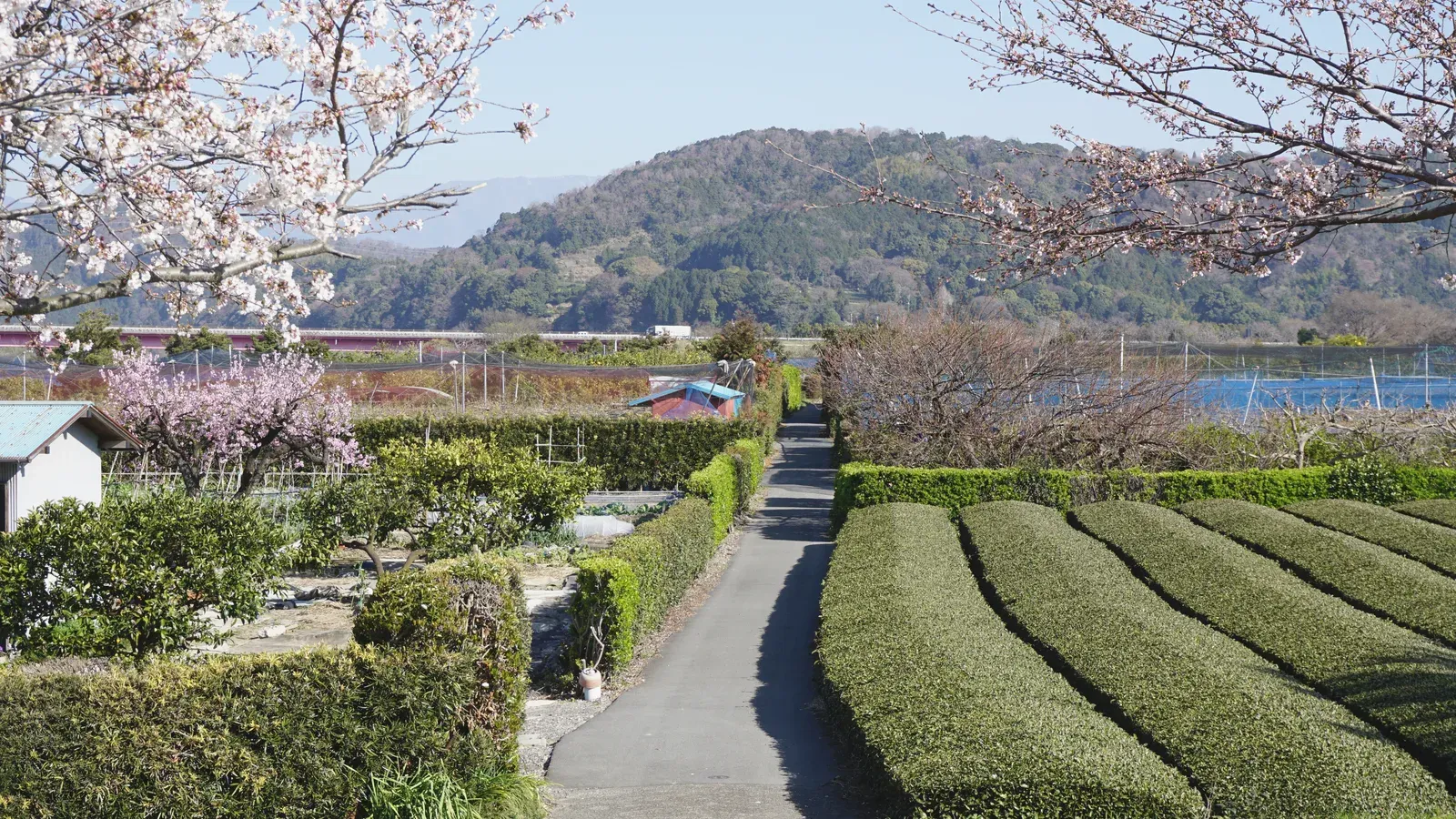
Four regions carry most of Japan’s tea reputation and volume. Uji (Kyoto) is the historic home of premium matcha and gyokuro, Yame (Fukuoka) the gyokuro capital, Shizuoka the long-time largest producer and home of fukamushi sencha, and Kagoshima the warm, mechanized south that overtook Shizuoka in total output in 2024. Region matters less than the cultivar, harvest, and shading behind it.
A tin of Japanese green tea almost always names a place. Uji, Yame, Shizuoka, Kagoshima. Those names carry real information about how the leaf was grown, when it was picked, and what cultivar it was bred from. They also carry prestige, some of it earned by eight centuries of history rather than by anything in the current bag. Telling the two apart is most of what this guide is for.
Japan grows tea in roughly forty prefectures, but the output piles up in a few. In fiscal 2025 the national aracha (荒茶, crude, unfinished tea) crop came to about 75,100 tonnes off some 33,400 hectares, and Kagoshima out-produced Shizuoka for the second fiscal year running: 30,000 tonnes against 24,100 13. Five years earlier the order was the other way round, Shizuoka near 25,200 tonnes to Kagoshima’s 23,900 out of about 69,800 nationwide, with Mie third at roughly 5,080, Kyoto fifth near 2,360, and Fukuoka — home of Yame — sixth at about 1,600 2. Note where Kyoto sits in both years. The prefecture that holds Uji and supplies the mental image most people have of Japanese tea has never been near the top of that table. Prestige and volume do not line up, and that gap is the first thing to understand about the map.
Uji (Kyoto): the historic core
Uji sits just south of Kyoto, in a river basin that traps morning mist and holds an even temperature. Tea grew here from the early Kamakura period, and for once the origin story is well recorded. The monk Eisai (Myōan Eisai, 1141–1215) carried tea seeds and the Song Chinese method of whisked powdered tea back from China. He is traditionally said to have passed seeds to Myōe Shōnin (明恵, 1173–1232), a monk of Kōzan-ji (高山寺) in the Toganoo district northwest of the city 4. Myōe planted them and helped send seed onward to Uji, whose soil and climate suited the plant 3.
Two developments turned Uji from an old farm into the technical center of Japanese tea. The first was shade. Around the sixteenth century, growers here began ōishita saibai (覆下栽培), covering the bushes for weeks before the pick 3. Starved of light, the leaf stays tender, builds amino acids, and sheds astringency, which is exactly the leaf that becomes tencha (碾茶), the base for matcha (抹茶). Uji’s shaded tea fed the whisked-tea practice that Murata Jukō, Takeno Jōō, and Sen no Rikyū were refining in those same decades. The second development was that Uji kept inventing. A steamed-and-rolled method for sencha (煎茶) took shape at Ujitawara in the eighteenth century, and gyokuro (玉露), shaded leaf rolled like sencha instead of dried flat for grinding, appeared in the mid-nineteenth. The common account credits Yamamoto Kahei of the Edo tea house Yamamotoyama with the breakthrough around 1835 6. Tellings differ on who did precisely what, so hold the date loosely and the lineage firmly.
What all this produces is a region of small volumes and high difficulty, turning out top-grade matcha and gyokuro above everything, under a name that lifts the price of the whole category. Here the reader needs the fine print. “Uji tea” is defined by the Kyoto Prefectural Tea Industry Chamber, which since 2004 has counted as Uji tea any leaf grown in Kyoto, Nara, Shiga, or Mie and then finished and processed inside Kyoto by a Kyoto business 5. The designation guarantees a finishing tradition and a standard, not that every leaf grew within sight of the Uji River.
Yame (Fukuoka): gyokuro’s stronghold
Yame is a growing area in the south of Fukuoka Prefecture, on Kyūshū, set in a misty river valley with hard swings between day and night temperature. Small volumes, narrow specialism. Yame is Japan’s gyokuro capital, producing somewhere between roughly 45 percent and more than half of the national crop depending on the source: near 45 percent by one count 7, above 50 percent by another 8. Either way, no other region comes close. In its mountain villages, growers still make dentō hon gyokuro, traditional gyokuro shaded under natural straw rather than synthetic cloth, the older and far more labour-heavy method 8.
Yame’s standing is on the record. Its gyokuro took the top production-area prize at the national tea competition run by the Ministry of Agriculture, Forestry and Fisheries for twelve straight years, 2001 through 2012, until a gyokuro from Uji finally broke the streak 7. If Uji is the region everyone has heard of, Yame is the one that quietly wins the gyokuro prizes. So the practical read is short: when you specifically want gyokuro, Yame is at least the equal of Uji, often at a lower price for the same quality. That is a case where the less famous name is the better buy.
Shizuoka: scale, and the heart of sencha
Shizuoka runs along the Pacific coast between Tokyo and Nagoya, and for more than a century it was the largest tea prefecture in Japan. Its symbol is the Makinohara (牧之原) plateau, a broad, gently rolling upland that was empty scrubland until the Meiji Restoration, when former Tokugawa samurai and out-of-work Ōi River boatmen cleared and planted it from 1869 9. Flat and open, Makinohara took to machines early, and it is still the largest single stretch of tea plantation in the country.
The prefecture’s signature style is fukamushi (深蒸し, “deep-steamed”) sencha, steamed two to three times longer than ordinary sencha — roughly 90 to 150 seconds against the usual 30 to 60 9. The long steam breaks the leaf down further, so the cup pours a dense green with a soft, round, low-astringency body. Kakegawa is its heartland. Shizuoka grew about 38 percent of national crude tea as recently as 2020 2, and most of Japan’s everyday sencha, the tea most households pour, passes through here.
Part of Shizuoka’s weight is geography and part of it is trade. The prefecture became the country’s tea market and blending hub, the place where leaf from many growing areas is bought, refined, and assembled into steady commercial lots 9. Its auction floor is one of the places what Japanese tea costs gets decided. So “Shizuoka” on a bag can mean leaf grown there, leaf finished there, or both. Its reputation rests on volume, consistency, and a deep sencha tradition more than on any one flagship cup.
Kagoshima: the south, mechanized, and now on top
Kagoshima occupies the southern tip of Kyūshū, on volcanic-ash soil under a warm, near-subtropical sky. Two things follow from the latitude. The tea comes early: Kagoshima’s shincha (新茶, the year’s first new tea) is among the first harvested in Japan, sometimes weeks ahead of Shizuoka, which counts for a lot in a market that pays a premium for the first pick 10. And the fields are big, level, and built for machines, where Uji’s and Yame’s finest plots are small and part hand-tended. Kagoshima plants for the warm south and for early budding. Yabukita (やぶきた) still covers about 30 percent of its fields, alongside the disease-resistant Yutakamidori (ゆたかみどり) and the high-amino-acid Saemidori (さえみどり), prized for its colour and sweetness 10.
Climate, scale, mechanization, and modern cultivars steadily closed the gap with Shizuoka, then erased it. Kagoshima passed Shizuoka in total tea output in 2024 1. In 2025 it took the lead in ichibancha (一番茶, first flush) tonnage as well, for the first time since the records began in 1991: Kagoshima’s first-flush volume held near 8,440 tonnes while Shizuoka’s dropped about 19 percent to roughly 8,120 1. The old story that Kagoshima was bulk leaf for blending is out of date. Its early-budding cultivars give clean, sweet, deep-steamed senchas that stand on their own.
The sharper fact sits one level down. Kagoshima is now Japan’s largest producer of tencha (碾茶) too, the shaded leaf that becomes matcha, ahead of Kyoto and Shizuoka 13. National tencha output has risen roughly 2.7-fold in a decade, to 5,336 tonnes in fiscal 2024 13. Uji still owns the top of that market and the name on the tin, but the tonnage has moved south — which is why a matcha labelled by grade and producer tells you more than one labelled by region.
Sayama: the northern outlier
Sayama earns a place because it breaks the assumption that good tea only comes from the warm south. Sayama tea grows in southwestern Saitama Prefecture and a sliver of northwestern Tokyo, about as far north as commercial tea reaches in Japan 11. The cold does the shaping. Bushes that survive frost put out thick, sturdy leaves, and the region’s high-heat finishing fire, Sayama-biire (狭山火入), documented from around 1802 and adapted from Uji’s roasting method, gives the tea a strong roasted aroma 11. The short northern season allows only two harvests a year, spring and summer, which pushes growers toward quality over tonnage 12.
An old tea-picking song sums up the order the growers see: colour from Shizuoka, aroma from Uji, taste from Sayama 12. It is a growers’ boast, and it still captures, in nine words, how differently three places can treat the same plant. If you like aroma over sweetness, Sayama’s high-fired sencha sits close in spirit to a roasted tea like hōjicha.
The regions at a glance
| Region | Prefecture | Known for | Note |
|---|---|---|---|
| Uji | Kyoto | Premium matcha, gyokuro, sencha | Birthplace of shaded cultivation (ōishita, ~16th c.); the prestige name; “Uji tea” is defined by finishing in Kyoto |
| Yame | Fukuoka | Gyokuro | Roughly 45%–50%+ of Japan’s gyokuro; traditional straw shading; twelve national prizes 2001–2012 |
| Shizuoka | Shizuoka | Sencha, fukamushi, scale | Long the largest producer; the Makinohara plateau; Japan’s blending hub |
| Kagoshima | Kagoshima | Early shincha, deep-steamed sencha | Warm volcanic south; mechanized; Yabukita, Yutakamidori, Saemidori; No. 1 in total output since 2024 |
| Sayama | Saitama | Aromatic, high-fired sencha | Far north; thick leaves from frost; Sayama-biire firing (1802) |
The terroir caveat, honestly
It is tempting to read these regions the way wine reads appellations, as guarantees of character that ride along with the name. Tea is looser than that. Much commercial Japanese tea is blended across growing areas, and a designation like “Uji tea” lets leaf from Nara, Shiga, or Mie carry the name so long as a Kyoto house does the finishing 5. A region’s fame also rests on its trade and finishing infrastructure as much as its soil: Shizuoka’s standing owes as much to its blending market as to any single field 9.
None of that makes region meaningless. Climate, cultivar, harvest timing, and processing tradition are real, and they reach the cup. But three of those four travel with the leaf, not with the map. A first-flush, single-cultivar Saemidori grown in Kagoshima tells you more about what you are about to drink than the word “Uji” stamped on an anonymous blend. Chasing the prestige syllable on a tin is often paying for history that a named Kagoshima cultivar would beat in a blind cup.
How the region shows up in what you buy
- Top matcha or ceremony-grade gyokuro: Uji and Yame are the names to reach for. Expect to pay, and remember an “Uji” label can include blended leaf, so judge by grade, producer, and harvest over the place alone. On the grade question, see ceremonial vs. culinary matcha.
- Gyokuro specifically: Yame is the specialist and often the better value. Uji matches it only at the very top.
- Reliable everyday sencha: Shizuoka is the safe default, broad and consistent.
- Early-season shincha, or a sweet deep-steamed sencha: Kagoshima, now the largest producer by volume.
- Something aromatic and off the beaten path: Sayama’s high-fired sencha.
Read the region as one line of information among several, and usually not the decisive one. The most honest label on a bag of Japanese tea is rarely the biggest word on it. It is the small print: the cultivar, the grower, the shading period, the harvest date. Those tell you what the leaf will taste like. The region tells you where it was finished, and what it costs to say so. To see how shade, rolling, and grinding build these teas, start with what tencha is and the gyokuro guide. For where Uji fits in the long arc of Japanese tea, follow it into chadō, the Way of Tea, and the wider map of the seven green teas.
Sources
13sourcesGlobal Japanese Tea Association
SupportsKagoshima surpassed Shizuoka in total output in 2024; in 2025 Kagoshima led ichibancha for the first time since 1991 (Kagoshima ~8,440 t vs Shizuoka ~8,120 t, Shizuoka down ~19%)
Japanese Tea Sommelier (Florent Weugue)
Supports2020 aracha figures (MAFF): Shizuoka 25,200 t (38%), Kagoshima 23,900 t (34%), Mie 5,080 t (3rd), Kyoto 2,360 t (5th), Fukuoka 1,600 t (6th); national total ~69,800 t
Kyoto Prefecture / Yamashiro region (Uji green tea history, PDF)
SupportsEisai's seeds, Myōe of Kōzan-ji at Toganoo, ōishita shaded cultivation, and the development of sencha and gyokuro in Uji/Yamashiro
Far East Tea Company
SupportsMyōe Shōnin received tea seeds from Eisai and founded Uji tea cultivation at Toganoo
Kyoto Prefectural Tea Industry Chamber (ujicha.or.jp)
SupportsOfficial 'Uji tea' definition (2004): leaf grown in Kyoto, Nara, Shiga, or Mie and finished/processed within Kyoto Prefecture by a Kyoto business
Global Japanese Tea Association
SupportsGyokuro origin commonly dated to 1835; Uji (Kyoto) and Yame (Fukuoka) as its renowned regions
Wikipedia, Yamecha
SupportsYame produces about 45% of Japan's gyokuro; won the national competition for gyokuro 12 straight years 2001–2012 until a gyokuro from Uji broke the streak
Yunomi
SupportsYame accounts for over 50% of Japan's gyokuro; top national prize 2001–2012; many Yame growers keep traditional woven-straw (honzu) shading rather than synthetic cloth
Far East Tea Company
SupportsMakinohara plateau cleared by former samurai after the Meiji Restoration; fukamushi sencha steamed ~90–150 s (Kakegawa); Shizuoka as Japan's largest region and blending hub
Wikipedia, Kagoshima green tea
SupportsCultivars Yabukita (~30% of fields), Yutakamidori (early, disease-resistant), Saemidori (early, high amino acid); early shaded first-flush harvests; second-largest producer
Wikipedia, Sayama tea
SupportsSayama tea in southwestern Saitama; Sayama-biire firing (狭山火入) invented 1802, based on Uji's roasting technique; thick leaves from the cold
Global Japanese Tea Association
SupportsSaitama's northern climate allows only two harvests a year; the tea-picking song 'colour from Shizuoka, aroma from Uji, taste from Sayama'; roasty aroma from extra firing
Matcha Wholesale Japan, citing MAFF production statistics
SupportsFY2025: national aracha ~75,100 t across ~33,400 ha; Kagoshima 30,000 t vs Shizuoka 24,100 t, Kagoshima ahead for two consecutive fiscal years (2024 and 2025). Tencha ~2.7x FY2014 to FY2024, reaching 5,336 t; top three tencha prefectures Kagoshima, Kyoto, Shizuoka in that order
Image: vault006, Wikimedia Commons · CC BY 3.0
Common questions
Which Japanese tea region is best?
There is no single best region, only best-at-something. Uji sets the standard for top matcha and gyokuro, Yame for gyokuro, Shizuoka for consistent everyday sencha, and Kagoshima for early shincha and sweet deep-steamed sencha. For any given cup, the cultivar, harvest date, and shading tell you more than the region does.
Is Uji matcha worth the premium?
Sometimes. 'Uji tea' is defined so that leaf grown in Kyoto, Nara, Shiga, or Mie can carry the name as long as a Kyoto business does the finishing, so the label guarantees a finishing tradition rather than that every leaf grew in Uji. At the very top, Uji is superb. Lower down, a stated grade, producer, and harvest are better signals than the place name alone.
Why did Kagoshima overtake Shizuoka?
Kagoshima's warm southern climate, flat mechanized fields, and early-budding modern cultivars let it harvest earlier and grow more cheaply. It passed Shizuoka in total output in 2024, and in 2025 it led first-flush (ichibancha) tonnage for the first time since 1991, helped by a roughly 19% fall in Shizuoka's first flush that year, per the Global Japanese Tea Association.