The Leaf
What Is Tencha? How Matcha Is Made, Leaf to Powder
Tencha is the shaded, steamed, unrolled leaf that becomes matcha. Here is the full process, why each step matters, and how it differs from gyokuro.
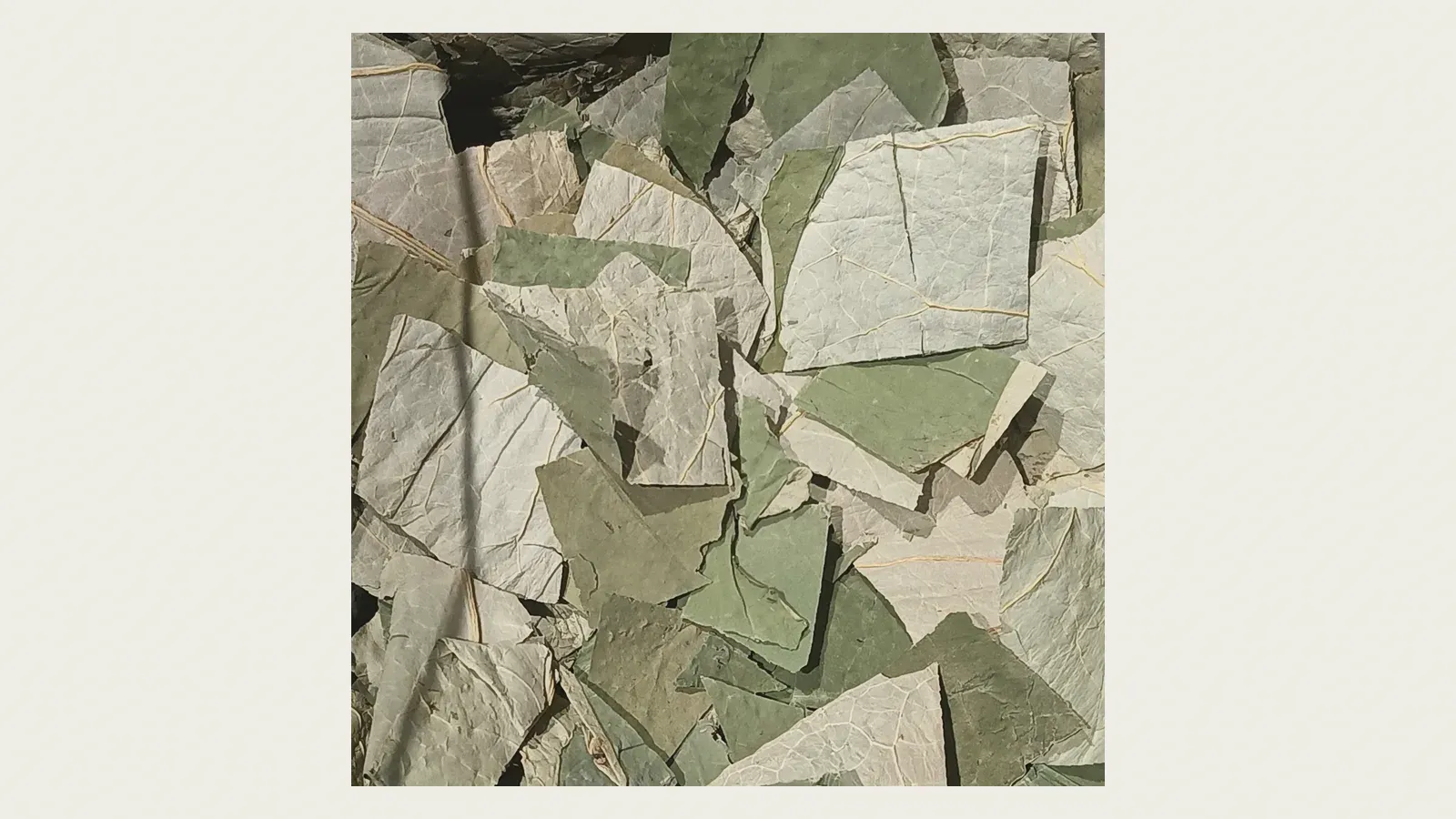
Matcha is ground tencha (碾茶): shaded tea leaf that is steamed, dried flat without rolling, then stripped of stem and vein. Stone mills grind it to powder at about 40 grams an hour, which is why good matcha is slow to make and limited in supply.
Matcha is the one Japanese tea you swallow whole. Every other green tea in the country is an infusion: hot water pulls flavor from the leaf, and the spent leaf goes in the bin. Matcha is the ground leaf itself, held in suspension in the water you drink. That difference decides how the plant is grown, how the picked leaf is fixed, and how it is finished. And the finished leaf, in the moment before it meets the mill, carries its own name and trades on its own market. It is tencha. No tencha, no matcha.
The word, and where it sits
Tencha (碾茶) is a shaded, steamed, unrolled green tea grown almost entirely to be ground into matcha (抹茶). The Global Japanese Tea Association lists it as its own category, sitting apart from sencha, gyokuro (玉露), and bancha, and defines it by what happens after the pick: the leaves are shaded for four weeks, steamed, dried, and then the dried leaf is carefully separated from the stems, with “the rolling process, that breaks the tea leaf cell walls and helps to release flavour components into water, skipped entirely” 1. That skipped roll is the hinge the whole category turns on, and it comes up again at step three.
The full chain runs like this:
shade the plant (three to four weeks) → harvest → steam to fix the leaf → dry flat, no rolling → winnow off stems and veins → tencha → stone-grind → matcha
Every arrow is a choice, and every choice lands in the bowl.
Step one: shade, the last month before harvest
Weeks ahead of the pick, growers cover the bushes. The block comes two ways. A direct cover drapes black synthetic netting straight onto the plants. The older, higher-tier method builds a canopy on a frame and layers reed, straw, or grass across it, the reeds cutting the light more gently and evenly 2. Growers tighten the shade in stages as harvest nears, so the leaf spends its final days in deep shadow. Tencha for matcha stays covered for roughly thirty to forty days, pushed toward fifty for the top grades. Gyokuro is covered about twenty 2. More light is withheld, for longer, than in any other Japanese green tea.
Starving a leaf of light does three measurable things, and they sit in the plant-science literature rather than in folklore.
Chlorophyll climbs. Short on light, the leaf builds extra pigment to catch what reaches it. A 2021 study in Frontiers in Plant Science traced the mechanism: shading suppresses the transcription factor CsHY5 and frees chlorophyll-synthesis genes such as CsPORL-2 to run, so pigment accumulates 3. A review in Molecules attaches a number to the result. Tencha leaf measured 5.65 mg/g of chlorophyll against 4.33 mg/g in ordinary green tea 4. That surplus pigment is why good matcha glows a deep, near-electric green instead of the yellow-green of sencha.
Theanine holds. L-theanine, the amino acid behind matcha’s brothy, savory sweetness, is made in the roots and travels up into the leaf. Under full sun the leaf converts theanine onward into catechins. Shade interrupts the conversion: the Molecules review reports that under shading “theanine does not break down,” and tencha “contains larger amounts of it compared to other teas” 4.
Catechins fall. Those same catechins are the source of green tea’s bitterness and grip. Slowed formation leaves the finished tencha rounder and sweeter than a sun-grown leaf 4. The most abundant of them, EGCG, is still there in quantity — shade shifts the balance rather than stripping the polyphenols out 4. So the cup you eventually whisk is greener, sweeter, and more umami-laden before a single leaf is picked. Shade does most of the flavor work.
Step two: steam, within hours of the pick
Picked leaf is steamed fast, usually the same day. Japanese green tea is steamed where Chinese green tea is pan-fired, and the timing is the whole trick: steam deactivates the leaf’s oxidation enzymes almost at once. For tencha the steam is short, on the order of thirty seconds of high heat 6. That “kill-green” step locks the color and the fresh, vegetal aroma in place — precisely what a powder meant to be eaten, pigment and all, has to keep. Skip it or slow it, and the leaf browns toward oolong or black tea. Steam it right, and it stays a vivid green.
Step three: dry flat, and call it tencha
Here is the divide. After steaming, nearly every Japanese leaf tea is rolled and kneaded as it dries. Rolling ruptures the cell walls, twists the leaf into the tight needles of sencha, and trains it to give up its compounds quickly to hot water. Tencha gets none of that. The steamed leaf is dried open and flat: air blows the leaves apart, then a tall drying oven called the tencha-rō (碾茶炉) carries them through on tiers of conveyor, holding around 200°C for roughly thirty minutes until the leaf comes out as brittle, papery flakes 7.
That flatness is the one property that sets tencha apart from every other tea. A rolled, part-crushed leaf mills into something fibrous and streaky. A flat, brittle, dried-open leaf shatters into a fine, even powder. To make matcha, you have to keep the leaf unrolled. It is also why gyokuro can never become matcha: gyokuro is shaded like tencha but then steamed and rolled into needles the way sencha is, and rolling commits it for good to being a leaf you steep 5.
Step four: winnow, de-stem, de-vein
The dried flake still carries stalk, stem, and the tough midrib veins of the leaf. Winnowing lifts them out. In a Japanese tencha refinery the leaf rides up through vertical columns under fans, past netting that can stand six meters tall. The lighter leaf blade floats and separates while the heavier stems and veins drop away and get knocked loose against the walls 6. A cutter and air-sorter finish the job, splitting the tender blade from the woody tissue and reducing it to small, uniform flakes.
The reason is flavor and grindability at once. Stems and veins are fibrous. They grind poorly, and they hold far less of the sweet, umami-rich substance concentrated in the leaf body. The harder a producer de-veins, the smoother and sweeter and brighter the resulting matcha — and the less powder they get from the same field. What leaves this stage is tencha proper: clean, deep-green blade flake, sorted and ready. Only now is it the raw material for matcha.
Step five: stone-grind into matcha
Tencha becomes matcha on a granite stone mill, the ishi-usu (石臼): two carved granite discs, the lower one fixed, the upper turning slowly above it. Leaf drops into a hole at the center and the powder works its way out to the rim, sheared finer with every pass. The upper stone turns at only about thirty revolutions a minute, roughly one turn every couple of seconds, and grinds down to a particle of six or seven microns — fine enough that the powder stays suspended in whisked water instead of settling to the bottom of the bowl 6.
The pace looks absurd until you learn why. Nakamura Tokichi, a long-established Uji house, states it plainly: “only about 40 grams can be produced in one hour,” the leaf “ground slowly, with gentle and even pressure, in one direction and at a constant speed” 8. Forty grams is roughly twenty bowls of thin tea. One mill, one hour, twenty bowls.
Speed is the enemy here. Grinding makes friction, friction makes heat, and heat wrecks the volatile aromatics and the green pigment that weeks of shade were spent to build. Granite grinds cool, and the light, one-direction pressure keeps the powder from scorching. Run the mill hard and you get heat, a coarser grain, and a duller, flatter tea. Nakamura Tokichi even names the faint warm scent a touch of grinding heat can lend — hika — welcome in a whisper, ruinous in force 8.
That forty-grams-an-hour ceiling is the supply story in a single figure. One mill turns out well under a kilo a day. Scaling up means running banks of mills side by side, not spinning any one of them faster. This is the real constraint under matcha’s price and its recurring shortages: the last step resists being hurried.
Faster machines do exist. A ball mill produces a few kilograms an hour and a bead mill tens of kilograms, orders of magnitude past the stone 7. The method deserves a verdict. For matcha you will whisk and drink as tea, the stone earns its keep: the cool, slow grind protects the aroma and gives the talc-fine texture that froths in the bowl. For matcha you will bury in a latte, a smoothie, or a batch of cookies, ball-milled powder is fine and the money spent on a stone-milled tin is largely wasted, since milk and sugar flatten the distinctions you paid for. The producers themselves are honest about the limit of the method. Nakamura Tokichi says outright that what matters most is not the mill but the quality of the tencha going into it 8.
Tencha and gyokuro: same shade, opposite finish
The fastest way to fix tencha in mind is to stand it next to gyokuro, because the two begin almost as twins and then split.
| Gyokuro (玉露) | Tencha (碾茶) → matcha | |
|---|---|---|
| Shaded before harvest | Yes, ~20 days | Yes, ~30–40 days |
| Steamed to fix | Yes | Yes |
| Rolled / kneaded | Yes — shaped into needles | No — dried flat |
| Stems and veins | Largely kept | Winnowed out (de-veined) |
| Final form | Whole leaf, steeped and discarded | Powder, whisked and drunk whole |
| What you consume | The infusion | The entire leaf |
Both are shaded, both are sweet and umami-forward, both are premium. The fork is the roll. Gyokuro is rolled, so it stays a leaf you steep. Tencha is dried flat, so it can be milled into a powder you eat. To taste the shaded-leaf character in steeped form, gyokuro is the tea — our guide to gyokuro covers the low temperatures it demands.
Tencha as a leaf you can buy
Tencha has a life beyond the mill. It is sold loose, and a small number of drinkers steep it as tea. The flake brews pale gold, light and sweet, with the low astringency that shade produces and little of the seaweed depth of a top gyokuro. Cool water suits it, around 60 to 70°C, and a short steep. Think of it as a gentler, more delicate cousin of gyokuro that happens to be shaped like confetti.
Storage matters more with tencha and matcha than with any rolled tea. An unrolled, open leaf has enormous surface area exposed to air, and the pigments and aromatics that shade concentrated are the first to go. Keep tencha and matcha sealed, cold, and away from light and strong smells, and buy in amounts you will finish soon. Ground matcha fades fastest of all, dulling in color and flavor within weeks of opening. This is why the tins are small and the sealed pouches are opaque.
Reading a matcha tin
When you read a matcha label, you are reading its tencha. A bright, deep green means good shading and careful drying. Smoothness and sweetness with little bitterness mean real shade-days and thorough de-veining. A fine, near-talc powder that froths and does not sink means proper, slow stone milling. The evidence lives in the color, the texture, and the taste, and it will tell you more than any adjective printed on the metal.
Knowing how tencha is made hands you the right questions. How long was it shaded? Is it stone-milled? First harvest or later? With those answered, whisk it properly and the labor in the leaf will show in the cup. For the full breakdown of tiers, see ceremonial vs. culinary matcha. For the bowls it is whisked in, read Japan’s tea ceramic traditions. And for where all of this is headed, a bowl of powdered green tea whisked and shared, there is chadō, the Way of Tea. Tencha is one leaf in a large family, and the rest of it is laid out across the Leaf.
Every tin of matcha names the powder. The leaf that made it had a name first, and now you can read it.
Sources
8sourcesGlobal Japanese Tea Association (GJTA)
SupportsTencha shaded 4 weeks, steamed, dried, stems separated; rolling skipped entirely; matcha stone-milled; gyokuro shaded ~3 weeks
Japanese Green Tea Co., 'The Covering Process for Matcha and Gyokuro'
SupportsTencha covered ~30–40 days (up to ~50 for top grades); gyokuro ~20 days; direct-cover net vs canopy of straw/reed/grass
Dziedzic et al., 'Mechanism Underlying the Shading-Induced Chlorophyll Accumulation in Tea Leaves,' Frontiers in Plant Science (2021)
SupportsShading raises chlorophyll via CsHY5/CsPORL-2 regulation; reduced light is the driver
Jakubczyk et al., 'Health Benefits and Chemical Composition of Matcha Green Tea: A Review,' Molecules 26(1):85 (2020)
SupportsTencha chlorophyll 5.65 mg/g vs 4.33 mg/g in ordinary green tea; theanine does not break down under shade; EGCG most active and abundant catechin
Japanese Green Tea Co., 'Gyokuro vs. Tencha'
SupportsGyokuro steamed then rolled into needles like sencha and dried whole; tencha dried flat, de-veined, stone-ground into matcha
CHA-OLOGY (Kyoto), 'From Tencha to Matcha'
SupportsSteam ~30 seconds; vertical winnowing columns and netting up to 6 m tall knock off stems and veins; stone milling ~30–40 g/hour at ~6–7 micron particle size
d:matcha Kyoto, 'Tencha Processing'
SupportsTencha-rō drying oven ~200°C for ~30 min; grinding output stone mill 40 g/h vs ball mill (few kg/h) vs bead mill (tens of kg/h)
Nakamura Tokichi Honten (Uji), 'Stone-Milled vs. Machine-Milled'
SupportsAbout 40 g of matcha per hour from a stone mill, ground in one direction at constant speed; hika aroma from grinding heat; quality of the tencha matters most
Common questions
Is tencha the same as matcha?
Almost, but not quite. Tencha (碾茶) is the finished dried leaf. Matcha (抹茶) is that same leaf stone-ground into powder. Every matcha starts as tencha. The milling is the last step that turns one into the other.
Can I brew tencha as a loose-leaf tea?
Yes. Tencha is sold loose and steeps into a pale, sweet, low-astringency cup that tastes close to a light gyokuro. Use cool water, around 60–70°C, and a short infusion. Most tencha is grown to be ground, but drinking it as a leaf is a real and pleasant option.
Why is good matcha so expensive?
Three costs stack up: weeks of shading with labor-intensive covers, the yield lost when stems and veins are removed, and a stone mill that produces only about 40 grams an hour. The finishing step cannot be sped up without degrading the powder, so supply stays tight.
Is tencha the same as gyokuro?
They start the same and diverge at one step. Both are shaded green teas. Gyokuro (玉露) is rolled into needles and steeped like sencha. Tencha is dried flat, de-veined, and ground into matcha. Rolling is the fork in the road.