The Leaf
Gyokuro: Japan's Shaded Treasure (and How to Brew It)
Gyokuro is shaded like tencha but rolled like sencha — a thick, sweet, broth-like green tea. What it is, why shading works, and how to brew it cool.
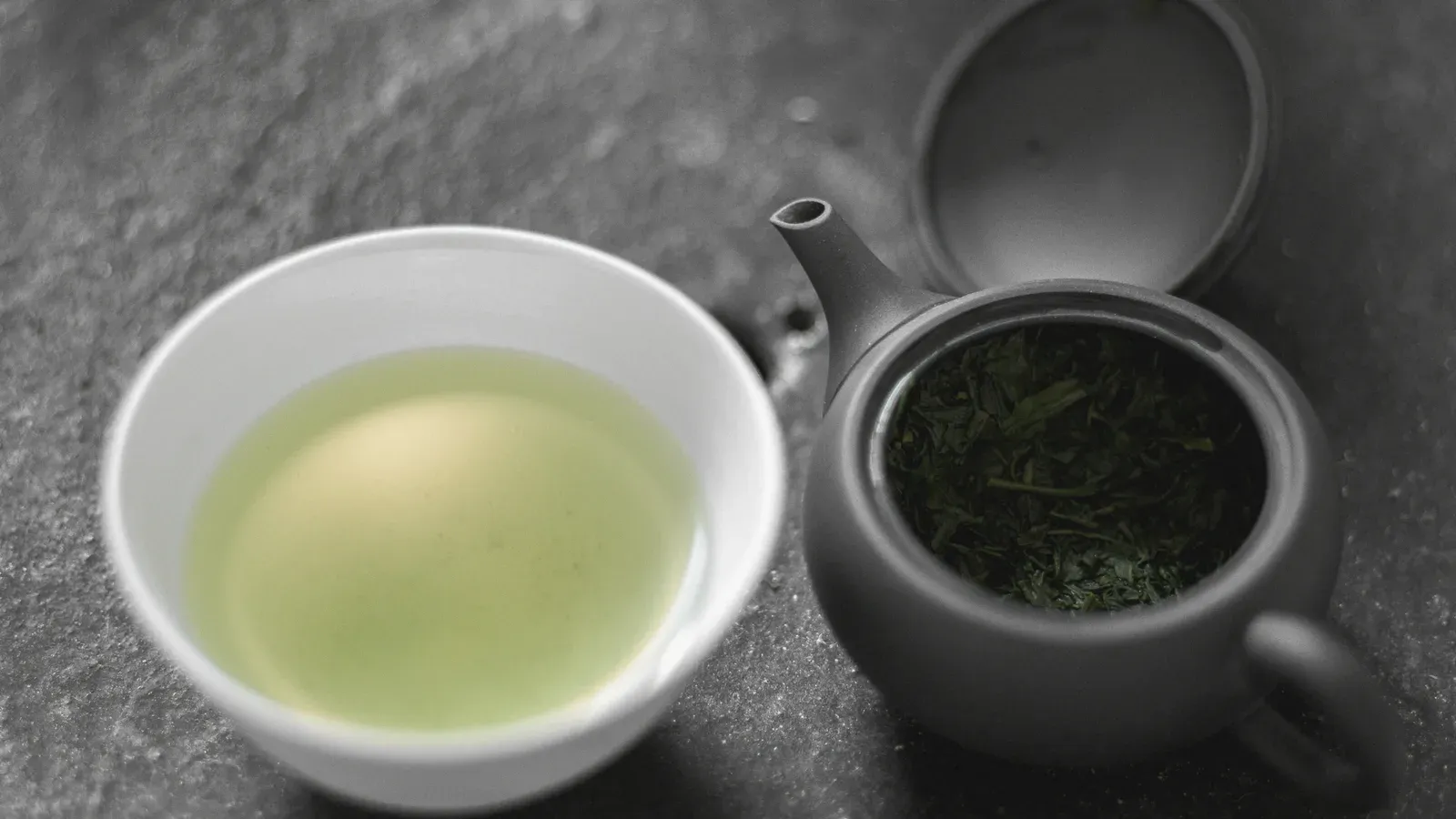
Gyokuro is a premium Japanese green tea shaded for about three weeks before harvest, then rolled like sencha. The shade builds theanine and holds back the bitter catechins, giving a thick, sweet, almost broth-like cup. Brew it cool — around 50–60°C — with generous leaf and very little water, and re-steep it three or four times.
Most people meet Japanese green tea as matcha or as a bright, grassy sencha. Gyokuro (玉露, “jade dew”) is where a sencha drinker goes next. The liquor is small, deep, and viscous, closer to a thin savory broth than to the clean snap of an everyday green. A first cup from a good pot can be barely 40 millilitres, sweet, so low in bitterness it takes a moment to register as tea at all. This is the connoisseur’s green tea. It also rewards a brewing method that looks, the first time you see it, like a mistake.
What gyokuro is
Gyokuro is leaf tea. That single fact separates it from matcha (抹茶), the powder it is most often confused with, and the confusion is fair enough: the two plants spend their last weeks in the field the same way.
For roughly three weeks before the pick, gyokuro fields are covered, cutting off most of the sunlight 1. The same shade regime produces tencha (碾茶), the leaf that becomes matcha. What splits the two is what happens after the harvest. Tencha is steamed and then dried flat for grinding, its stems and veins stripped out, so it can be milled to a clean powder. Gyokuro takes that same shaded leaf and rolls it — steamed to stop oxidation, then worked for several hours to break down the cells and shape it, then dried 1. The result is the tightly furled, needle-dark leaf you steep and pour. Shaded like tencha, rolled like sencha. That parallel is the fastest way to hold the category in your head.
The name comes from the cup. 玉 is jewel or jade, 露 is dew, and “jade dew” is a fair reading of the small measure of dense green liquid a proper brew yields.
How the shade builds the cup
Gyokuro’s flavor is set in the last three weeks in the field, before any processing happens, and the mechanism is plain plant chemistry.
A tea plant in full sun converts the amino acid L-theanine into catechins. Theanine carries umami and sweetness. Catechins carry astringency and grip. Sunlight drives the conversion, so a sun-grown leaf trades sweetness for bite 2. Cover the plant and that conversion slows. Theanine accumulates in the leaf instead of being spent, while catechin levels stay comparatively low — the same theanine-and-caffeine balance discussed in matcha’s caffeine and L-theanine. The leaf also floods itself with extra chlorophyll to catch what little light gets through, which is why shaded teas run such a deep, saturated green. Shade even leaves a signature in the aroma: a green, faintly marine note growers call the covering aroma (ōi-ka), present in properly shaded leaf and absent from ordinary sencha.
The shade itself is more deliberate than a tarp thrown over the rows. Growers build a canopy on a frame set above the bushes — a shelf structure called a tana (棚) — and layer the cover across it, rather than draping netting straight onto the plants as they do for the shorter-shaded kabusecha (かぶせ茶) 2. The block goes on in stages. A first layer takes out roughly 70 percent of the light. After a week to ten days a second layer goes over it, bringing the combined block to around 90 to 95 percent, and the field spends its final stretch in near-darkness 3. Around twenty days under cover is the working line for gyokuro. Less than that, and the leaf is sold as the lighter kabusecha instead 2.
Two shelf methods run side by side. The common one, kanreisha, stretches black synthetic cloth over the frame. The older and higher-tier one, honzu (本簀), lays a screen of reeds under mats of rice straw 3. Straw costs more labor and it doesn’t heat the canopy the way dark synthetic cloth can, which is one reason the top competition lots still use it 7. What all of it buys is a single trade: weeks of shade for a leaf loaded with the sweet, savory compounds and short on the bitter ones. Ippodo describes the finished liquor as thick, sweet, and intensely umami, with little of green tea’s usual edge 5.
Gyokuro next to sencha, kabusecha, and matcha
Four teas can come off closely related bushes and diverge on two variables: how long the plant sat in shade, and what the factory did with the leaf afterward.
| Tea | Shade before harvest | Processed by | You drink |
|---|---|---|---|
| Sencha | None (full sun) | Steamed, rolled, dried | The steeped liquor |
| Kabusecha | ~7–14 days, direct cover | Steamed, rolled, dried | The steeped liquor |
| Gyokuro | ~20+ days, on a shelf | Steamed, rolled, dried | The steeped liquor |
| Matcha (from tencha) | ~20–40 days, on a shelf | Steamed, dried flat, de-veined, ground | The whole leaf, as powder |
Read down the shade column and you can taste the gradient: sencha is briskest and most astringent, kabusecha rounder, gyokuro deep and sweet. Gyokuro and tencha get the same long shade, then part ways at the roller. That’s why gyokuro tastes closer to matcha than to sencha while still being a leaf you steep and strain.
How to brew it
Gyokuro inverts almost every habit from brewing other green tea. You use a lot of leaf, very little water, and a temperature that would seem far too low anywhere else. The reason sits in the chemistry above. Theanine and the amino acids extract readily in cool water, while catechins need heat to leave the leaf. Brew cool and you pull the sweetness and strand most of the bitterness. Brew at a sencha temperature and you get the opposite of what you paid for.
Ippodo’s standard first infusion is a good anchor: 10 grams of leaf, 80 millilitres of water, 60°C, 90 seconds 4. That’s far more leaf and far less water than sencha asks for. The Global Japanese Tea Association pushes the first steep cooler still, as low as 40 to 50°C, for the most umami and the least edge 1. Then re-steep. The same leaves give three or four infusions before the sweetness gives out, and the rule each round is to raise the temperature a little and shorten the time 5.
| Infusion | Water temp | Steep | Character |
|---|---|---|---|
| 1st | 40–60°C | 90 s | Thick, sweet, deep umami; a very small pour |
| 2nd | ~60°C | 30–45 s | Fuller body, still sweet |
| 3rd | ~70°C | 20–30 s | Lighter, brighter, more like sencha |
| 4th | Just off hot | Quick | Thin; the sweetness mostly gone |
Getting the water cool is the fiddly part. Straight off the boil it sits near 95°C, and you need to shed 35 to 45 degrees of that. The traditional tool is a yuzamashi (湯冷まし, “water cooler”), a wide open vessel you pour the hot water into and let stand a couple of minutes. Pouring between cups does the same job — each transfer into cool ceramic sheds heat. Brew it in a small kyūsu (急須), the side-handled Japanese teapot built for exactly this: a wide, low body and a fine mesh that lets a few grams of leaf open fully in a small pour.
Two habits carry the rest. Pour every infusion out to the last drop, because the strongest, sweetest liquor pools at the bottom of the pot and left there it stews the next steep. And let the later infusions run hot and quick, walking the leaf down toward an ordinary green-tea profile as its sweetness empties. For the numbers on every other Japanese tea, see the full temperature and time guide.
The ice-drip cup
If you want to taste, in isolation, what twenty days of shade does to a leaf, drink gyokuro brewed on ice. The method is kōridashi (氷出し, “ice extraction”): a generous measure of dry leaf in the pot with two or three ice cubes set straight on top, and nothing else 6. The ice melts drop by drop over an hour or two, extracting the amino acids at close to zero degrees while the catechins and caffeine, which need heat, stay behind in the leaf. What you get is a tiny pour — 30 to 40 millilitres — of something so sweet and so free of astringency that first-time drinkers rarely guess it’s tea 6.
It’s slow, it wastes most of the leaf’s later steeps, and it’s the clearest single demonstration of shade there is. A hot brew always carries some bitterness for the sweetness to play against. The ice cup strips that away and leaves the theanine standing alone. Save it for a top-grade leaf and a warm afternoon, and use good water for the ice, since at that temperature the water is most of what you taste.
Where it comes from
Gyokuro is a nineteenth-century invention. It’s commonly credited to 1835, when Yamamoto Kahei, a merchant of the Edo tea house Yamamotoyama, saw Uji farmers netting their plants against frost and found the shading had changed the leaf’s flavor and aroma 8. The word began as that firm’s product name and stuck to the whole category. Uji (宇治), the historic tea district south of Kyoto, is still a benchmark, and its name reads as shorthand for high-grade Japanese tea.
The other center is Yame (八女), in Fukuoka Prefecture on Kyushu, and it has become the dominant one. Yame accounts for more than half of all the gyokuro on the Japanese market, and its growers have taken the top prize at the national tea competition year after year since 2001 7. Part of that comes down to method: many Yame producers keep the labor-heavy honzu straw shading that the rest of the industry has traded for synthetic cloth 7. Uji is the classic reference. Yame is where much of the country’s finest gyokuro now grows. For the wider map, see Japan’s tea regions.
How to choose and store it
There’s no legal grade for gyokuro, the same way there’s none for “ceremonial” matcha, so read the substance on the label and ignore the tier words. A stated origin is a real signal — Uji or Yame means something. So does a recent harvest, since gyokuro is a first-flush tea picked in late spring and its sweetness is the first thing to fade. The dry leaf should be a deep, dark green, tightly rolled into fine needles. A seller who tells you the shading period and the cultivar is one who knows what’s in the bag.
Because gyokuro is rich in exactly the compounds that light, heat, air, and moisture break down, it keeps worse than a sturdy roasted tea. Store it sealed, cool, and away from strong smells, and drink it within a few months of opening rather than saving it for an occasion. The sweetness that justifies the price doesn’t wait.
Everything about gyokuro points at the same handful of grams. Weeks of shade, hours of rolling, and a brew of cool water and small pours all exist to carry a few grams of leaf to the far end of what a green tea can be sweet. That care over so little is where a cup of gyokuro meets the older tradition it grows out of — chadō, the Way of Tea, and the seven teas it draws from, mapped at The Leaf.
Sources
8sourcesGlobal Japanese Tea Association
SupportsShading ~3 weeks on an elevated shelf structure; rolled for hours like sencha; stems separated as karigane; origin 1835; Uji (Kyoto) and Yame/Hoshino (Fukuoka) as renowned regions; first steep as low as 40–50°C for ~90s for maximum umami
Yunomi
SupportsShading mechanism — sunlight converts theanine to catechins; shade preserves theanine and holds catechins low; shelf (tana) method for gyokuro/tencha vs direct cover for kabusecha; ~20+ days for gyokuro vs shorter for kabusecha
Tezumi
SupportsStaged shading — first layer blocks ~70% of light, a second layer added after 7–10 days brings the combined block to ~90–95%; kanreisha (synthetic cloth on a frame) vs honzu (reed screen plus straw mats) shelf methods
Ippodo Tea
SupportsStandard first-infusion recipe: 10 g leaf, 80 ml water, 60°C, 90 seconds
Ippodo Tea
SupportsThree to four infusions before the leaves lose their sweetness; thick, sweet, intensely umami liquor with little bitterness; raise temperature and shorten time on later steeps
Global Japanese Tea Association
SupportsKōridashi (ice-brew) method — a generous measure of leaf with ice cubes set on top; takes roughly two hours to melt; extracts umami at its best with no astringency; sweeter than cold brew
Yunomi
SupportsYame (Fukuoka) accounts for over 50% of Japan's gyokuro; won the top national prize repeatedly from 2001 on; many Yame growers keep the traditional woven-straw shading rather than synthetic cloth
Wikipedia, Gyokuro
SupportsOrigin commonly credited to the merchant Yamamoto Kahei of Yamamotoyama in 1835, who saw farmers netting plants against frost; gyokuro began as that firm's product name; 'jade dew'
Common questions
Is gyokuro the same as matcha?
No. Both are shaded for roughly three weeks, but matcha is made from tencha — steamed and dried flat, then stone-ground to powder. Gyokuro takes the same shaded leaf and rolls it like sencha, so you steep it as loose leaf and drink the liquor rather than the whole leaf.
Why brew gyokuro so cold?
Low temperature extracts theanine and the other amino acids, which carry the sweetness and umami, while leaving most of the catechins — the bitter, astringent compounds — locked in the leaf. Hot water pulls the bitterness forward and flattens the sweetness gyokuro is grown for.
How many times can I re-steep gyokuro?
Three or four times before the sweetness gives out, according to Ippodo. Raise the water temperature a little and shorten the steep each round: the first infusion is cool and slow, the later ones hotter and quick, drifting toward an ordinary green-tea character as the leaf empties.