The Leaf
Matcha, Caffeine and L-Theanine: What the Science Shows
What controlled studies show about matcha's caffeine and L-theanine: measured per-serving ranges, the 'calm energy' claim, and the honest limits.
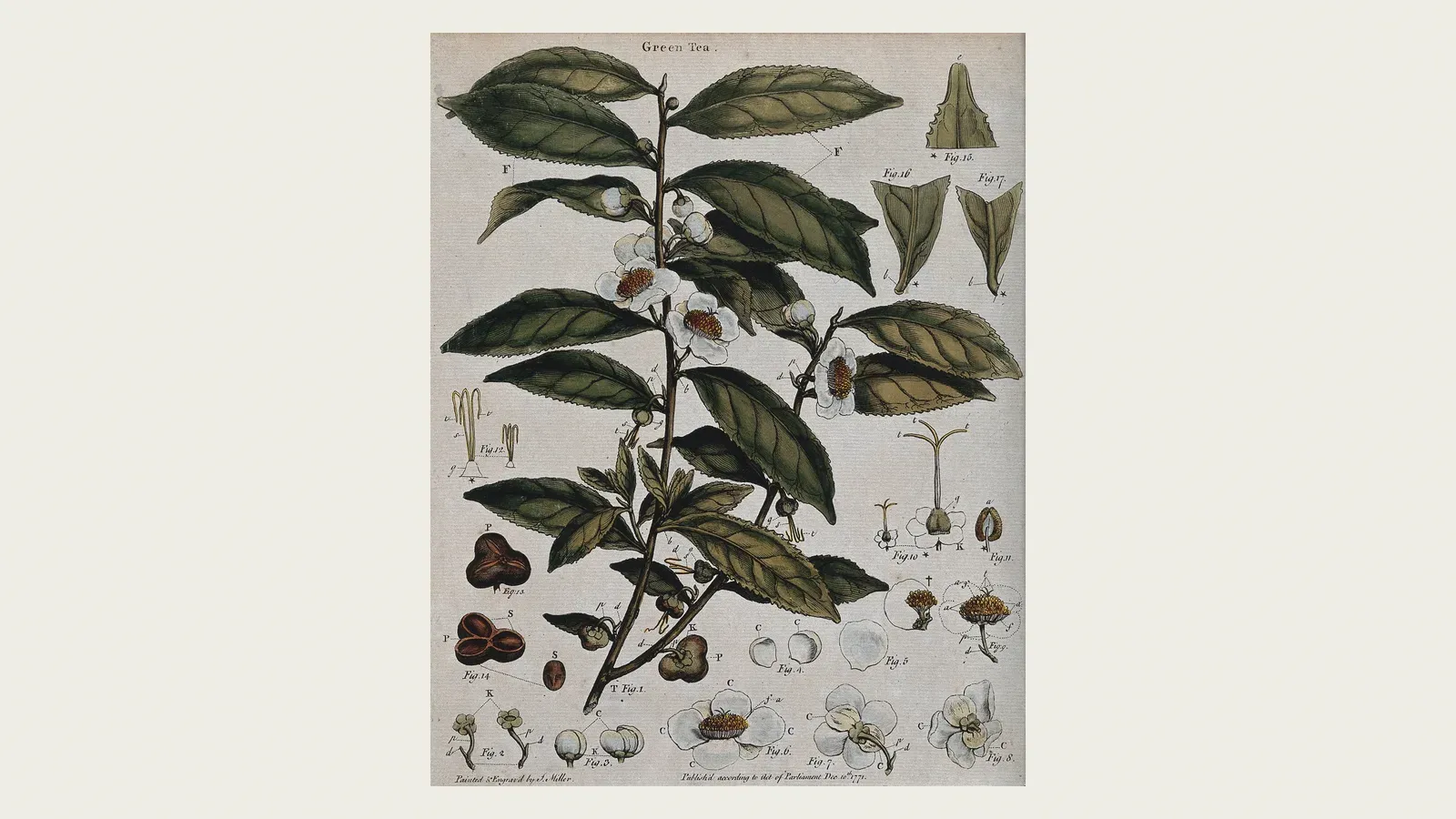
Matcha is whole powdered leaf, so a serving delivers more caffeine per gram of tea than a steeped cup, and more L-theanine because the plant is shaded. Controlled trials suggest the caffeine-and-theanine pairing can sharpen attention, though the effect is modest and the evidence is thin.
People who move from coffee to matcha (抹茶) tend to describe the change the same way: less of a jolt, no hard crash, a steadier alertness. That phrase, “calm energy,” has become matcha’s main selling point. Part of it traces to two compounds in the leaf. Part of it is marketing stretched over studies smaller and softer than the headlines suggest. This page separates the two, with the numbers attached.
Here is the short version. The caffeine is real, and how much you get depends almost entirely on how much powder you whisk. The L-theanine (L-テアニン) is real, and matcha carries more of it than most teas because the plants are shaded. The claim that the two together create a distinct mental state has support in controlled trials, though the effect is small and the literature is thin. The broader antioxidant claims are weaker than the wellness market implies, and they belong to a companion piece rather than this one.
Caffeine: you drink the leaf, not an infusion
What sets matcha apart from every other green tea is that you swallow the whole leaf. Sencha or gyokuro (玉露) steeps in water, and the spent leaves go in the bin. Matcha is stone-ground tencha (碾茶), shade-grown leaf that is steamed, dried flat, de-veined, then milled to powder and whisked into the water you drink. Nothing stays behind in a strainer. Per gram of tea, a bowl therefore carries more caffeine than an infusion of the same leaf.
Measured values scatter, because the caffeine you get rides on the dose of powder. Peer-reviewed analyses put matcha somewhere between roughly 16 and 40 mg of caffeine per gram. A 2022 study in Antioxidants measured 16.1 mg per gram in native matcha by HPLC 2, while a 2021 review in Molecules estimates a standard 2-gram serving at about 60 to 80 mg 1. A thin usucha (薄茶, “thin tea”) uses around 2 grams. A generous café scoop or a koicha (濃茶, “thick tea”) preparation runs to 3 or 4. So a usual bowl lands near 35 to 80 mg of caffeine, and a heavy scoop pushes past 100. An 8-ounce cup of drip coffee sits near 96 mg for comparison, and a single steeped cup of green tea near 28 9.
| Drink | Typical caffeine |
|---|---|
| Steeped green tea, 1 cup | ~28–30 mg |
| Matcha, 2 g whisked (usucha) | ~35–80 mg |
| Matcha, 3–4 g (café or koicha) | ~80–130 mg |
| Drip coffee, 8 oz | ~96 mg |
Two cautions before treating any of these as fixed. Ranges this wide mean a given tin can fall anywhere inside them, and the figure printed on a marketing page estimates your powder without measuring it. Method matters too. One 2024 chemical analysis in Foods reported a caffeine value far below the rest, near 2 mg per gram 8, an outlier that shows how much the sample and the assay drive the result. “Matcha has X mg” is always shorthand for a distribution.
The practical takeaway sits inside your control. Caffeine tracks the gram weight of powder. If a bowl feels too strong, use less. If it feels weak, the fix is rarely a stronger tin and usually a bigger scoop.
L-theanine: the amino acid the shade protects
L-theanine is an amino acid found in tea and almost nowhere else in the diet. It gives tea its savory, broth-like note, the umami (旨味), and it is the second half of the calm-energy story.
Its concentration is a product of how the plant was grown. In sunlight, the tea plant draws on theanine as a nitrogen source to build catechins. Shade the rows for two to three weeks before harvest, the standard practice for tencha and gyokuro, and that conversion slows, so more of the amino acid stays in the leaf. A 2020 study in Molecules comparing shaded and unshaded leaf found free amino acids rose several-fold under shade, with theanine among the compounds the plant no longer breaks down 3. Whole-leaf matcha from shaded tencha therefore tends to be theanine-rich next to sun-grown teas.
How much reaches your bowl is harder to pin down than the marketing suggests. Peer-reviewed measurements run lower than vendor certificates. The 2022 Antioxidants analysis found about 4 to 10 mg of theanine per gram across its matcha samples 2, which puts a 2-gram serving near 10 to 20 mg. Supplier lab sheets often quote higher figures, sometimes double that, and they may be right for a given first-flush lot. Treat any single number with caution. The direction holds regardless: shade means more theanine, and whole leaf means you ingest what the leaf holds. L-theanine also crosses the blood-brain barrier, which is why an amino acid you swallow can act on attention at all 4.
The combination: what controlled studies show
Here the claims get strongest and the evidence gets most interesting. The hypothesis is that caffeine and L-theanine together do something neither does alone, pairing caffeine’s alertness with the amino acid’s smoothing of its rougher edge.
The evidence is real and qualified. A 2025 systematic review and meta-analysis in the Journal of Clinical Medicine pooled randomized, placebo-controlled trials of L-theanine on cognition and reached a deliberately hedged verdict. Its title calls the effect “promising, but not completely conclusive” 4. Theanine on its own showed no significant effect on simple reaction time or the Stroop test, with a dose-dependent gain only on a sustained-attention measure. The pairing with caffeine, the review noted, is where earlier work found the benefit, improving attention-switching accuracy. The authors graded the certainty of evidence as low to very low, drawn from five trials in 148 healthy adults, and asked for larger studies using standardized products.
One much-cited trial tested the combination head-on. L-theanine plus caffeine improved a composite cognition score and a measure of sustained attention, and was linked to quieter activity in the brain’s mind-wandering network 5. Read the sample before you read the result: five boys with ADHD, all male, all prior responders to stimulant medication, in a study the authors themselves call underpowered and decline to generalize. It points somewhere. It does not arrive.
One number sharpens the whole discussion: the trial doses. That ADHD study dosed 2.5 mg of L-theanine per kilogram of body weight against 2.0 mg of caffeine per kilogram 5, which for a small child works out to roughly 100 mg of theanine, and the adult trials the meta-analysis pooled sit in a similar band, commonly around 100 to 200 mg 4. A 2-gram bowl of matcha supplies closer to 10 to 20 mg of theanine 2. The research is testing a bigger, cleaner dose than a cup pours.
So what holds up? Studies suggest the caffeine-and-theanine combination can modestly improve some measures of attention, more reliably than theanine by itself. Because trial doses run higher and better controlled than what one bowl delivers, the research stops short of proving that your cup reproduces the effect. “Calm energy” is fair shorthand for a small, real, still-uncertain finding. As a proven mechanism it is oversold, and the marketing rarely admits the gap.
One thing the trials cannot settle is how much of the smoother feeling is pharmacology at all. A bowl of matcha is often a smaller, slower dose of caffeine than a large coffee, taken while you sit still and whisk. A gentler caffeine curve and a calmer setting would account for part of the “no crash” report on their own, theanine or no theanine. The most defensible read is that the amino acid probably contributes something, the ritual and the modest dose contribute at least as much, and no study yet separates the three cleanly.
Catechins, in brief
Matcha’s antioxidant reputation rests on green tea’s catechins, chiefly EGCG (epigallocatechin gallate, エピガロカテキンガレート). In a test tube, EGCG is a potent antioxidant. In people the picture is murkier, and the disease-claim literature is inconsistent. A 2021 review in the European Journal of Clinical Nutrition found green tea’s cancer associations ran inverse for some sites, mixed for others such as breast and gastric, and largely null for colorectal, pancreatic, and prostate, with a more consistent inverse association for cardiovascular outcomes 6. All of it is observational, so it shows association without establishing cause. Because whole-leaf matcha delivers more catechins per serving than a steeped infusion, the same evidence and the same caveats apply with more force. What EGCG does and doesn’t do inside the body is its own long subject, taken up in the companion piece, Matcha, EGCG & Your Health.
What this does and doesn’t mean for you
The same whole-leaf fact that makes matcha potent also draws its boundaries.
Caffeine adds up. A few strong bowls can equal several cups of coffee. What swapping one for the other costs, in money and in caffeine, is its own calculation. If you are caffeine-sensitive, pregnant, managing blood pressure or anxiety, or protective of afternoon sleep, count matcha as a real caffeine source and dose it on purpose.
Whole-leaf also means you ingest whatever the leaf carries, including any trace contaminants it picked up. Buying matcha that a producer has tested for heavy metals is reasonable diligence.
Matcha earns its place on the strength of what it plainly is: caffeine, a distinctive amino acid, and a dose of catechins in a single whisked bowl 1. That is enough to know accurately. The honest boundary reads like this. Whisked tea carries a wide safety margin and a small, real cognitive nudge. The strong disease claims and the calm-energy mystique run out ahead of the trials.
To turn the numbers into a cup, The Beginner’s Matcha Starter Kit covers what to buy and the Daily Matcha Ritual covers the doing, while Ceremonial vs. Culinary Matcha explains why grade changes flavor far more than it changes the science. The rest of the leaf sits alongside it, and the powdered-tea habit these measurements describe grew, over centuries, into chadō (茶道), the Way of Tea. Weigh the powder, and you control most of what the science can honestly promise you.
Sources
9sourcesMolecules (MDPI)
SupportsKochman et al. 2021 review of matcha composition; ~2 g serving estimated at 60–80 mg caffeine; shading preserves theanine in tencha
Antioxidants (MDPI)
SupportsKoláčková et al. 2022 measured native matcha: caffeine 16.1 mg/g, L-theanine 4.22–9.85 mg/g, theobromine 0.14–0.27 mg/g by HPLC
Molecules (MDPI)
SupportsUnno et al. 2020 on shaded leaf; sunlight uses theanine as nitrogen source for catechins, shade suppresses that decomposition, raising free amino acids several-fold
Journal of Clinical Medicine (MDPI)
Supports2025 systematic review & meta-analysis of L-theanine on cognition; 5 RCTs, 148 adults, low-to-very-low GRADE; theanine alone limited, combination with caffeine improved attention switching
Scientific Reports (Nature)
Supports2020 proof-of-concept crossover RCT, L-theanine + caffeine on sustained attention/inhibitory control in boys with ADHD; n=5, all male, stimulant responders, authors call it underpowered and not generalizable
European Journal of Clinical Nutrition (Nature)
SupportsAbe & Inoue 2021 review of green tea epidemiology; cancer associations inconsistent by site, cardiovascular inverse association, observational only, no causation established
Regulatory Toxicology and Pharmacology (Elsevier)
SupportsHu et al. 2018 systematic review of green tea safety; observed safe levels 704 mg EGCG/day (beverage), 338 mg/day (solid bolus); hepatotoxicity from concentrated bolus doses, not brewed/whisked tea
Foods (MDPI)
SupportsKika et al. 2024 chemical composition of matcha; reports an unusually low caffeine value (~2.2 mg/g), plus phenolic-acid and crude-protein figures — illustrates method-driven scatter
Mayo Clinic
SupportsCaffeine content reference; brewed coffee ~96 mg per 8 oz, steeped green tea ~28 mg per 8 oz — used for the comparison table
Image: Wikimedia Commons · CC BY 4.0
Common questions
How much caffeine is in matcha?
A standard 2-gram bowl holds roughly 35 to 80 mg of caffeine. Measured matcha runs about 16 to 40 mg per gram of powder, so a 3 to 4 gram café scoop can exceed 100 mg. Because you whisk and drink the whole leaf, the amount tracks how much powder you use more than the grade on the tin.
Is matcha safe to drink every day?
For most healthy adults a daily bowl or two sits well within observed safe intake levels. The liver-toxicity signal in the research comes from concentrated green-tea extract capsules taken as large single doses, not from whisked tea. If you are pregnant, caffeine-sensitive, or on medication, ask a clinician about your own limit.
Does matcha really give you calm energy?
Controlled trials suggest caffeine and L-theanine together can modestly improve some measures of attention, more reliably than L-theanine alone. The certainty is low, the studies are small, and trial doses run higher than a single bowl. Treat 'calm energy' as a small, real, still-uncertain effect rather than a proven one.