The Practice
The Beginner's Matcha Starter Kit: What You Actually Need
What a matcha starter kit requires, what's optional, and what you can improvise. The whisk and fresh matcha are where money matters; the rest can wait.
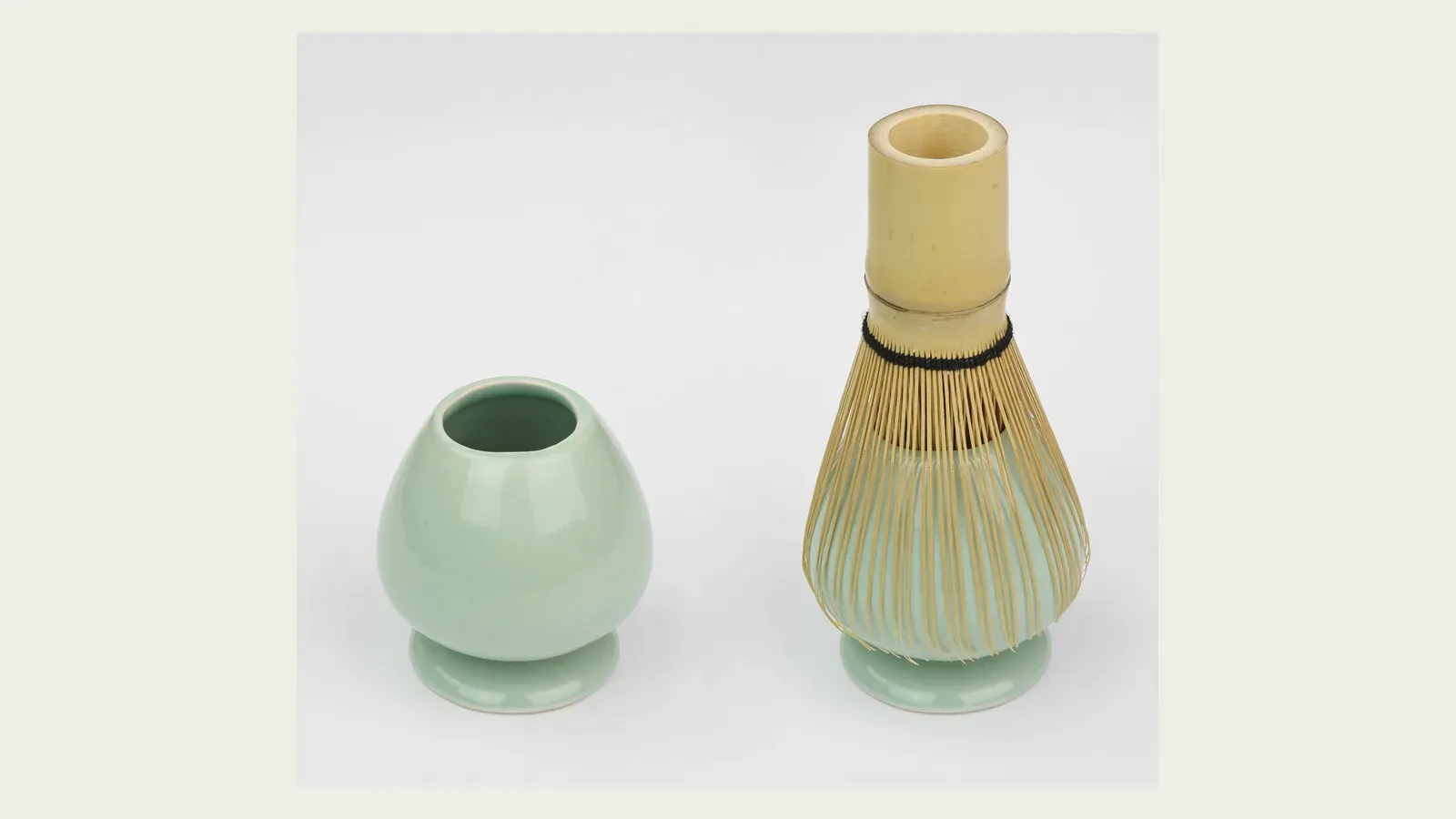
Two things justify spending: a real bamboo chasen (whisk) and good, fresh first-flush matcha. A wide bowl, a sifter, and a scoop round out a real kit, but a cereal bowl, a fine strainer, and a half-teaspoon all substitute fine. An electric frother is an honest beginner shortcut that won’t teach you the whisk.
You can spend two hundred dollars assembling a matcha kit, or you can spend thirty. Almost the whole gap is teaware you don’t need yet: a handsome bowl, a lacquered caddy, a scoop carved from a single node of bamboo. None of it changes how the tea tastes. Two purchases do. Get the whisk and the powder right, and a cereal bowl from the cupboard will carry you for months.
So the useful question about any item in a starter kit is a plain one. Does it change the cup, or only the photograph? Most of what gets sold as essential belongs to the second group. The order below runs from what earns its money to what you can improvise or skip outright.
The two purchases that change the cup
Two things justify real money. Everything else can wait, borrow from your kitchen, or never arrive at all. One of the two is the powder. The other is the whisk.
Fresh matcha from the first flush
This is where the money goes, and where most beginners under-spend. Matcha is tencha (碾茶), shade-grown leaf that has been steamed, dried flat, stripped of stem and vein, then stone-ground to a powder finer than flour. You drink the whole leaf instead of steeping it and pouring it off, so quality and freshness land straight in the bowl. Stale or coarse powder tastes flat, dusty, and bitter however well you whisk it.
The single most useful thing to look for is the harvest. First flush is Japan’s spring picking, the ichibancha (一番茶), and it yields the sweetest, smoothest, most vivid powder, because leaves that grew slowly through the cold months store amino acids without the astringency of summer growth. Sugimoto Tea dates the first flush from early April to early June and calls it the source of the highest matcha grades, with markedly higher L-theanine and a sweeter, milder taste 5. Later pickings race up under strong sun and give a coarser, cheaper leaf 4.
Color is the quick tell. Good matcha is an almost unreal jade green, and a dull, yellowish, or olive powder means later-harvest leaf, age, or oxidation. It also wants drinking young, closest to its spring harvest and finished within a month or two of opening, because light, heat, and air degrade the green pigment and turn the flavor bitter. The mechanics of that fade, and how to slow it, are in how to store matcha.
Then there’s the tin’s front label, which you can ignore. “Ceremonial grade” is not a legal or regulated term. Naoki Matcha, a Uji producer that sells under the label itself, states plainly that no organisation regulates it and Japan has no standardized matcha grading system to begin with 6. What separates a whisking matcha from a baking one is harvest timing, how long the plants were shaded, leaf selection, and the grind, all of which you can read off color, origin, harvest date, and price per gram. The full method is in ceremonial vs. culinary matcha.
A real bamboo chasen
The chasen (茶筅, “tea whisk”) is the one tool nothing else replaces. It is a single length of bamboo, the working end split and shaved into dozens of fine tines that curl inward. Whisked briskly, those tines shear air into the tea and break the powder into suspension, raising the fine microfoam that makes matcha taste smooth instead of gritty 2. A fork pushes the powder around. A spoon stirs it. The geometry of a split-bamboo fan is what does the actual work, and nothing in a kitchen drawer copies it.
For a first whisk, roughly 80 to 100 tines is the practical count. Yunomi puts the standard whisk at 70 prongs and recommends about 80 to 100 for beginners, because more and finer tines fold in air more easily and foam with less technique 2. The very high counts, 100 to 120, make a slightly finer foam and break sooner.
Where the money matters is provenance, not tine count. A handmade Japanese whisk, almost all of them carved in Takayama in Nara Prefecture, is cut from a single node with the knife work done by eye, and it out-lasts and out-performs the few-dollar machine-cut imports that use thicker, coarser tines and lower-grade bamboo, often sold as Japanese-made when they are not 3. The cheap ones foam poorly and shed splinters into the tea as they flex. A real one costs more up front and earns it. Whichever you buy, treat it as a consumable: the tines break down over months of use, and that is normal wear, not abuse 3. Of all the teaware here, the whisk is the one to buy properly from the start. For counts, bamboo, and care, see the chasen. For the wrist motion itself, how to whisk matcha.
The supporting kit, and what substitutes for it
These help. None is urgent, and every one has an honest stand-in already in your kitchen.
A bowl wide enough to whisk in
You whisk in the bowl, so it has to give the chasen room to sweep. A chawan (茶碗) is built for it: usually 12 to 15 cm across the rim and 7 to 9 cm deep, wide enough to move the whisk flat across a broad, gently curved floor, deep enough that brisk whisking doesn’t throw tea onto the counter. A bowl too shallow can’t build the resistance that raises foam. A bowl too narrow jams the tines against the wall and frays them.
You don’t need to buy one on day one. Any wide, deep-enough bowl works for learning (a soup or cereal bowl with a rounded interior and no sharp inner corners), and it serves longer than most people expect. A good chawan is a real pleasure to hold, and it earns a place in the cupboard eventually, but it is teaware, not equipment. What to look for when you do buy one is in the chawan.
A sifter, or any fine strainer
Matcha clumps. The powder is fine enough to cake from static and humidity, and the clumps don’t whisk out. They only break into smaller clumps that leave bitter little knots on the tongue. Sifting the powder into the bowl before the water goes in is the fix, and it is the step the sellers themselves put first: Ippodo’s usucha method opens with sifting 1. A dedicated matcha sifter or furui (篩), usually a small canister with a mesh floor, is convenient. Any fine-mesh kitchen strainer does the identical job. Push the powder through with the back of the scoop. With fresh, well-sealed matcha the caking is mild and the sift takes ten seconds, not a chore.
A scoop, or a half-teaspoon
Consistency is what makes a bowl repeatable, and the chashaku (茶杓), a slim bamboo scoop bent from a single sliver, is the traditional measure. Ippodo’s standard thin-tea (薄茶, usucha) ratio is about 2 g of matcha to 60 ml of water near 80°C 1. A level scoop of matcha runs close to 1 g, so the usual dose is roughly two scoops, and a level half-teaspoon lands in the same place. The chashaku is cheap and lovely and the easiest tool here to replace. For real precision a small kitchen scale beats both: weigh 2 g and you will never wonder why one bowl came out thin and the next pasty.
A whisk stand you can skip
A kusenaoshi (くせ直し, “habit-fixer”) is a low ceramic dome you rest the wet chasen on to dry. It holds the tines splayed in their curl so the whisk keeps its shape and lasts a little longer, instead of drying clenched and warped. It is the most skippable object in this guide. Standing the rinsed whisk upright in a cup, tines up, air-dries it nearly as well. One rule holds either way: never store a damp chasen sealed in a closed container, stand or no stand, or it grows mold.
The electric frother, honestly
The frother deserves a straight answer, because the usual advice is precious about it. A cheap handheld electric frother, the spinning-coil kind sold for milky coffee, works. It dissolves matcha into water without clumps and puts a head of foam on top, faster than a chasen and with no technique to learn. If that is what gets you drinking matcha every morning, use it. It is a legitimate beginner’s tool.
The catch is the foam and the motion. A frother whips large, loose bubbles that flatten into a thin layer within a minute. A chasen shears in much finer air and leaves a dense, velvety microfoam that holds in the bowl and carries the flavor differently. You’ll taste the gap once you’ve had both, and a motor will never teach your wrist the stroke. Start with the frother if it gets you drinking matcha. Move to the whisk when you want the cup the frother can’t make, which is the whole reason the chasen sits in the first group and not this one.
What to buy, what to improvise
Here is the whole thing on one page. The left column is the traditional piece, then what it does, an honest substitute, and when the upgrade earns its cost.
| Item | What it does | Honest substitute | When to upgrade |
|---|---|---|---|
| Chasen (bamboo whisk) | Shears air into the tea for fine foam | Cheap electric milk frother | Buy the real whisk first; it changes the cup most |
| Fresh first-flush matcha | The flavor itself | none — this is the spend | Start here; buy small, buy fresh |
| Chawan (tea bowl) | A wide, curved floor to whisk on | Any wide, deep cereal bowl | When you want one for pleasure, not performance |
| Furui (sifter) | Breaks the clumps before whisking | Any fine-mesh kitchen strainer | Rarely; the strainer does the same job |
| Chashaku (scoop) | Measures the dose (~1 g per scoop) | Level ½ teaspoon, or a scale | A scale, if you want exact doses |
| Kusenaoshi (whisk stand) | Holds the tines in shape to dry | Air-dry tines-up in a cup | Only once you’re committed |
Two ways to start, then. The minimum kit that makes a real bowl is a small tin of fresh first-flush matcha, a Japanese-made chasen, a wide bowl already in your cupboard, a fine kitchen strainer, and a half-teaspoon. Every piece either changes the cup or you already own it. Nothing in that list is a compromise on the tea.
The real kit adds the teaware you buy for its own sake: a chawan you like the weight of, a bamboo chashaku, a dedicated sifter, a whisk stand. None of it makes better tea. All of it makes the ritual more pleasant to perform, which is a fair reason to own it, as long as you know which column each object belongs to.
On rough prices, and these are general ballparks rather than any one shop’s number: a Japanese-made chasen commonly runs about US$20 to US$40, with named-artisan Takayama whisks well above that. A whisking-grade tin of first-flush matcha commonly lands around US$25 to US$45 for 30 to 40 grams, which works out near one to two US dollars a gram, the floor set by how slowly stone mills turn the powder out. The bowl, the strainer, and the spoon you already have. So the minimum kit is roughly US$45 to US$85 all in, and most of that is the matcha and the whisk, exactly where the money should sit.
Reading the matcha tin
Since the matcha is half of what matters, a short checklist for the tin before you buy:
- A stated first-flush (spring) harvest. A seller confident in the leaf tells you when it was picked. Vagueness is a flag.
- Vivid jade color. Bright, near-electric green. Yellow, brown, or dull olive powder is old or low-grade.
- Single-origin, from Japan, sold for drinking. Look for “usucha” or “thin tea” framing and a named region such as Uji, Yame, or Kagoshima. Read “ceremonial grade” as marketing, not information.
- Small quantity, opaque sealed packaging. Buy an amount you’ll finish in a month or two, in a tin or foil pouch that blocks light. A small tin you drink fresh beats a large one that fades in the cupboard.
- A believable price per gram. Real first-flush, stone-milled matcha costs money to produce. A big bargain tin is almost always later-harvest, machine-ground culinary powder wearing a nicer word.
Then whisk it the way the sellers do. Sift, add about 2 g of powder to 60 ml of water at around 80°C (below boiling, which scorches the leaf and turns it harsh), and whisk briskly in an M or W shape for roughly fifteen seconds 1. That one set of numbers, with fresh matcha and a real whisk, is most of the distance between a good bowl and a disappointing one. The full technique, water temperature and all, is in how to whisk matcha.
The kit is smaller than the market wants it to be. You spend on two things and pay attention to them, fresh first-flush powder and a real bamboo whisk, and everything else in the drawer is a substitute you already own. Sift with a strainer, whisk in a cereal bowl, and the drink in front of you is the same one, made with the same two gestures, as the bowl set down at a formal table. The daily practice is built from exactly this handful of tools, and if the two gestures start to hold your attention more than the gear does, that is the quiet on-ramp to chadō (茶道), the Way of Tea.
Sources
6sourcesIppodo Tea (Global, Kyoto since 1717)
SupportsUsucha method: sift first, 2 g matcha to 60 ml water at 80°C, whisk vigorously ~15 seconds; preparing quickly preserves the fragrance
Yunomi.life
SupportsChasen anatomy; whisks carry ~80–120 tines (minimum ~16), standard 70, and ~80–100 recommended for beginners; carved from a single piece of bamboo; more and finer tines foam more easily
Global Japanese Tea Association
SupportsSingle-piece bamboo construction; ~80–100 tines for usucha; handmade Japanese whisks versus cheaper, coarser imports; the chasen is a consumable to rinse, dry, and replace
Encha
SupportsFirst harvest (ichibancha) naturally sweet, smooth, vibrant green; second harvest earthier and fuller-bodied, cheaper, for blends; first flush limited and hand-selected, so it commands a premium
Sugimoto Tea Company (since 1946)
SupportsIchibancha (first flush) early April to early June; markedly higher L-theanine, a sweeter and milder taste, and the source of the highest grades of matcha and sencha
Naoki Matcha (Uji)
SupportsNo government or international organisation regulates 'ceremonial grade'; Japan has no standardized matcha grading system; producers define the term themselves
Image: D-Kuru, Wikimedia Commons · CC BY-SA 4.0
Common questions
Do I need a bamboo whisk, or is a milk frother fine?
A frother is a fine way to start. A cheap handheld electric frother dissolves matcha and puts foam on it, faster than a chasen and with no technique to learn, and if it gets you drinking matcha daily it has done its job. What it can't do is match the foam or teach the wrist motion: a frother whips large, loose bubbles that flatten within a minute, while a bamboo chasen shears in much finer air and leaves a dense microfoam that holds in the bowl. A fork or kitchen whisk only pushes the powder around. The chasen is the one tool with no true substitute, so if you buy one thing, buy that.
Is 'ceremonial grade' matcha worth the money?
The label is worth nothing on its own, because it is not a regulated term. No organisation certifies 'ceremonial grade' and Japan has no standardized matcha grading system, so anyone can print it on any tin. What you are paying for, when the tea is good, is a stated first-flush (spring) harvest, long shade, hard leaf selection, and stone-milling. Judge those by color, named origin, harvest date, and price per gram rather than the front label.
How much should a matcha starter kit cost?
A workable minimum kit runs roughly US$45 to US$85, and most of that should be the matcha and the whisk. As general ballparks: a Japanese-made chasen commonly costs about US$20 to US$40 (named-artisan Takayama whisks run well above that), and a whisking-grade tin of first-flush matcha commonly lands around US$25 to US$45 for 30 to 40 grams. A cereal bowl, a fine strainer, and a half-teaspoon you already own, so they cost nothing.