The Implements
Tetsubin, Tetsukyūsu & Kyūsu: Choosing a Japanese Teapot
A tetsubin boils water; a tetsukyūsu and a kyūsu brew tea. The difference is the lining and the heat — get it wrong and you ruin the pot or the tea.
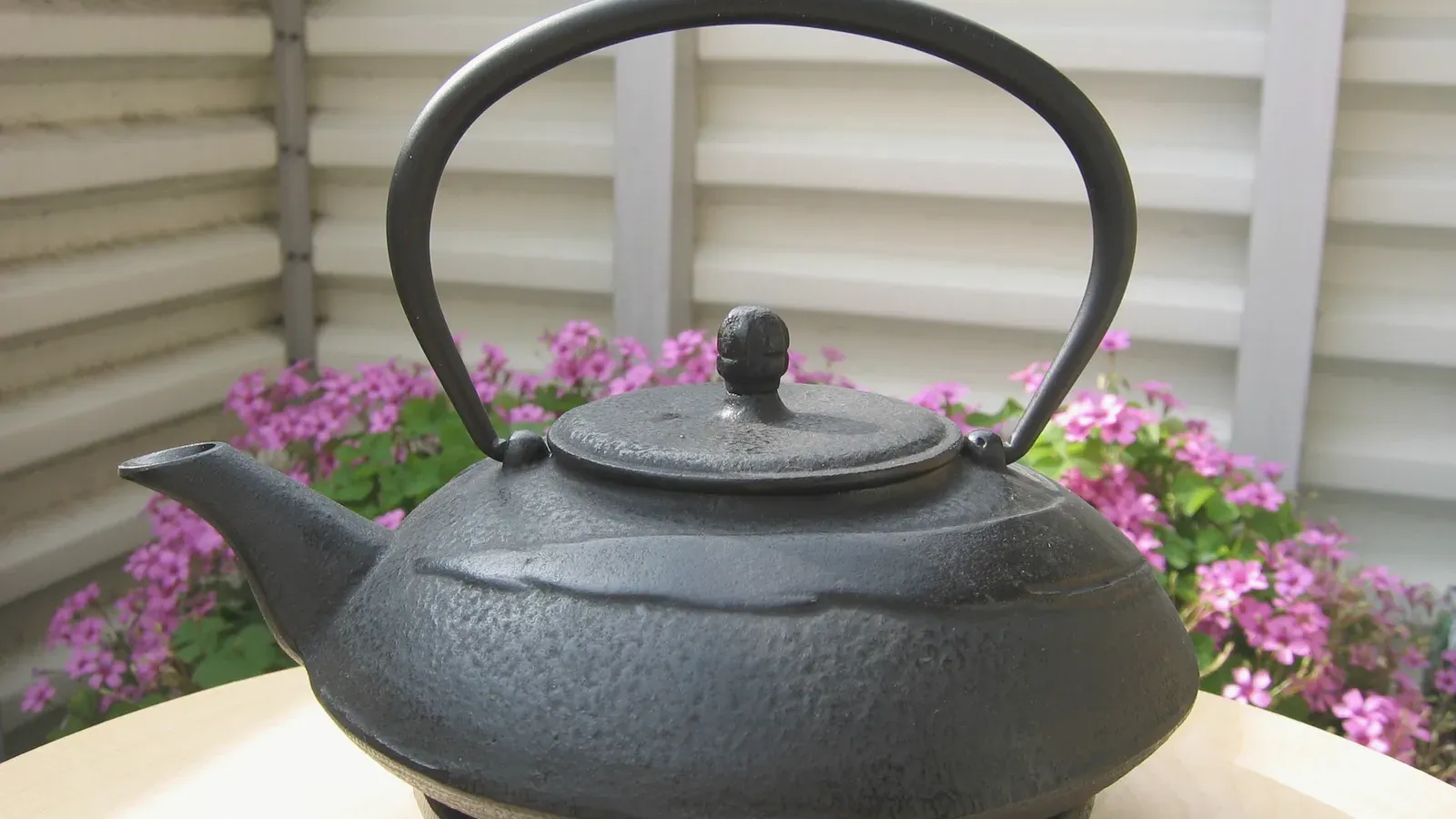
Three Japanese vessels get confused. A tetsubin is bare cast iron for boiling water on the stove, never for brewing. A tetsukyūsu is an enamel-lined iron teapot for brewing only, never over a flame. A kyūsu is the ceramic side-handle pot most people should brew loose-leaf in. Buy a true bare-iron tetsubin for water and a kyūsu for tea.
Search for a “Japanese cast iron teapot” and you will be sold a heavy, handsome pot with a top handle, usually enamel-lined inside, and often described in the same breath as a tetsubin. Some of those listings are mislabelled. Buy the wrong one and you get either a ruined pot or ruined tea. The three vessels look related and do different jobs, and the whole tangle comes apart with two questions: what is the inside made of, and can it take direct heat.
The three vessels, sorted
| Vessel | Job | Interior | On a flame? | Material |
|---|---|---|---|---|
| Tetsubin (鉄瓶) | Boil water | Bare cast iron | Yes, made for it | Cast iron |
| Tetsukyūsu (鉄急須) | Brew tea | Enamel-lined | No, enamel cracks | Cast iron |
| Kyūsu (急須) | Brew tea | Glazed or bare ceramic | No | Ceramic / porcelain |
The table settles most of it. The two iron pots are near-identical from the outside and opposite in function, and the line between them runs along the lining. The kyūsu is the odd one out in material, and the one most people need. It also happens to be the cheapest of the three by a wide margin, which most buyers reaching for iron never consider.
The tetsubin: a kettle, not a teapot
A tetsubin (鉄瓶) is a cast iron kettle for boiling water. Its defining feature is a raw, uncoated cast iron interior, and that feature is non-negotiable. A genuine tetsubin is bare metal inside 3. You fill it, set it on the stove or a brazier, and bring the water to a boil. The body is built to take direct heat 1.
Sellers make a further claim for that bare interior: that it softens the water and leaves a trace of iron behind, rounding the hard mineral edge that flattens delicate greens. Treat the claim with care. A well-used, unlined tetsubin can shed a small amount of iron into boiling water, and in casual side-by-side sips people often do prefer it, calling it fuller or a touch sweeter. The testing behind that is informal, and the effect is subtle. “Adds healthful iron” and “softens hard water” are marketing sentences more than measured ones, and how much iron transfers depends on the pot, its seasoning, and your water. One benefit is not in dispute. Heavy iron holds heat, so a tetsubin keeps water hot long after it leaves the flame.
Tea itself stays out of the pot. Tannins react with bare iron and turn the brew dark and metallic while stripping the thin protective seasoning the interior slowly builds. The bare metal that suits water is exactly wrong for leaf. Boil in the tetsubin, then pour the water over your tea in something else.
The tetsukyūsu: iron outside, glass inside
A tetsukyūsu (鉄急須) is what most Western shops are selling when they say “cast iron teapot.” It looks like a small tetsubin, and its interior is enamel-lined, a glassy coating fired onto the iron 1. The enamel is what the pot is for. It seals the iron away from the tea, so the tannins never meet metal and the pot can sit full of brew without rusting or going inky. Many come with a small removable strainer.
The same enamel sets the pot’s one hard rule: keep it off the flame. Enamel is glass, and direct heat cracks it, which can then chip and flake into the tea 1. A tetsukyūsu is a brewing pot. You fill it with hot water from a kettle, ideally a tetsubin, and let the leaf steep. It gives you iron’s looks and its steady warmth at the table, with none of the tetsubin’s water chemistry, because the tea never touches the metal.
So the two iron pots invert each other. The tetsubin is bare inside and lives on the stove. The tetsukyūsu is lined inside and never sees a flame. An enamelled interior tells you which one you are holding, whatever the listing called it.
The kyūsu: the one most people should buy
The kyūsu (急須) is the everyday Japanese teapot, and for loose-leaf green tea it is the one to reach for. It is ceramic or porcelain rather than iron, and its signature is the handle set at a right angle to the spout. That side-handle form has a name, yokode (横手), and it is the common Japanese type 6. It lets you pour one-handed while a finger steadies the lid, the quick controlled pour that sencha and gyokuro want. Two other shapes exist: the ushirode (後手), a rear handle like a Western teapot, easier if you are left-handed or used to the Western grip, and the uwade (上手), a top handle over the body that stays cooler and suits larger pots 6.
Most kyūsu carry a built-in filter to hold back fine leaf, and the best of them are ceramic rather than metal. The sasame (笹目) is a field of small holes formed directly in the clay near the spout, which keeps the whole vessel one material and avoids the faint metallic edge a steel mesh can leave 4. A wide ceramic filter also copes with the fine sediment of deep-steamed fukamushi sencha, which clogs a small basket strainer.
Here is the judgment this piece will stake. A modest ceramic kyūsu, the kind that costs a fraction of a good iron pot, brews Japanese green tea better than either the tetsubin or the tetsukyūsu. It is light, it holds only the small volume you steep at a sitting, and a thin wall lets you feel the water’s heat through the clay. For the temperatures and steep times each tea wants, see the brewing guide. If you are buying one vessel to make good gyokuro or sencha, buy a kyūsu.
The clay does more than hold shape
Not all kyūsu clay is neutral. The most prized comes from Tokoname (常滑), a kiln town on the Chita Peninsula and one of Japan’s Six Ancient Kilns, with a ceramic tradition going back to the Heian period. Tokoname developed the kyūsu during the Edo era as loose-leaf sencha spread 4. Its trademark red shudei (朱泥) clay is rich in iron, which is what fires it to that brick-red, and the low-porosity body seasons gently over time without pushing flavour of its own into the tea.
Banko ware (萬古焼), from Mie Prefecture, works a similar seam. Its shidei (紫泥) clay is exceptionally high in iron, and firing it in a reduction chamber turns the surface a purplish brown. The clay is left unglazed, and it is said to react with the tannic acid in the tea and smooth off some of the bitterness 7. That is the same rounding effect claimed for a tetsubin, arriving here through the pot’s own iron-bearing clay rather than through the water, and without the risk of an inky brew. Whether the softening is dramatic is a matter of taste. The pots are light, well-made, and pleasant to use, which is reason enough.
Nambu tekki: where the good iron comes from
The benchmark for a real tetsubin is Nambu tekki (南部鉄器), the cast ironware of Iwate Prefecture in the northern Tōhoku region. It grew from two towns with separate lineages, now sold under one name.
Morioka is the tea-ceremony line. In 1659 the local feudal lord, keen to promote chanoyu, brought a kettle caster named Nizaemon Koizumi up from Kyoto to work near the castle 2. The Koizumi family cast the large kama used over the hearth in the tea ceremony, and it was the third-generation Nizaemon who scaled that kettle down, adding a handle and a pouring spout to make it useful for open-air tea. That smaller pot became the tetsubin 2. The iron kettle you know is a descendant of the ceremonial hearth-kettle, a connection the brazier and sunken hearth make plain.
Mizusawa, further south in Ōshū, runs older and more workaday. Its casting began in the late Heian period, when Kiyohira Fujiwara of the Ōshū Fujiwara clan brought foundrymen in from Shiga to make pots, kettles, and farm tools 5. The two towns’ output now carries the single name Nambu tekki, which is why it holds both the polish of an art craft and the plainness of a working tool. For a tetsubin, a Nambu piece is the one to want, and a well-kept one will outlast you.
Which size, and when
Size follows the job, and the two iron pots and the kyūsu land in different places.
- Tetsubin (kettle): roughly 0.6 to 1.5 litres. Match it to how many cups you boil for at once, and remember that full cast iron is heavy before you add water. A 1-litre pot lifted with wet hands is already a two-handed object.
- Everyday kyūsu: around 240 to 360 ml, enough for two or three small Japanese cups in a sitting.
- Gyokuro or high-grade sencha kyūsu: smaller, often 150 to 200 ml, because these teas are brewed in little water and drunk in tiny servings. A big pot forces you to over-brew.
- Tetsukyūsu (serving): typically 300 to 600 ml, sized for the table rather than for precision. Its strength is holding heat while a group drinks, not the exacting little pour a gyokuro wants.
If you buy only one kyūsu, a 300 ml Tokoname pot handles nearly everything short of top-grade gyokuro. It is the safe first pot, part of the wider Japanese tea toolkit.
How to choose, and what to avoid
The single most useful check costs nothing and happens before you buy. Look inside.
- Bare, raw iron, sold for the stovetop. That is a tetsubin, the pot for boiling water. Buy genuine Nambu tekki if the budget allows.
- Enamel-coated, sold for brewing. That is a tetsukyūsu. Fine for serving tea with iron’s looks, as long as you know you are buying a pot that can never boil water.
- Heavy decorative “cast iron teapot,” suspiciously cheap. Treat it with suspicion. Many mass-market imports are coated, thinly enamelled, or close to purely decorative, with neither the honest bare interior of a real tetsubin nor the quality lining of a good tetsukyūsu.
Now the honest steer, because the marketing muddies it. Want what makes iron special, the softer and rounder water? Buy a true bare-iron tetsubin and use it as a kettle. Mostly want to brew good Japanese tea? A ceramic kyūsu beats an enamel-lined iron pot for a fraction of the weight and the price. The enamel-lined “cast iron teapot,” the thing most often sold to beginners as their first serious pot, is the one vessel of the three that is hardest to justify on its own. Most buyers who think they are getting a tetsubin are getting one of these.
Caring for iron and enamel
Iron’s enemy is standing water. When a tetsubin comes off the heat, empty it and dry the inside thoroughly, because residual water rusts the bare interior 1. Leave the lid off so the inside air-dries, and let the pot’s own leftover heat finish the job. Never scrub the interior. The thin film of mineral scale that builds up there is the seasoning that protects the iron and does the quiet work on the water, and a scouring pad takes years off the pot in a minute.
A tetsukyūsu asks for less. Rinse it with hot water, let it air-dry, and keep it off any flame for good. The enamel does the protecting, so there is no seasoning to nurse, but there is also no forgiveness for a burner. The full routine for iron, enamel, and every other material sits in how to care for your teaware.
All of which returns to the one test that decides everything here. Turn any of the three pots over and look inside. Raw iron is a kettle, enamel is a teapot, and bare red clay with holes near the spout is the kyūsu you will use every morning. The word on the box stops mattering the moment you can see the interior.
Sources
7sourcesGlobalkitchen Japan
SupportsTetsubin = bare cast iron, boils water, used over open fire, must be dried to avoid rust, said to soften water; tetsukyūsu = enamel-lined interior, brews tea, must NOT go over open fire (enamel is glass, cracks under direct heat)
KOGEI JAPAN (Nambu Ironware)
SupportsMorioka origin 1659: a feudal lord promoting tea ceremony ordered kettle caster Nizaemon Koizumi to move from Kyoto; the Koizumi family cast ceremonial vessels, and the third-generation Nizaemon developed the smaller iron kettle known as the Nambu iron kettle (tetsubin)
Nio Teas
SupportsA genuine tetsubin has a raw, uncoated cast iron interior — non-negotiable; an enamelled interior means it is a tetsukyūsu, for brewing only; tetsubin valued for heat retention and subtle mineral effect on water
Rishi Tea, 'Tokoname: The Ancient Ceramic City That Shaped Sencha Brewing'
SupportsTokoname shudei clay rich in iron, quartz and mica, fires brick-red, low porosity; the sasame filter is perforations formed directly in the clay near the spout, avoiding a metallic taste; Tokoname is one of Japan's Six Ancient Kilns (Heian period), and developed the kyūsu in the Edo period as sencha spread
Japanese Traditional Crafts (japanese-tc.com), 'Nambu Ironware'
SupportsMizusawa production began in the late Heian period (794–1185) when Kiyohira Fujiwara invited foundrymen from Shiga to make pots and kettles; Morioka dates to the mid-17th century when the feudal lord invited a tea-kettle master from Kyoto
Kyūsu — Wikipedia
SupportsKyūsu handle taxonomy: yokode (横手, side handle, the common type, at a right angle to the spout); ushirode (後手, rear handle, like a Western teapot); uwade (上手, top handle)
Sazen Tea (Banko ware / shidei kyūsu)
SupportsBanko-yaki shidei clay is exceptionally rich in iron; fired in a reduction chamber the iron turns the clay from red to purplish-brown; the unglazed clay reacts with the tannic acid in tea, smoothing bitterness; Banko origin in the Genbun era (1736–40), now centred on Mie Prefecture
Image: No machine-readable author provided. Blanu assumed (based on copyright claims)., Wikimedia Commons · CC BY-SA 3.0
Common questions
Can you brew tea directly in a tetsubin?
You shouldn't. A true tetsubin has a raw, uncoated cast iron interior made for boiling water, and tea's tannins react with bare iron, turning the brew inky and metallic and harming the pot's seasoning. Boil your water in the tetsubin, then pour it over leaf in a separate kyūsu or tetsukyūsu.
Is a cast iron teapot the same as a tetsubin?
No, and this is the most common mistake buyers make. Most 'cast iron teapots' sold in the West are tetsukyūsu: enamel-lined inside, made for brewing, and unable to go on a flame. A tetsubin is bare iron inside and made to boil water over heat. Check the interior. Enamel means teapot, raw iron means kettle.
What is Nambu tekki?
Nambu tekki (南部鉄器) is the traditional cast ironware of Iwate Prefecture in northern Japan, made in Morioka and Mizusawa. It is the benchmark for a quality tetsubin, with a casting tradition running back to 1659 in Morioka and to the 12th century in Mizusawa.