Zen Writing
How to Read the Tea Room Scroll
The kakemono in the tokonoma is the first thing a guest reads at a tea gathering. What the hanging scroll is, why it ranks first, and how to read a bokuseki.
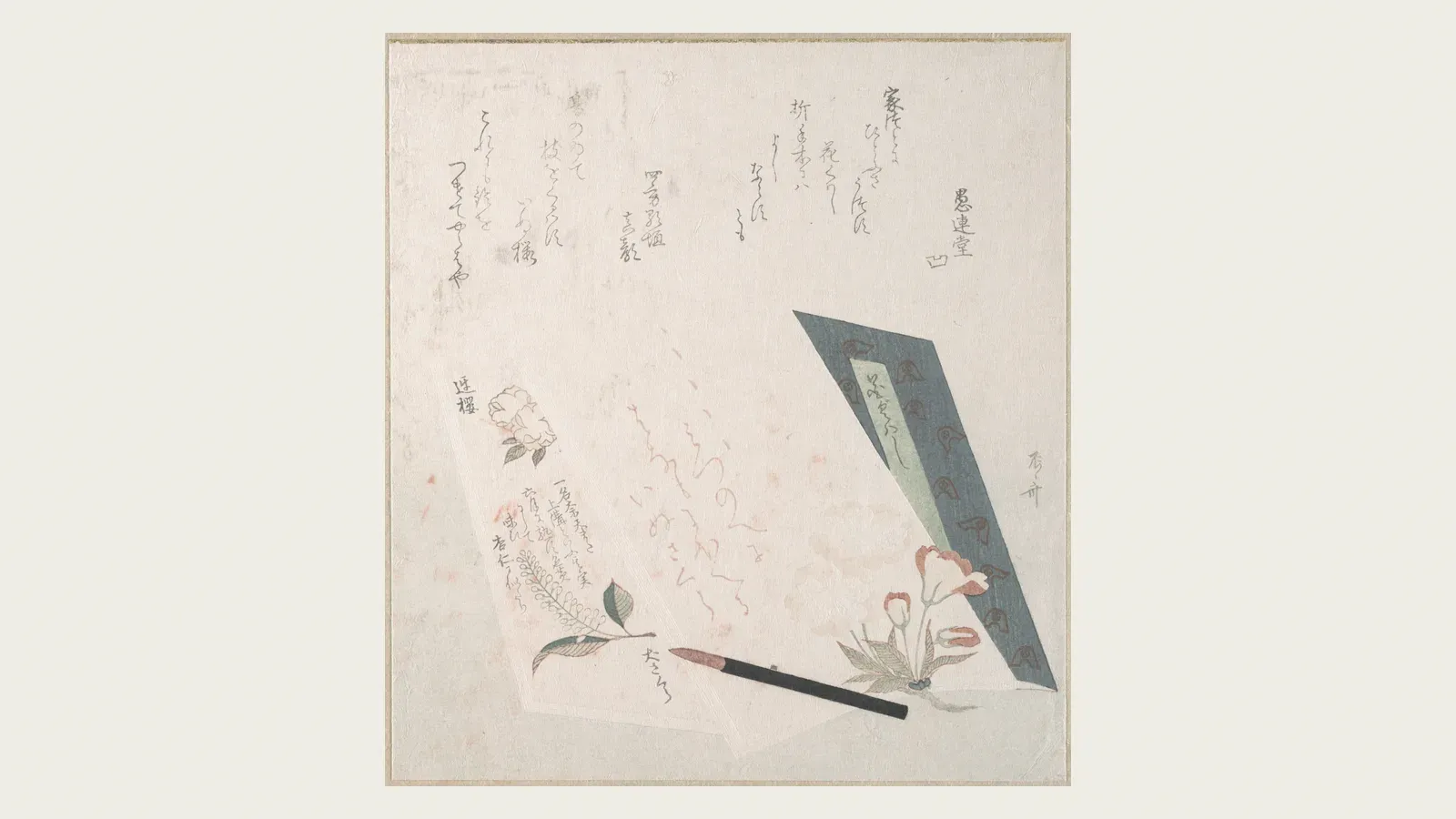
At a tea gathering the guest kneels at the alcove and reads the hanging scroll (kakemono) before anything else. The scrolls held highest are bokuseki, calligraphy by Zen monks, prized for the writer’s standing more than for a polished hand. This is a guide to the object and the act of reading it: how a scroll is mounted and hung, why it outranks every other utensil, the guest’s viewing sequence, and how to face a line of cursive Zen you can barely decode.
Step into a tea room through the low crawl-through door and the first thing asked of you happens at the wall. Not the greeting, not the kettle. You cross to the recessed alcove, the tokonoma (床の間), kneel in front of it, set your folding fan on the mat before your knees, and bow to a narrow strip of paper hung there with a few black characters brushed down its length.7 That strip is the kakemono (掛物), the hanging scroll, and by the tradition’s own reckoning it is the most important object in the room. This piece is about the scroll as a thing you read: what it is, how it is built and hung, and what a guest does in front of it.
This belongs to a wider look at Zen and the tea room. The words on the scroll are their own subject, covered in the companion piece on the one-line Zen phrases a host chooses from. Here the interest is the object and the encounter: the ranking, the mounting, the sequence of viewing, the practical problem of a line you cannot read.
Why the scroll outranks everything else
Chanoyu ranks its utensils, and the scroll sits at the top of the list. The clearest old statement of this comes from the Nanpōroku, the Edo-period compilation of Sen no Rikyū’s (1522–1591) teaching: there is no more important utensil than the kakemono, the calligraphy is the first priority, and the guest should respect the spirit of the writer.2 Treat the phrasing with a little care, since the Nanpōroku was written down generations after Rikyū and its authenticity is debated by scholars. The ranking it records, though, is uncontested across the schools. A modern teaching glossary puts it flatly: the scroll is the most valued item in the tearoom.6
That precedence is physical, built into the order of the work. The host decides the scroll first when assembling a gathering, before the flowers, before the sweet, before the bowl, because everything else is chosen to agree with it.8 The line names the theme of the day, and the season in the flowers, the pace of the host’s hands, and the choice of a summer or winter bowl all read as a commentary on it. Chadō (茶道) is a made composition, and the scroll is the sentence the rest of the room is built to complete.
There is a second reason it comes first in time as well as rank. In a full gathering the scroll hangs only through the opening seating and the meal. At the mid-gathering break, the host sweeps the room, takes the scroll down, and hangs a single flower where it was.7 By the time thick tea is served, the words are gone and the alcove holds a stem of something seasonal instead. So the guest reads the scroll early or misses it. Whatever it had to say is said before the tea is made.
What a bokuseki is, and how it is judged
The scrolls held in highest regard are bokuseki (墨跡), “ink traces”: calligraphy brushed by Zen monks.1 A bokuseki is judged by the standing of the hand that made it. A line by a respected abbot of real practice outranks a more even sheet by a professional scribe, because the room reads the ink as a trace of the writer’s mind, evidence of the person ahead of the penmanship.2 This is the reverse of how most calligraphy is valued, and it takes some getting used to. A line that looks blunt or unbalanced on the wall can be the prized object in the room, hung precisely for whose hand it is.
The link between tea and the Zen temples runs back to the fifteenth century. By tradition, Murata Jukō, usually named as the first wabi tea master, received a sheet of Chinese Zen calligraphy by the Song master Engo (Yuanwu Keqin) from his teacher Ikkyū Sōjun at Daitoku-ji (大徳寺), the Kyoto Rinzai monastery bound up with the whole history of tea, and hung it where he served.2 From that gesture, a monk’s brushwork treated as the heart of a gathering, the tea scroll descends. Daitoku-ji stayed its source. Rikyū is recorded mounting a line by his own Daitoku-ji teacher, Shunoku Sōen, and even now a scroll from a Daitoku-ji abbot carries the weight of the temple behind the ink.2
None of this is about the phrase itself, which is a separate study. The catalog of what the lines say, from the gentle kissako to the single character mu, is laid out in the companion piece. What matters for reading the object is the ranking: you are looking at a thing valued for its writer, and the more you know about who held that brush, the more the scroll gives back.
The parts of the scroll
The calligraphy is a small sheet at the center. Everything around it is the mounting, the hyōgu (表具), and reading a scroll well means seeing where the paper of the writing ends and the dressing begins. The mounting exists to protect a fragile sheet, to let it roll into a box for storage, and to frame the writing in cloth graded from plainest at the edges to finest against the work.4 A mounter, the hyōgushi, builds it in tiers.
| Part | Reading | What it is |
|---|---|---|
| 本紙 | honshi | the brushed sheet itself, the calligraphy |
| 一文字 | ichimonji | the two strips of the best brocade, directly above and below the honshi; named for the character 一 |
| 中廻し | chūmawashi | the middle border framing the honshi; narrowed in tea mounts |
| 天・地 | ten / chi | ”heaven” above and “earth” below, the broad plain expanses at top and bottom |
| 柱 | hashira | the “pillars,” the vertical strips running down each side |
| 風帯 | fūtai | the two “wind straps” hanging loose from the top bar |
| 軸・軸先 | jiku / jikusaki | the weighted roller at the foot and its two end knobs, which you grasp to roll it |
| 掛緒 | kakeo | the cord at the top you hang the scroll by |
Two details reward a guest’s notice. The fūtai, the pair of straps hanging from the top, are the fossil of a real function, having once hung outward to keep birds off a scroll displayed in the open. Indoors they stay as a mark of formal mounting.4 And the chūmawashi, the border immediately around the writing, is where tea leaves its fingerprint. The mounting style developed for tea, called chagake or Rikyū hyōgu, deliberately narrows that border, tightening the cloth around the line so the room looks at the ink and not at the dressing.3
Mounts run on the same three-grade scale as the rest of chadō, from shin (真, most formal) through gyō (行) to sō (草, most informal), each grade set by the richness of the brocade and the geometry of the tiers.3 A gold-thread formal mount suits a sutra or an imperial hand. A bokuseki wants something quieter. Here is a judgment I will stake: a gorgeous brocade wrapped around a Zen line is a small vulgarity, because it dresses up a hand whose whole claim was that it needed no dressing. The best tea mounts on a bokuseki are the plain ones, and a host who reaches for the loud silk has misread the object.
How it is hung, and how you view it
The scroll hangs flat against the back wall of the tokonoma, its roller weighting it straight, the cord looped over a small hook near the alcove’s lintel.5 A tea room is either a small koma of a few mats or a larger hiroma, and the host sizes the scroll and its mounting to the alcove of the room in hand, which is one reason a scroll is chosen before anything else.8 The alcove itself, its dimensions and its place in the tea room, sets the frame the scroll has to fit. It is a viewing space you look into from outside its raised edge. You do not step into it, and you do not touch what it holds.
The guest’s sequence is fixed. Do it in this order:
- Enter and cross to the alcove. After coming through the low door, before settling at your place, move to the front of the tokonoma and kneel.
- Set the fan down. Place your folding fan on the mat in front of your knees, a boundary that marks a formal viewing and keeps your hands empty and low.7
- Bow, then read the scroll. Make the bow to the alcove, then look at the hanging scroll first, taking in the whole of it before the flower.7
- Take in the flower and its vessel. After the scroll, look to the chabana, the single seasonal flower, and the vase it stands in, since these were chosen to answer the line above them.8
- Then greet the room. The bow to the host and the later formal viewing of the kettle, the tea container, and the bowl all come after the alcove has been read.
Do all of this from your knees. Look closely, but keep your hands off the scroll and stay clear of the alcove’s edge. The one utensil a guest never handles is this one. The bowls and caddies come out for close viewing later, but the scroll stays on its hook. Where this bow at the alcove falls in the wider choreography of arriving, greeting, and being served is set out in how to host a tea gathering.
Reading a line you can barely read
Here is the practical difficulty nobody warns a new guest about. The scroll is the thing you are meant to read first, and you almost certainly cannot read it. Zen phrases are usually brushed in sōsho (草書), the fast “grass script” cursive, where characters collapse into a few continuous gestures and lose the printed shapes a learner knows. Fluent readers of standard Japanese routinely stall on it. So the honest starting point is that decoding the characters cold is not the skill being asked of you, and the tradition knows it.
What a guest can do:
- Ask, or listen. The host expects the question and will name the phrase. It is also written into the kaiki (会記), the record of the gathering that lists the utensils, so the line is documented even when no one can read it off the wall.
- Read the shape before the meaning. You can register a single bold character filling the sheet, a line of five running downward, or an ensō (円相), the one-stroke ink circle, without parsing a word. The format alone tells you whether the host has hung something spare and hard or something discursive.
- Look for the signature and seal. Below the phrase sits the writer’s mark: a signature or stylized monogram (a kaō, 花押) and one or two red seal impressions, together the rakkan (落款). This is what tells you whose hand it is, which for a bokuseki is the greater half of the object. A host who names “the Daitoku-ji abbot who wrote this” has read the seal, where the identity lives.
- Learn to know a handful on sight. A working guest recognizes the recurring lines by their overall pattern, ahead of any stroke-by-stroke decoding: the single character mu (無), the four squared characters of wa-kei-sei-jaku, the ensō. That short repertoire covers a large share of what gets hung.
Vertical Japanese reads from the top down, and where a scroll carries more than one column, the columns run right to left. A single-line tea scroll is the simplest case, one gesture of ink falling from the top bar toward the roller. You read it the way you enter the room: from the top, slowly, once.
Naming the characters is the smallest part of the reading. Once you know the line, whether you puzzled it out or the host told you, the work is to hold it lightly through the gathering and let the afternoon answer it. The bare walls, the chosen flower, the pace of the water all lean on those few characters, and a guest who has taken the line in is reading the whole room by its light.
Then, at the break, the scroll comes down. The host rolls it around its weighted foot, returns it to its box, and hangs a flower where the words were. You will have read the most important object in the room in the first quarter of an hour, and by the time the tea is whisked it will be gone, its box already closed, the line it carried left to do its work in a room that no longer shows it.
Sources
8sourcesWikipedia — Japanese tea utensils
SupportsKakemono (掛物, 'hanging thing') is a painting or calligraphy mounted for the tokonoma and the centerpiece of the tea room; Zen calligraphy is bokuseki (墨蹟, 'ink traces'), particularly highly esteemed for kakemono in chanoyu
SAKURA Kyoto — Hanging Scroll / Bokuseki
SupportsPer the Nanpōroku, 'there is no more important utensil than the kakemono; the calligraphy is the first priority,' and one should 'respect the spirit of the writer'; bokuseki is prized for the writer's spiritual state over technical skill; the tea use of Zen calligraphy began when Murata Jukō received a sheet by the Song master Engo (Yuanwu) from Ikkyū Sōjun at Daitoku-ji; Rikyū is recorded mounting calligraphy by his teacher Shunoku Sōen
Japanese Wiki Corpus — Kakejiku (Japanese hanging scroll)
SupportsMounting parts (chūmawashi center, ten/chi heaven and earth, ichimonji, fūtai wind straps, jiku roller and jikusaki ends, kakeo and makio cords); shin-gyō-sō formality grades; chagake and Rikyū hyōgu narrow the chūmawashi width for the tea ceremony; scrolls changed to match guests, season and time of day
Society of Japanese Art — Uki-pedia: hanging scrolls
SupportsInstitutional mounting glossary: honshi (main work), ichimonji (best brocade strips), chūmawashi (middle border), ten/chi (heaven/earth), hashira (pillars), fūtai (wind straps), jikubō (weighted roller bar); the mount is cloth for easy rolling and is switched out for a tea ceremony
Wikipedia — Kakemono
SupportsRoller parts jiku and jikusaki (grasps for rolling), hassō (top rod), kan (metal loops), kakehimo (hanging cord), ten/chi and hashira; fūchin weights
Five Colleges Center for East Asian Studies — Tearoom, Utensils, and Accessories
SupportsThe kakemono/jiku is 'the most valued item in the tearoom'; the scroll displays Zen words and the host selects one matching the theme of the gathering; the tokonoma is the place to hang a scroll and display flowers or utensils
Wikipedia — Japanese tea ceremony
SupportsGuests view the items in the tokonoma on entering; scrolls are hung there, often by monks or noted calligraphers; during the nakadachi intermission the host sweeps, takes down the scroll and replaces it with a flower arrangement before serving tea
Tea Ceremony Japan Experiences MAIKOYA — Harmony of the Kakemono, Chabana and Hanaire
SupportsWhen assembling utensils the host decides the kakemono in the tokonoma first, before the seasonal chabana chosen to match it; the scroll and the flower are kept in harmony with the room
Common questions
Do I need to be able to read the scroll?
No. The lines are usually brushed in a fast cursive (sōsho) that few readers, Japanese or otherwise, can decode on sight. The host will name the phrase if you ask, and it is written down in the record of the gathering (kaiki) alongside the utensils. Reading the characters is a smaller part of the encounter than sitting under the line once you know it.
Why do I bow to the scroll before greeting the host or the room?
Because the scroll is treated as the most important object in the room, and it carries the host's theme for the day. On entering, a guest kneels before the tokonoma, sets the folding fan down in front of the knees, and bows to the alcove first. The greeting to the host and the viewing of the kettle and utensils come after.
Can I touch the scroll or lean in for a closer look?
Look closely from your knees, but do not touch it, and do not reach into the alcove. The tokonoma is a display space a guest views from outside its edge. Later in the gathering the host may bring certain utensils out to be handled during haiken, the formal viewing; the scroll is not among them.
Why is the scroll gone by the time tea is served?
In a full gathering the scroll hangs during the first seating, through the meal. During the mid-gathering break the host takes it down and hangs a single flower in its place, so the later seating, when thick tea is served, faces flowers rather than words. The scroll has said its part before the tea is made.