Zen Writing
Ichigyō-mono: The One-Line Zen Phrases of the Tea Room
The tea-room scroll usually carries one line of Zen. What kissako, nichi nichi kore kōjitsu, mu and the other zengo mean, and where each began.
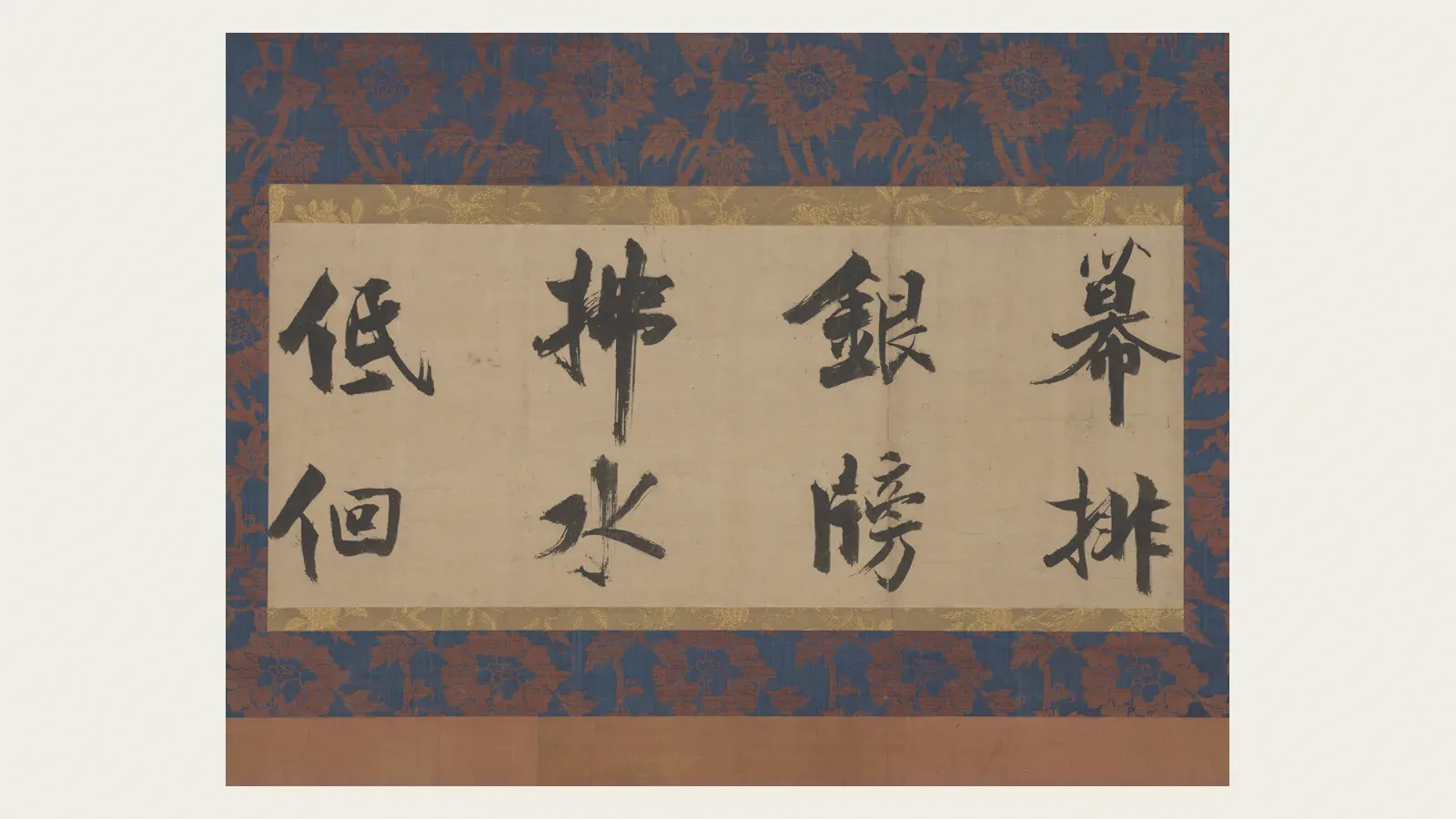
An ichigyō-mono (一行物) is the single-line Zen scroll hung in the tea room’s alcove — a short phrase, a zengo, brushed by a monk, often from Daitoku-ji. Guests bow to it first, because it sets the theme of the whole gathering. This is a guide to the phrases: kissako, nichi nichi kore kōjitsu, wa-kei-sei-jaku, ichigo-ichie, and the harder cuts a host reaches for when the room can carry them: honrai muichimotsu, mu, heijōshin kore dō.
Step into a tea room before the water is hot and there is almost nothing to look at. Bare walls, a kettle, and in the alcove a narrow hanging scroll with a few black characters brushed down its length. A guest attends to that scroll first, ahead of the flowers, ahead of the bowl. Usually it carries a single line of Zen, and that line is the host’s chosen theme for the whole afternoon. The form has a name: ichigyō-mono (一行物), the “one-line object.”
This is a guide to the lines themselves: what the common ones say, who first said them, and how the tea-room reading drifts from the original. It belongs to a longer look at Zen and the tea room. Looking at the scroll as an object, its mounting and its place in the alcove and the etiquette of viewing it, belongs to reading the tea scroll. Here the interest is the words and where they came from.
What an ichigyō-mono is
An ichigyō-mono is a scroll written as a single vertical line, most often a Zen phrase of about five characters.1 The single-line form was already a habit of Zen monks by the Kamakura period, long before tea claimed it. What tea added was a reason to hang one. In the sixteenth century, the age of Sen no Rikyū (1522–1591), the whisked-tea gathering and Zen practice drew close, and a line of monastic calligraphy became the natural centre of the room.
The words for the parts matter, because people use them loosely. The phrase itself is a zengo (禅語), a “Zen word,” the teaching compressed into a handful of characters. The calligraphy, when a Zen monk brushes it, is bokuseki (墨跡), “ink traces,” the broad category that also covers his letters, his poems, his certificates of enlightenment.1 A zengo is what the scroll says. Bokuseki is what it is. A tea scroll is usually the first, brushed as the second.
The scrolls came, and still come, from the temples. Many were written by Zen monks of Daitoku-ji,2 the Kyoto Rinzai monastery bound up with the whole history of tea. The link runs back to the beginning. By tradition, Murata Jukō, the fifteenth-century monk usually named as the first wabi tea master, received a piece of Chinese Zen calligraphy from his teacher Ikkyū Sōjun at Daitoku-ji, and hung it in the room where he served tea.3 That gesture, a monk’s brushwork treated as the heart of a gathering, is where the tea scroll starts. A line by a respected abbot carried the weight of his practice behind it, not only his handwriting.
Why the scroll comes first
The scroll is treated as the most important object in the room. It sets the theme of the gathering, and a guest’s first act on entering is to kneel and bow before the tokonoma where it hangs.2 Everything that follows reads in its light: the season in the flowers, the choice of bowl, the pace of the host’s hands. Those few characters tell you what the afternoon is about, and the rest of it is a quiet commentary on them.
This is why the host’s choice of phrase carries so much. A line hung on a grey November afternoon for two old friends says something different from the same line hung at a bright New Year gathering for strangers. The words are borrowed from Zen, fixed and centuries old, but the act of choosing which one, for this day and these guests, is entirely the host’s. You can learn to read that choice. It is the closest thing tea has to a host speaking in their own voice, and they do it in someone else’s words.
The four you will meet most
| Phrase | Reading | Meaning | Source |
|---|---|---|---|
| 喫茶去 | kissako | ”Go drink tea” | Jōshū (Zhaozhou), 778–897 |
| 日々是好日 | nichi nichi kore kōjitsu | ”Every day is a good day” | Unmon (Yunmen), Blue Cliff Record, case 6 |
| 和敬清寂 | wa-kei-sei-jaku | Harmony, respect, purity, tranquility | Attributed to Sen no Rikyū |
| 一期一会 | ichigo-ichie | ”One time, one meeting” | Ii Naosuke, 1815–1860 |
Each of these rewards a second look, because the warm phrase a tea-shop prints on its bag and the sharp line in the original koan are often not the same thing.
Kissako 喫茶去: “go drink tea”
The most tea-fitting phrase of all comes from a Chan koan, and it has teeth. The master Zhaozhou Congshen (Jōshū Jūshin in Japanese, 778–897) asked two newly arrived monks whether they had been to the monastery before. One said yes. One said no. To both he gave the same three words: go drink tea. When the temple supervisor asked why the answer was identical regardless of the reply, Zhaozhou called his name, the supervisor answered, and Zhaozhou told him too: go drink tea.4
Hung in a tea room, kissako reads as a warm host’s welcome, a plain “have a cup.” That reading is pleasant and it is the softer half of the phrase. In the koan the words are a leveller. The same flat instruction lands on the experienced monk, the novice, and the official who thought he stood outside the exchange to ask about it. Zhaozhou refuses every rank the three of them tried to claim. The teaching lives in the drinking itself, whatever answer the mind wants to give about who has drunk before. I would keep the sharper sense over the tea-shop one: drink the tea in front of you, and stop measuring yourself against the room. A host who hangs kissako and means only “welcome” has left the better half on the wall.
Nichi nichi kore kōjitsu 日々是好日: “every day is a good day”
This line comes from Yunmen Wenyan (Unmon in Japanese, 864–949) and stands as the sixth case of the Blue Cliff Record (Hekiganroku), the Song-dynasty koan collection compiled in 1125. The phrase is more than eleven hundred years old.5 Yunmen set it as a trap. Say something, he told the assembly, about the days after the fifteenth of the month. Nobody spoke. He answered his own challenge: every day is a good day.
The easy misreading is “every day is pleasant,” a hope for fair weather and no bad news. The phrase points the other way, away from wishing. Whatever a day holds, taken fully and without reaching past it for a better one, counts as a good day: good because it is met and lived. The grey afternoon qualifies. So does the one where the guest of honour cancels and the kettle boils dry. In the tea room the line settles on the gathering itself: this day, these people, this bowl, enough as they are. A scroll reading nichi nichi kore kōjitsu on an unremarkable Tuesday is making a specific claim about that Tuesday.
Every day is a good day.
Wa-kei-sei-jaku 和敬清寂: the four principles
Four characters (harmony, respect, purity, tranquility) set down as the spirit of tea and attributed to Sen no Rikyū.2 This one is a precept rather than a riddle. Where the koan phrases refuse to resolve, wa-kei-sei-jaku states plainly how host and guests are meant to be with one another. One nuance escapes most quick glosses. The fourth term, jaku (tranquility), is understood as the result of the first three: the stillness that arrives once harmony, respect, and purity are in the room, not a separate fourth thing to manufacture. The phrase has its own full treatment in wa-kei-sei-jaku, the four principles.
Ichigo-ichie 一期一会 — “one time, one meeting”
The most famous tea phrase of all is also the most often misattributed. It was coined not by Rikyū but by Ii Naosuke (1815–1860), the late-Edo tea master and statesman, in his treatise Chanoyu Ichie Shū, drawing on a saying recorded from Rikyū’s circle. It holds that this gathering, these guests, this arrangement of the day will never recur in exactly this form, and so it asks to be met as though it were the only meeting there would ever be.
Of the four common phrases, ichigo-ichie has travelled furthest from the tea room, and it has paid for the distance. It now sells wedding stationery and day planners, softened into a generic “cherish the moment.” The tea meaning is harder and more useful: the host prepares as if there will be no second chance because, at the level that counts, there will not be. The full history and the real authorship are in ichigo-ichie.
The harder scrolls
The four above are the safe choices, the ones a guest can usually read and a host can hang without asking too much of the room. A host who wants to ask more reaches past them. These next phrases give a viewer less to hold. A single character, sometimes. They belong to gatherings where the guests are practised enough to sit with a line that offers no comfort, and a host who hangs one is telling the room what they expect it to bear.
Honrai muichimotsu 本来無一物: “originally not one thing”
This phrase is attributed to Rokuso Enō (Huineng, the Sixth Patriarch of Chan), and it comes from the story at the centre of the Platform Sutra.6 As the tale goes, the senior monk Shenxiu wrote a verse comparing the mind to a mirror that must be wiped clean of dust. Huineng, then an illiterate kitchen worker, answered with his own: there is no mirror-stand, no tree of enlightenment, and from the first, not one thing exists, so where would the dust settle? The verse won him the succession.
Read on a scroll, honrai muichimotsu says we arrive with nothing. No possessions, no fixed ideas, no standing.6 In a room already stripped to a kettle and a flower, four characters denying that anything was ever there to begin with are close to a summary of wabi itself. It is a demanding line to hang, and an honest one for a bare room.
Mu 無: “no”
The shortest scroll in the tradition is one character. Mu (“no,” “nothing”) is Jōshū’s answer to a monk who asked whether a dog has Buddha-nature. Mahayana teaching holds that every being does, so the flat “no” makes no logical sense, and that is its work. It stands as case one of the Gateless Gate (Mumonkan), the koan collection compiled by Wumen Huikai (1183–1260), and it turns up again as case eighteen of the Book of Serenity (Shōyōroku).7 Mu is the classic first koan set to a Rinzai student. Later teachers called it a one-word barrier: a negation so total the reasoning mind, reaching for an answer, finds nowhere to land.
A single black character on a white ground, hung in a room designed to hold almost nothing, is about as far as tea takes the idea of restraint. Mu asks the guest to stop solving it. Very few phrases suit the alcove of a wabi room as exactly, and very few are harder to sit under.
Heijōshin kore dō 平常心是道: “the everyday mind is the Way”
The young Jōshū, before he was a master himself, asked his teacher Nansen (Nanquan, in Chinese) what the Way is. Nansen answered: the everyday mind is the Way. Should I turn toward it, Jōshū asked. Turn toward it, said Nansen, and you turn away. The exchange is case nineteen of the Gateless Gate.8 The Way is the ordinary mind you already have, walking, sleeping, drinking tea, and the reaching for something grander is what hides it.
No phrase sits more comfortably over a bowl of tea. The whole wabi gathering is built from ordinary acts done with full attention: water heated, a bowl warmed, a whisk turned. Heijōshin kore dō names the wager the room is making, that nothing more exotic than the everyday is required, and that trying to make the afternoon into something more would spoil it.
The phrase the room performs
There is one line the tea room never brushes on a scroll and hangs every time anyway. When the water reaches its last stage before the boil, the kettle begins to whistle, a soft steaming “shun, shun.” Chanoyu calls that sound matsukaze (松風), “wind in the pines,” and hears in it a breeze moving through a stand of pine trees.9 Some kettles are cast with a thin iron plate set into the floor precisely to produce it, the note arriving around the moment the surface tightens toward a boil.
Matsukaze is a poetic name rather than a koan, and it does turn up brushed on scrolls. Its more usual home is the air of the room. Where the ichigyō-mono is the text a guest reads on the wall, matsukaze is the one the room plays aloud, once per gathering, and lets go of. A scroll can be rehung next month. The kettle’s wind sounds for a few minutes and is gone with the tea.
How to read one as a guest
You do not need to recognise every scroll on sight, and most guests do not. The lines are usually brushed in a running cursive that few readers, Japanese or otherwise, can decode cold, so a host will often name the phrase, or it is recorded with the day’s utensils. Recognising the words is a smaller part of the encounter than sitting under them. When you enter a tea room, give the alcove your attention before anything else. Kneel, bow to it, and if you can read the line or are told it, hold it loosely as the tea proceeds. The host chose it for a reason, whether the season, the occasion, or the particular people kneeling on the mats, and the gathering is a slow answer to it. If you want the ritual around the scroll set out step by step, the guest’s part is covered in how to host a tea gathering, and the attentive way of sitting with a single line is the subject of tea meditation. The scroll’s companion in the alcove, the single seasonal flower beneath it, is treated in chabana and the tea scroll.
Whichever line the host has hung, the pattern holds: a few characters of borrowed Zen, placed where every guest must pass them, turning a bare room and a bowl of tea into an afternoon with a subject. The ichigyō-mono is the shortest text in the house and, by the tradition’s own reckoning, the most important thing in it. And when the last guest has read it and knelt back, the room offers its one unwritten line — the kettle finding its wind in the pines, matsukaze, sounding once and gone before the tea is poured.
Sources
9sourcesChanoyu Wiki — Jiku
SupportsIchigyō-mono (一行物, 'one-liner'): vertical single-line scroll, usually a five-character Zen phrase, a form Zen monks brushed from the Kamakura period; bokuseki (墨跡) is the broad category of Zen-monk calligraphy, zengo (禅語) the narrower teaching-phrase subset
Nara Tea Co. — Why Is Zen Calligraphy Displayed in the Tea Room
SupportsThe hanging scroll is the theme of the gathering, not decoration; guests' first gesture on entering is to bow before the tokonoma; many tea scrolls written by Zen monks of temples such as Daitoku-ji; phrases include ichigo-ichie, wa-kei-sei-jaku (attributed to Sen no Rikyū)
SAKURA Kyoto — Hanging Scroll / Bokuseki
SupportsBokuseki is calligraphy brushed by a Zen monk; the use of Zen calligraphy in tea began with Murata Jukō, from a piece received as a seal of proof after Zen study with Ikkyū Sōjun at Daitoku-ji
The Daily Enlightenment — The 'Go Drink Tea' Koan
Supports喫茶去 kissako from the Record of Zhaozhou (Jōshū Jūshin, 778–897): the master tells the monk who had visited before, the one who hadn't, and the supervisor alike to 'go drink tea'
Wikipedia — Nichinichi kore kōnichi
Supports日々是好日 'every day is a good day' from Yunmen Wenyan (Unmon, 864–949), sixth case of the Blue Cliff Record (Hekiganroku), compiled 1125; read nichinichi kore kōjitsu, hibi kore kōjitsu, or kōnichi
Takase — By Nature, Having Nothing (honrai muichimotsu)
Supports本来無一物 honrai muichimotsu ('originally not one thing'), attributed to Rokuso Enō (Huineng, the Sixth Patriarch); we arrive with nothing — no possessions, no fixed ideas
Everyday Zen Foundation — Zhaozhou's Dog (Mumonkan 1)
Supports無 mu is Jōshū's answer to whether a dog has Buddha-nature; case 1 of the Gateless Gate (Mumonkan), compiled by Wumen Huikai (1183–1260); the classic first koan of Rinzai training
Rochester Zen Center — Ordinary Mind is the Way, Case 19 of the Mumonkan
Supports平常心是道 heijōshin kore dō, 'the everyday mind is the Way': Nansen's (Nanquan's) answer to Jōshū, case 19 of the Gateless Gate
Seattle Japanese Garden — The Way of Tea and the Art of Listening
Supports松風 shōfū / matsukaze, 'wind in the pines': the poetic name for the whistling sound of the kettle at the last stage of the boil, around 190°F, produced by a thin iron plate set in the kettle floor
Common questions
What does ichigyō-mono mean?
Ichigyō-mono (一行物) means 'one-line object' — a hanging scroll bearing a single vertical line of calligraphy, usually a short Zen phrase of about five characters. It is the standard scroll hung in the tea room's alcove. The single-line form was a practice of Zen monks well before tea adopted it, and it became the tea scroll in the sixteenth century.
What is the most common Zen phrase in a tea room?
A handful recur: kissako (喫茶去, 'go drink tea'), nichi nichi kore kōjitsu (日々是好日, 'every day is a good day'), wa-kei-sei-jaku (和敬清寂, the four principles of tea), and ichigo-ichie (一期一会, 'one time, one meeting'). Harder single-character scrolls like mu (無) and honrai muichimotsu (本来無一物) turn up when the host wants to ask more of the room. The choice suits the season, the occasion, and the guests.
What is the difference between bokuseki and zengo?
Bokuseki (墨跡, 'ink traces') is the broad category of calligraphy brushed by a Zen monk — certificates, letters, poems, sermons, and Zen phrases all count. A zengo (禅語, 'Zen word') is the narrower thing: the short teaching phrase itself, the words rather than the object. A tea scroll is usually a zengo, brushed as bokuseki.