The Implements
The Chasen: Types, Prong Counts & Care
How a bamboo matcha whisk is carved from one node, which prong count to buy for usucha or koicha, and how to make it last.
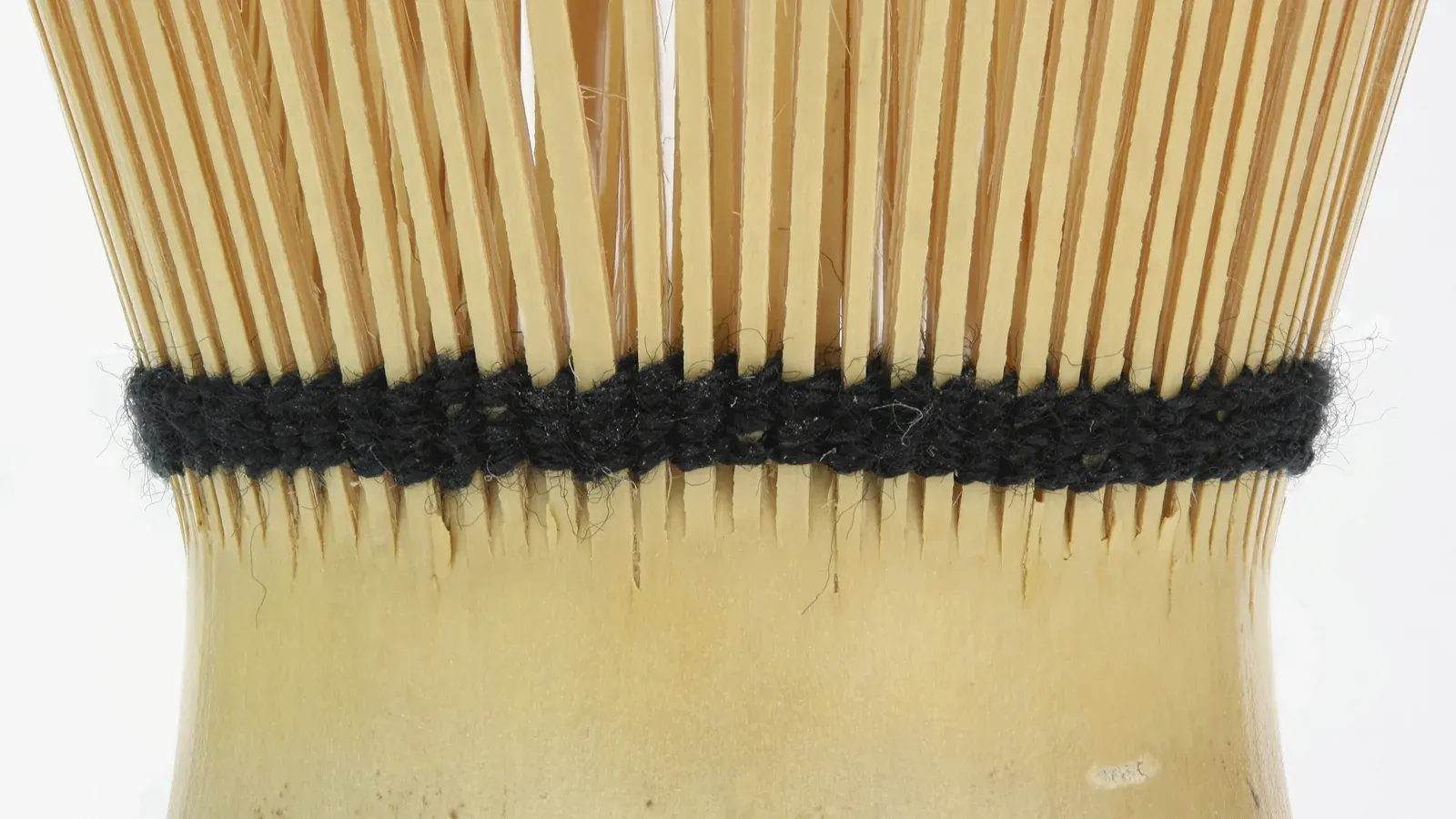
A chasen is a whisk carved by hand from a single node of bamboo. Buy a high-count one (around 80–100 tines) for everyday thin tea, rinse it in warm water only, dry it on a stand, and treat it as a consumable.
The whisk is the one piece of matcha equipment nothing else replaces. A milk frother aerates. A fork just pushes the powder around the cup. Neither breaks up the clumps and folds air through the tea the way a fan of split bamboo does. A chasen (茶筅, “tea whisk”) looks like a handle with a tuft of shaved bamboo on top, and it hides a good deal of craft: a single one can carry more than a hundred tines, each one curled by hand, and it all started as one short length of stalk. It is one of the core utensils in the tea ceremony’s kit, and the only one you are expected to wear out.
Carved from one node
A chasen is cut from a single node of bamboo. No assembly, no glue. The maker starts with a piece of culm roughly 2 to 2.5 cm across and 9 to 12 cm long, leaving the fushi (節), the solid joint in the stalk, at the base to become the handle. Everything above that joint gets split, again and again, into the tines you whisk with. Handle, inner core, and every last tine are one continuous piece of bamboo 1.
Almost all of it comes from one village. Takayama (高山), in the northwest of Nara Prefecture at the foot of Mount Ikoma, has made whisks since the Muromachi period, roughly the fourteenth through sixteenth centuries, and remains Japan’s only chasen-producing region of any scale 2. The standard account credits Sōsetsu, a son of the lord of Takayama, with carving the first whisk at the request of Murata Jukō (村田珠光, 1423–1502), the tea master usually named as a founder of wabi-cha, the pared-down style that Rikyū later brought to its height 3. The founder’s personal name drifts between tellings, from Sōsetsu to Sōgai to Sōkei, so take the man as tradition and the village as fact. In 1975 the craft was designated a National Traditional Craft (伝統的工芸品) under the program run by what was then Japan’s Ministry of International Trade and Industry, now the Ministry of Economy, Trade and Industry (METI) 3.
The work is hand craft in the strict sense, described by producers in eight stages: drying and preparing the culm (haratake), the first coarse split (katagi), the fine splitting into individual tines (kowari), shaving and tapering each tip (aji-kezuri), chamfering the inner corners (mentori), the lower and upper threading that separates the two rows of tines (shita-ami and uwa-ami), and a finishing pass (shiage) 4. One bamboo stalk yields only three or four whisks. The knife work is close and unforgiving, done mostly by eye.
The number of people who still do this keeps shrinking. Reports put the remaining Takayama masters somewhere between sixteen and eighteen, and the figure is soft, because it turns on who counts as a master rather than a workshop hand 4. One well-known lineage, the Tanimura family, reckons its craft by the generation, and counts a living maker as the twenty-fifth 4. None of this is mechanized, which is the plain reason a real Takayama whisk costs several times what a machine-made import does.
The parts, named
A few of the parts carry names that listings and teachers use. The hosaki (穂先) are the tine tips, the finest and most fragile part of the whole thing. Two rows of tines do the whisking: an outer ring that splays outward and an inner cluster that curls in toward the core, held apart by a loop of cotton thread wound around the base of the fan. Below the node sits the handle, plain and round. That shaved-in curl at each tip is what lets the tines flick air into the tea instead of merely dragging through it.
Three colors of bamboo
Bamboo comes in three colors, and the difference is in the material, not the finish.
- White bamboo (白竹, shirotake, also sold as hachiku or awatake) — sun-dried until pale. The common choice, and where most beginners start.
- Smoked bamboo (煤竹, susudake) — bamboo that spent a century or more in the rafters of old thatched farmhouses, darkened by decades of hearth smoke. The supply is finite and no longer made, which is why susudake whisks carry a steep premium 6.
- Black or purple bamboo (黒竹・紫竹, kurotake or shichiku) — a naturally dark-stemmed species that colors as it ages through the seasons.
Prong counts: the spec that matters
The number of tines is the specification that matters most, and the one product listings get loosest with. The principle is plain. More tines, finer and closer together, fold in air more easily and raise a denser foam. Fewer, thicker tines are stiffer, better for working a paste than whipping a froth 5. There is no standardized set of prong counts across makers, so treat the numbers as approximate.
| Type | Approx. tines | Best for |
|---|---|---|
| Ōaraho (大荒穂) | ~16–36 | Koicha; kneading, not foaming |
| Chūaraho (中荒穂) | ~48 | Koicha and dense usucha |
| Kazuho (数穂) | ~64–80 | All-round; the Japanese standard |
| High-count | ~80–120 | Everyday usucha; easiest foam |
Kazuho (数穂, “many tines”) is the default whisk in Japan, versatile enough for both thin and thick tea. Producers put a classic kazuho at around 70 tines 6. The very high counts, 100 to 120, are a newer, foam-friendly extreme aimed at people making thin tea (薄茶, usucha) at home who want a thick crema with little technique. Those fine-tined whisks froth the most easily and break the soonest.
Araho (荒穂, “rough tines”) sits at the other end: sixteen to about thirty-six thick, stiff tines built for thick tea (濃茶, koicha). Koicha isn’t whisked into foam at all. It’s kneaded into a smooth, paint-like paste, and that takes a sturdy tine that can press and fold without snapping or pulling in air. Make only a frothy morning bowl and you will never need one.
The practical guidance: for daily usucha and for learning, buy a high-count kazuho, roughly 80 to 100 tines. It’s forgiving and it foams. Reach for an araho when you start making koicha, which has its own bowl, its own tempo, and its own whisk, because thin tea and thick tea are close to two different drinks.
The schools each whisk differently
Here the whisk stops being a tool and turns into a small argument about how tea should look. The three main schools of chadō each favor a different chasen, and the differences run deeper than color.
| School | Bamboo | Tine shape | Foam |
|---|---|---|---|
| Urasenke (裏千家) | White (shirotake) | Rounded shin (formal) | Thick, fine, cappuccino-like |
| Omotesenke (表千家) | Smoked susudake | Kazuho or shin, small-diameter | A thin crescent over green |
| Mushakōjisenke (武者小路千家) | Black or purple | Straight tines | Little to none |
Urasenke whisks up a deep, even foam, sometimes close to a centimeter of fine bubbles across the bowl, and its rounded shin (formal) whisk in white bamboo is cut for exactly that 7. Omotesenke leaves a thinner surface, a crescent of foam floating over pools of dark green, and reaches for small-diameter susudake in a kazuho or shin cut of around 70 tines 6. Mushakōjisenke goes furthest toward the bare liquid, aiming at almost no foam, and its straighter tines pull in less air by design 8. Tine geometry and school aesthetic are the same decision read from two ends.
If you don’t practice a school, none of this binds you, and a white-bamboo kazuho is the sensible default. If you study under a teacher, ask which whisk the school uses before you buy, because the choice is part of the form. The schools diverge on far more than teaware — the three schools of tea lays out the fuller split.
Cheap whisks and where the money goes
A supermarket or marketplace whisk at a few dollars is a false economy, and it shows up fast in the bowl. Machine-cut whisks tend to use thicker, coarser tines and lower-grade bamboo, sometimes bleached or chemically softened, and they are often marketed as Japanese-made when they are not 1. Two problems follow. The foam comes out coarse and short-lived, because thick tines can’t fold in the fine air a good bowl of usucha wants. And the tines shed. Rough bamboo splinters as it flexes, and you find yourself picking slivers off your tongue. A handmade Takayama kazuho costs more up front, out-lasts a stack of the cheap ones, and makes better tea the whole time it lives. For a home matcha drinker, that is the single upgrade that changes the most.
Care: how to make it last
A chasen is a consumable. Tines bend, fray, and eventually snap. A well-treated everyday whisk lasts several months to a year or two of steady use, then gets replaced 7. Care doesn’t make it immortal. It slows the wear and holds the tines in the right shape while they last, and the whisk stand does more for that than any washing ritual.
Soak before use. Before the first use, and ideally before each bowl, stand the whisk tines-down in warm (not hot) water for a minute or two. Wet bamboo flexes where dry bamboo cracks, so the tines bend instead of breaking, and the curled tips relax open 1. Some people soak only the first time. A quick soak before every bowl does no harm.
Whisk from the wrist. Hold the bowl steady, keep the whisk close to upright, and move it in a brisk back-and-forth, a W or M shape driven from the wrist. You’re breaking the matcha into the water and pulling air through it, not grinding the tines against the bottom of the bowl. Scraping the base is the fastest way to snap tips. The full method, with temperatures and ratios, is in how to whisk matcha.
Reshape and dry tines-up. After rinsing, reach for a kusenaoshi (くせ直し, “habit-fixer”), the small ceramic or plastic dome sold as a whisk stand. Press the wet whisk down over it so the outer tines splay back into their fan, then set it to air-dry with the tines pointing up 5. Drying upward drains water out of the handle instead of letting it pool at the node, and it holds the fan open while the bamboo takes its set, the moment the shape locks in. Dry it somewhere ventilated. Bamboo left damp grows mold, and bamboo left in direct sun turns brittle. Let it dry fully between bowls.
Replace it without sentiment. Once tines start snapping off, and they will, the whisk stops aerating evenly and begins shedding bamboo into the tea. That’s the signal to retire it 1. A chasen is meant to wear out. Use one up over a year of good bowls and buy the next. The wider routine for bowls, scoops, and iron is in how to care for your Japanese teaware, and the chawan it whisks into keeps its own rules.
Every other object in the tea room is built to last. The iron kettle darkens with age, the cracked bowl is mended in gold, the scoop outlives the person who carved it. The whisk is the exception, the one thing designed to be used up and thrown away, remade three or four to a stalk in a village of sixteen aging hands. Buy a good one, work it from the wrist, dry it on its stand, and let it go when the tines begin to break. How much foam belongs on the tea is the one question the whisk can’t settle for you. The three schools have argued it for four centuries, tine by tine, and never agreed.
Sources
8sourcesGlobal Japanese Tea Association
SupportsSingle-piece bamboo construction; ~80–100 tines for usucha; handmade vs. cheaper imported whisks; soak, rinse, dry, and replace as a consumable
KOGEI JAPAN (Assoc. for the Promotion of Traditional Craft Industries / METI)
SupportsMuromachi origin; Murata Jukō requested Sōsetsu; Takayama as sole producing region; eight-stage process; 60+ whisk types
JAPAN SUI COLLECTION (Government of Japan)
SupportsTakayama origin; Murata Jukō connection; 1975 traditional-craft designation
Hojicha Co.
SupportsEight-step process names; ~18 remaining masters; one stalk yields 3–4 whisks; Tanimura 25th generation; care
Tezumi
SupportsProng-count families (araho/kazuho); bamboo varieties; handmade vs. machine-made; kusenaoshi reshaping and drying
Sugimoto Tea Company
SupportsSusudake age and scarcity; Omotesenke prefers kazuho/shin at ~70 tines from small-diameter bamboo
Path of Cha
SupportsSchool bamboo preferences (Urasenke white hachiku/awatake, Omotesenke susudake, Mushakōjisenke shichiku/kurochiku); ~2-year lifespan
Tezumi
SupportsFoam by school (Urasenke thick, Omotesenke crescent, Mushakōjisenke minimal); straight tines create less foam
Image: D-Kuru, Wikimedia Commons · CC BY-SA 4.0
Common questions
How many prongs should I buy?
For everyday thin tea (usucha), a high-count kazuho of about 80 to 100 tines is the forgiving choice: it foams easily and suits beginners. Buy a coarse araho (16 to 48 stiff tines) only if you make thick koicha, which is kneaded into a paste rather than frothed. Counts vary between makers, so read the numbers as ranges.
How long does a chasen last?
With warm-water rinsing and drying on a stand, a whisk used most days lasts several months to a year or two before the tines break down. It is a consumable by design, so plan to replace it rather than preserve it.
Do I need a whisk stand?
A kusenaoshi stand is not strictly required, but it earns its small cost. Drying the whisk tines-up over the dome drains water from the handle and holds the tines in their fan as the bamboo sets, which does more for the whisk's life than any cleaning step.