The Implements
The Mizusashi: The Fresh-Water Jar
The lidded jar of cold water in chanoyu: what the cold is for, when the lid comes off, and the summer and October forms that change with the season.
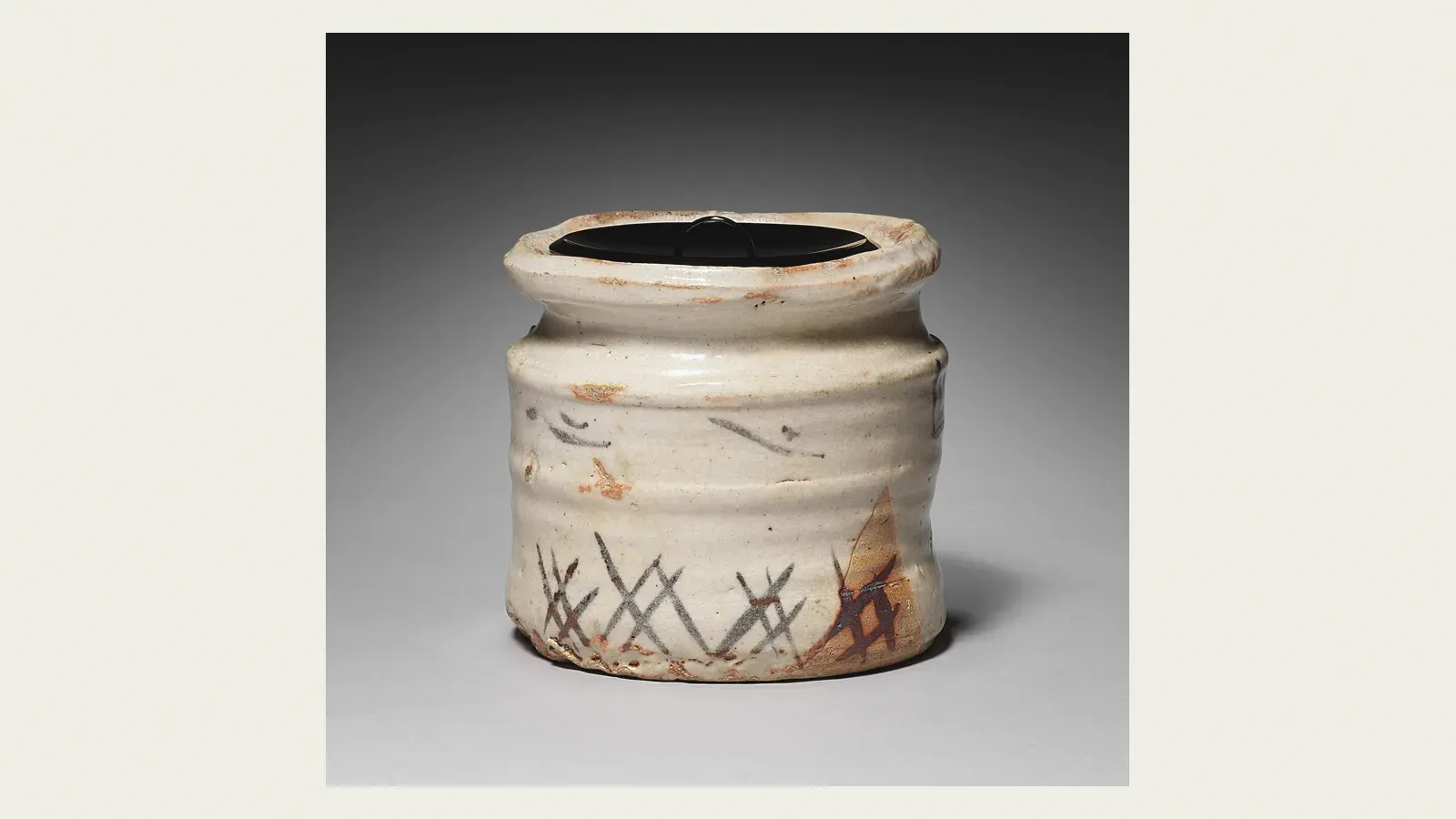
The mizusashi is the lidded jar of cold water that stands beside the kettle. It is the first utensil carried into the room and the last carried out, and no guest ever touches it. Its lid opens only when the host needs cold water: to bring the kettle down to temperature, to rinse the whisk, and to top the kettle up at the end.
The tea room runs on two temperatures and keeps them in two vessels. One is iron, sits in the fire, and holds water at or near the boil. The other is a jar of ceramic or wood standing to its right, holding water that has been heated by nothing at all. Everything the host does with hot water is a subtraction from the kettle, and everything done with cold is a subtraction from the jar. Between them the host has a range, and the room needs only one fire.
The Cincinnati Art Museum, showing ninety years of these jars from the Horvitz collection, put the mizusashi’s position plainly: the first utensil to enter the room and the last to leave, the visual anchor of the tearoom, setting the aesthetic tone of the entire ceremony. 2 The utensil glossary gives it one line, because in a list of a dozen objects it looks like the plumbing. On the mat it is the largest thing the host brings in, it stands in the guests’ sight for the whole gathering, and it is the only major utensil they will never pick up.
What the cold is for
Three jobs, and all three are the kettle’s problem rather than the tea’s.
The first is temperature. A kama at a rolling boil is too hot for matcha, and cold water from the jar brings it down. The second is the whisk and the bowl: the chasen is rinsed at the end of the procedure, and that rinse water comes from the jar. The third comes last. The host replenishes the kettle before the utensils go out, so the kama is left full for whoever hangs it next. 3
The lid stays on the rest of the time. It is opened only when the host needs cold water — to adjust the temperature in the kama, or to clean the chasen at the end — and closed again immediately. 4 Where the lid goes when it comes off is prescribed too. If the lid is narrower than the jar is tall, which is the usual case, it leans against the jar’s flank, always on the side away from the guests. 4 A lid too wide to lean against its own jar goes against the frame of the standing screen behind the brazier, or against the wall. 4
Watch the whole sequence run, in order, in a tea procedure. What matters here is that the jar’s few appearances are all at the ends: it opens once early, once late, and otherwise sits closed.
The lid decides what the hands do
The lid is where a jar declares its class, and it changes the host’s movements.
A tomobuta (共蓋) is the lid the jar was made with, in the jar’s own material — a ceramic lid on a ceramic body. 1 A nuri-buta (塗蓋) or kae-buta (替蓋) is a lacquered wooden lid commissioned for a jar that arrived without one, or for one whose own lid was lost. 8 The distinction reaches into the procedure. During the temae the damp linen chakin is set down on the mizusashi lid, and a lacquered lid is wiped with the fukusa before it takes the cloth, while a tomobuta takes the cloth unwiped. 8 The lacquer belongs to the same family as the caddy and gets the caddy’s treatment. The ceramic lid belongs to the water, and on an unglazed jar it is wetted and shaken out over the kensui before the tea begins. 14
So a host who commissions a lacquered lid for a Bizen jar has altered what his hands do for the next thirty years of gatherings. The tea is identical. The choreography moved.
The forms
| Form | Kanji | What it is |
|---|---|---|
| magemono | 曲物 | bentwood: a shaved cedar strip bent round a disc base, the plainest jar there is |
| kiji-tsurube | 木地釣瓶 | a bare wooden well bucket, unlacquered |
| te-oke | 手桶 | a bucket with a handle across the top |
| hira | 平 | low and very wide, a broad surface of water on show |
| hoso | 細 | tall and narrow-mouthed |
Underneath the named shapes are three material families: ceramic, wood, and metal. 14 Ceramic is the default, and the wares JAANUS lists for it are the ones you would expect from the tea kilns — Seto, Shigaraki, Bizen, Satsuma, and the Kyoto work of Ninsei and Kenzan. 1 Their kiln lineages are a subject of their own; Rikyū’s taste for the unglazed Bizen jar is a large part of why Bizen has a place in the tea room at all. Wood covers the tsurube, the magemono, and the lacquered hand bucket. Glass turns up in midsummer and metal is rare. 3
Size is steadier than the variety suggests. The Met’s Arita jar of about 1650 stands 23.2 cm tall and 25.7 cm across, with a rim only 14.1 cm wide. 15 Retailers list current-production jars at 1.1 and 1.5 litres. 16 A serving of thin tea takes roughly 70 ml, so the jar holds an order of magnitude more water than the tea will ever use. It is sized for the kettle.
Rikyū’s well bucket
The most Rikyū thing in the room is a bucket.
A tsurube (釣瓶) is the vessel you lower down a well. Bringing one onto the mat as a water jar is the same move as the bamboo scoop and the Raku bowl: take the plainest object doing the job, and stop there. The Nanpōroku — a later compilation, and a text whose authority scholars dispute — has an entry on the tsurube that says it was carried from the well to the preparation room and that two or four bucketfuls would see out a day’s chanoyu. 13 Its translator flags that portion of the entry as reworked by later hands, so take the practice as tradition rather than as Rikyū’s own dictation. 13 The bucket was never lacquered. 13
Then the form outlived the reasoning. By the nineteenth century potters in Seto were making glazed stoneware jars in the shape of a wooden well bucket, and the Met holds one: 14.3 cm tall, 19.4 cm across, an Oribe Revival piece imitating in fired clay a thing whose entire argument was that it was a bucket. 7 That is what happens to a good idea in a tradition with a memory. The gesture becomes a shape, and the shape gets copied in a more expensive material.
The summer jars, and the claim that isn’t quite true
You will read that the mizusashi’s lid comes off in summer. As a general rule it does not. What exists is narrower and better.
Three summer procedures turn on this jar, all of them concerned with coolness, all of them belonging to July and August: habuta (葉蓋), wari-buta (割蓋), and ō-buta (大蓋). The last two use a wide-mouthed jar left standing in the room rather than carried in and out, its lid split in two or oversized and handled so that the expanse of the water shows. 14 A hira-mizusashi, low and very wide, does the same job by proportion: so much water surface is on view that the jar reads as cool. 8
Habuta is the one with a date on it. Gengensai (1810–1877), the eleventh-generation head of Urasenke and the man who invented the table-and-chair ryūrei service for the 1872 exposition, was also, as his school puts it, prolific in utensil designs and procedures. 10 At a Tanabata-themed gathering he took the cylindrical inner tube of a suehiro basket flower container, used it as a water jar, and laid a kaji leaf — paper mulberry, the leaf people once wrote their Tanabata wishes on — across the mouth as its lid. 11 The procedure survives. The host lifts the leaf in both hands, carries it to the kensui, folds it left and right, folds the top in half, folds the stem up and pierces it through the leaf to pin the bundle shut, and drops it in the waste water. 11 Taro and butterbur leaves serve if kaji is not to hand. 11 The leaf is destroyed on the mat, in front of everyone, and the jar it covered was a flower vase’s spare part. Because the lid is discarded rather than replaced, the procedure runs for thin tea only.
Here is the part that saves all of this from sentimentality. Sen Sōshitsu, then head of Urasenke, described these devices on NHK in 2006 as ways of staging coolness — the green leaf on the jar, the linen cloth wrung out so the room hears clear water — and said the intention is to create an aesthetically cool feeling, not to physically cool anything. 12 The water in that jar is the same temperature it was in April. Nobody in the room is a degree cooler. The school that built the effect is the one telling you it is an effect.
October: the jar moves and gets thinner
The other seasonal move on this utensil runs the opposite way from “fuller in winter,” and it is well documented.
In October, the last month of the brazier season, the arrangement changes to nakaoki (中置). The furo is set in the exact centre of the host’s tatami instead of at its left, and the mizusashi shifts across to the brazier’s left. 5 The plain reading is that the weather has turned and the fire is being brought closer to the guests. The consequence lands on the jar: with the brazier occupying the middle of the mat, the space left for the water no longer takes a normal jar, so a hoso-mizusashi (細水指) is used, taller and slenderer. 5 The Met’s late-eighteenth-century Arita example gives the proportion exactly — 20.3 cm tall and 12.4 cm across, roughly half the width of the standard jar at nearly the same height. 6
One month a year, the fire moves eight inches and a whole class of pottery exists to fit the gap. The rest of the tea year’s arithmetic — why the hearth changes in November, what October is a farewell to — is in furo versus ro and the saijiki of the tea year.
If you want one
Buy the bowl and the whisk first. But of the formal utensils, the mizusashi is the one that behaves sensibly outside a tatami room, because it is a lidded jar of cold water and your kitchen has several.
If you do buy one, the rule that will catch you is about surfaces, not taste. An unglazed jar — Bizen, Shigaraki — is soaked before use, sometimes overnight, with only the base dried, which is what gives the clay that live, just-drawn look. 8 A jar in that state wets whatever it stands on, and it will stain wood and tatami. 8 Hence the shelf rule: on a tana with a lacquered board, use a glazed jar; an unglazed one is permitted when the board is bare sanded wood, or when the jar sits directly on the matting in a carried-in procedure. 9 Wooden jars stay off shelves entirely. 14 Behind the etiquette is a wet pot on a good board.
For everything else — lacquer, rust, unglazed clay and what soap does to it — see how to care for your teaware.
The honest jar
Two of these traditions stage coolness, and only one admits it.
Gengensai’s leaf is theatre and says so. The head of the school went on television and told the country that the leaf cools nothing. Meanwhile the standard modern handling of the wooden tsurube is to soak it overnight and set it on the mat as late as possible so it is still dripping when the guests come in — and the well bucket’s original argument was about the water inside it, drawn fresh at dawn, not about the look of wet cedar. Wojciński, translating the Nanpōroku entry, calls that inversion out directly. 13 I think he is right, and I would take the leaf over the wet bucket. A host who tells you the effect is an effect has more respect for you than one who dampens a bucket and calls it purity.
Which is the argument for looking hard at this jar. The bowl passes through the guest’s hands and gets discussed. The kettle sings. The mizusashi sits there for four hours holding tap water, touched by nobody, doing nothing anyone will remember — and the host chose it first, before the bowl, and it will be the last thing carried out of the room.
Sources
16sourcesJAANUS (Japanese Architecture and Art Net Users System), Columbia University
SupportsMizusashi (also mizutsubo) defined as a water jar holding fresh water used to fill the tea bowl or the kettle; placed on a daisu, tanamono, temae-datami or naga-ita; made of ceramic, lacquer, magemono (bent wood) or bamboo; Seto, Shigaraki, Bizen, Satsuma, Ninsei and Kenzan wares named; tomobuta covers of the same material as the vessel
Cincinnati Art Museum, 'Mizusashi: Japanese Water Jars from the Carol and Jeffrey Horvitz Collection'
Supports'It holds the water used to replenish the kettle and rinse the tea bowls during the gathering'; 'The first utensil to enter the room and the last to leave, the mizusashi is the visual anchor of the tearoom, setting the aesthetic tone of the entire ceremony'
Wikipedia, 'Japanese tea utensils'
Supports'A mizusashi (水指) is a lidded container for fresh cold water used by the host in the tea room during ceremonies'; generally ceramic, but wooden, glass and metal jars are used; tomobuta ('matching lid') vs custom lacquered wooden lids; the water 'is mainly used to replenish the water in the kama at the end of certain ceremonies'; the jar is 'one of the main objects in the aesthetic scheme'
Chanoyu to wa (Adam Sōmu Wojciński), 'Notes on the Practice of Chanoyu, 6e — Wari-geiko 1'
Supports'The lid of the mizusashi is only opened when the host needs cold water, to adjust the temperature of the hot water in the kama, or clean the chasen at the end of the temae'; when the lid's diameter is less than the jar's height the lid is leaned against the side, always on the side away from the guests; oversized lids lean against the furosaki byōbu or the wall
Chanoyu Decoded (Prof. Allan Sōsei Palmer), 'October and Nakaoki'
SupportsIn October the furo is placed in the exact centre of the temae tatami; the mizusashi is placed to its left; 'A slender and somewhat taller, hoso mizu-sashi, 細水指, narrow water-handle, is used'; the practical reading is bringing the heat closer as the weather cools
The Metropolitan Museum of Art, 'Tall Freshwater Jar (Hoso-mizusashi) with Striped Design'
SupportsLate 18th century, Edo period; porcelain with cobalt blue under transparent glaze (Hizen ware, Arita type); H. 20.3 cm, Diam. 12.4 cm — the tall narrow proportion of the nakaoki jar
The Metropolitan Museum of Art, 'Water Jar in the Shape of a Well Bucket'
Supports19th century, Edo period; Seto ware, Oribe Revival type, glazed stoneware; H. 14.3 cm, Diam. 19.4 cm — a ceramic jar made in the form of the wooden tsurube
Chanoyu wiki / Chado (wiki.chado.no), 'Mizusashi'
SupportsNamed forms: kiji tsurube (木地釣瓶), magemono (曲物), teoke (手桶), hira (平); tomo-buta (共蓋) as the lid that comes with the jar, kae-buta (替蓋) as a lacquered wooden lid made to order, ha-buta (葉蓋) as a large leaf; 'hira mizusashi are usually only used in the summer. Because you can use so much of the water, it gives a cool feeling'; 'If the mizusashi has a tomo-buta it is not wiped with Fukusa prior to placing the Chakin on it'; unglazed wares 'are always used having been soaked in water for a longer time, even overnight, and then just the bottom dried… but it can cause stains on wood and tatami'
Chanoyu wiki / Chado (wiki.chado.no), 'Tana'
Supports'Tana in which the mizusashi is placed on top of a board, called jiita, are okidana'; 'With a tana one should use glazed mizusashi unless the jiita is kiji (sanded wood) than an unglazed mizusashi is permitted'; with a hakobi-dana an unglazed jar is allowed and yugaeshi is not performed because the jar sits directly on the tatami
Urasenke, 'Urasenke Tradition' (official)
SupportsGengensai Seichū Sōshitsu (1810–1877), eleventh-generation master of Urasenke; devised ryūrei table-and-chair service in 1872 for the International Exposition; 'blessed with prolific creativity, Gengensai brought forth numerous utensil designs as well as procedures for making tea'
茶の湯辞典 (Chanoyu Jiten), '葉蓋点前'
SupportsHabuta-temae created by Urasenke's 11th, Gengensai, at a Tanabata-themed gathering using the receiving tube (uketsutsu) of a suehiro basket flower container with a kaji (paper mulberry) leaf laid on top; kaji, taro and butterbur leaves named; the leaf is taken up in both hands, carried to the kensui, folded left and right, the top folded in half, the stem folded up and pierced through the leaf, and discarded into the kensui
Dr. Gabi Greve, Daruma Museum / World Kigo Database, 'Coolness (suzushi)'
SupportsSen Sōshitsu, head of Urasenke, on staging coolness (2006 NHK broadcast): using a large fresh green leaf as the cover of the water container (habuta 葉蓋), and wringing the linen cloth to produce the sound of clear water; 'The intention is to create an aesthetically cool feeling, not to physically cool anything'; the tsurube mizusashi described as a square cedar box
Chanoyu to wa (Adam Sōmu Wojciński), 'Nampō Roku, Book 1 (25): Concerning the Tsurube'
SupportsThe tsurube as a bucket used to carry water from the well to the mizuya; 'Two or four tsurube of water would suffice for a day's chanoyu'; the translator's caution that 'at least part of the present entry has been reworked' and that the writer 'was unaware of the kuden' — the Nanpōroku is a later compilation of contested authority
茶の湯おぼえがき (Chanoyu Oboegaki), '水指'
SupportsThree material families: metal, ceramic, wood; tsurube (釣瓶) and magemono (曲) in wood, ma-teoke (真手桶) in lacquered wood; tomobuta used with unglazed ceramics, the lid wetted and water dripped from it over the kensui; nuributa (塗蓋) wiped before the chakin is set on it; ō-buta (大蓋) and wari-buta (割蓋) jars described with their opening sequences; the tsurube used as a standing summer vessel; wooden and unglazed jars not used on shelves
The Metropolitan Museum of Art, 'Freshwater Jar (Mizusashi) with Pines'
Supportsca. 1650s, Edo period; porcelain with cobalt blue under transparent glaze (Hizen ware, Arita type); H. 23.2 cm, Diam. 25.7 cm, rim diam. 14.1 cm — typical proportions of a standard ceramic jar
Tezumi, mizusashi product listings
SupportsStated capacities for current-production jars: 1,100 ml and 1,500 ml — used here only for the volume figure, not for any claim about quality or grade
Common questions
What is the difference between a mizusashi and a kama?
Temperature. The kama is the iron kettle sitting in the fire, and it holds the hot water. The mizusashi is the jar standing beside it, and it holds cold water, unheated, straight from the tap or the well. The host moves water from the jar to the kettle with the ladle, never the other way. Between them they give the host both temperatures without a second fire.
Is the mizusashi lid really left off in summer?
Not as a general rule. What exists is more specific: three named summer procedures — habuta, wari-buta and ō-buta — in which a wide-mouthed jar is left standing in view with its lid replaced by a fresh leaf, split in two, or handled so that the surface of the water shows. They belong to July and August, and Urasenke's habuta was invented by Gengensai (1810–1877). Outside those, the lid goes on and comes off in the usual way.
How much water does a mizusashi hold?
Rather more than a gathering needs. Museum jars run around 20–25 cm tall and about the same across, and retailers list current production jars at roughly 1.1 to 1.5 litres. A single serving of thin tea takes about 70 ml, so the jar is sized for the kettle it feeds and for the rinsing, not for the tea.
Can I use an ordinary jug at home instead?
Yes, and you would be in good company. Rikyū's contribution to this utensil was to carry in a wooden well bucket. The mizusashi is the one object in the tea room whose job any clean lidded vessel can do, which is exactly why the choice of jar says so much about the host.